MCQ
A wave can transmit ...... from one place to another
  • Energy
  • B
    Amplitude
  • C
    Wavelength
  • D
    Matter

Answer

Correct option: A.
Energy
a
(a)A wave can transmit energy from one place to another.

Need a full question paper?

Generate a complete, print-ready paper with questions like this in minutes — across 16+ boards, with answer keys.

Start Generating Free

Similar questions

In Millikan’s oil drop experiment, an oil drop of mass $16 \times {10^{ - 6}}kg$ is balanced by an electric field of ${10^6}V/m.$ The charge in coulomb on the drop, assuming $g = 10\,m/{s^2}$ is
Two lenses of power $ 6D$ and $-2D$ are combined to form a single lens. The focal length of this lens will be
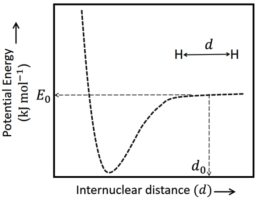
The figure below is the plot of potential energy versus internuclear distance $(d)$ of $H _2$ molecule in the electronic ground state. What is the value of the net potential energy $E_0$ (as indicated in the figure) in $kJ mol ^{-1}$, for $d=d_0$ at which the electron-electron repulsion and the nucleus-nucleus repulsion energies are absent? As reference, the potential energy of $H$ atom is taken as zero when its electron and the nucleus are infinitely far apart.

Use Avogadro constant as $6.023 \times 10^{23} mol ^{-1}$.
Given below are two statements

Statement $I:$ For transmitting a signal, size of antenna ( $l$ ) should be comparable to wavelength of signal (at least $l=\frac{\lambda}{4}$ in dimension).

Statement $II:$ In amplitude modulation, amplitude of carrier wave remains constant (unchanged).

In the light of the above statements, choose the most appropriate answer from the options given below.
A compound microscope has a magnifying power $30$. The focal length of its eyepiece is $5\,cm$. Assuming the final image to be at the least distance of distinct vision $(25\, cm)$. The magnification produced by objective is
Let V and H be the vertical and horizontal components of earth's magnetic field at any point on earth. Near the north pole
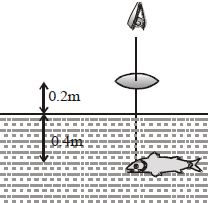
A smal fish $0.4\,m$ below the surface of a lake , is viewed through a simple converging lesn of focal length $3\,m.$ The lens is kept at $0.2\, m$ above the water surface such that fish lies on the optical axis of the lens. The image of the fish seen by oserver will be at  $\left( {{\mu _{water}} = \frac{4}{3}} \right)$
Which of the following graphs is the magnification of a real image against the distance from the focus of a concave mirror
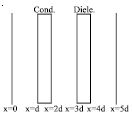
The distance between plates of a parallel plate capacitor is $5d$. Let the positively charged plate is at $ x=0$ and negatively charged plate is at $x=5d$. Two slabs one of conductor and other of a dielectric of equal thickness $d$ are inserted between the plates as shown in figure. Potential versus distance graph will look like :
The focal length of the obejctive lens and the eye piece of a microscope are $2\, cm$ and $5\, cm$ respectively and the distance between them is $20\, cm$. Find the distance of  the object from objective lens when final image is seen by the eye is $25 \,cm$ from the  eye piece......$cm$