Question
A wave going in a solid.
  1. Must be longitudinal
  2. May be longitudinal
  3. Must be transverse
  4. May be transverse.

Answer

  1. May be longitudinal
  1. May be transverse.
Explanation:
Particles in a solid are very close to each other; thus. both longitudinal and transverse waves can travel through it.

Need a full question paper?

Generate a complete, print-ready paper with questions like this in minutes — across 16+ boards, with answer keys.
Start Generating Free

Similar questions

A rocket is moving away from the earth at a speed of $6 \times 10^7 \mathrm{~m} / \mathrm{s}$ The rocket has blue light in it. What will be the wavelength of light recorded by an observer on the earth $($wavelength of blue light $= 4600 \mathring A )$
When a loop moves towards a stationary magnet with speed v, the induced emf in the loop is E. If the magnet also moves away from the loop with the same speed, then the emf induced in the loop is.
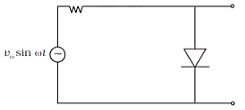
The output of the given circuit in Figure.
Image
An electric dipole is placed at the centre of a sphere.
Mark the correct options:
The law, governing the force between electric charges is known as.
In which region of the electromagnetic spectrum does the Paschen series of hydrogen spectrum lie ?
A magnet oscillating in a horizontal plane has a time period of $2$ second at a place where the angle of dip is $30^{\circ}$ and $3$ seconds at another place where the angle of dip is $60^{\circ}.$ The ratio of resultant magnetic fields at the two places is
 
Wavefront of a wave has direction with wave motion:
A block is placed on a rough floor and a horizontal force F is applied on it. The force of friction f by the floor on the block is measured for different values of F and a graph is plotted between them.
  1. The graph is a straight line of slope 45°.
  2. The graph is a straight line parallel to the F-axis.
  3. The graph is a straight line of slope 45° for small F and a straight line parallel to the F-axis for large F.
  4. There is a small kink on the graph.
A convex lens forms a real image of a point object placed on its principal axis. If the upper half of the lens is painted black:
  1. The image will be shifted downward.
  2. The image will be shifted upward.
  3. The image will not be shifted.
  4. The intensity of the image will decrease.