A wave is represented by the equation $y = 10 sin \,\,2\pi \,\,(100t-0.02x) + 10 \,\,sin \,\,2\pi\,\, (100t+0.02x)$. The maximum amplitude and loop length are respectively
Diffcult
Download our app for free and get started
$x=10 \sin 2 \pi(100 t-0.02 x)+10 \sin 2 \pi(100 t+0.02 x)$
$\Rightarrow 10[\sin A+\sin B]$
where
$B=2 \pi(100 t-0.02 x)$ and
$A=2 \pi(100 t+0.02 x)$
Thus,
$\Rightarrow 10\left[2 \sin \frac{A+B}{2} \sin \frac{A-B}{2}\right]$
$\Rightarrow 20 \sin (2 \pi 100 t) \sin (2 \pi 0.02 x)$
Comparing the above equation with standard standing wave equation, we get amplitude $=20$ and wave vector
$k=\frac{2 \pi}{\lambda}=2 \pi \times 0.02 \Rightarrow \lambda=50$
Therefore, the loop length $=\frac{\lambda}{2}=25$

Download our appand get started for free
Experience the future of education. Simply download our apps or reach out to us for more information. Let's shape the future of learning together!No signup needed.*
Similar Questions
- 1A stationary source emits sound waves of frequency $500\, Hz$. Two observers moving along a line passing through the source detect sound to be of frequencies $480\, Hz$ and $530\, Hz$. Their respective speeds are, in $m\,s^{-1}$ (Given speed of sound $= 300\, m/s$)View Solution
- 2View SolutionIn a harmonium the intermediate notes between a note and its octave form
- 3A vibrating tuning fork is moving slowly and uniformly in a horizontal circular path of radius $8\,m$. The shortest distance of an observer in same plane from the tuning fork is $9 \,m$. The distance between the tuning fork and observer at the instant when apparent frequency becomes maximum is ......... $m$View Solution
- 4In a closed organ pipe of length $105 \,cm$, standing waves are set up corresponding to third overtone. What distance from the closed end, a pressure node is formed .............. $cm$View Solution
- 5Two trains $A$ and $B$ are moving with speeds $20 \mathrm{~m} / \mathrm{s}$ and $30 \mathrm{~m} / \mathrm{s}$ respectively in the same direction on the same straight track, with $B$ ahead of $A$. The engines are at the front ends. The engine of train $A$ blows a long whistle.View Solution
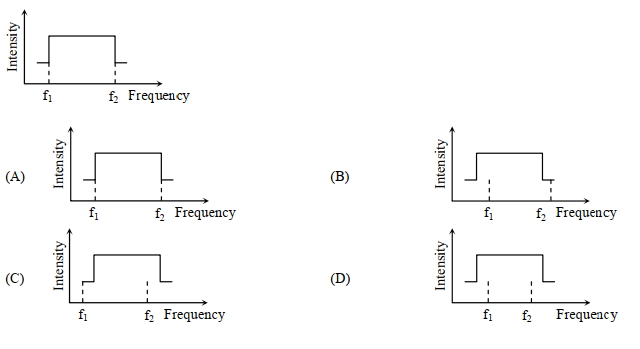
Assume that the sound of the whistle is composed of components varying in frequency from $f_1=800 \mathrm{~Hz}$ to $f_2=1120 \mathrm{~Hz}$, as shown in the figure. The spread in the frequency (highest frequency - lowest frequency) is thus $320 \mathrm{~Hz}$. The speed of sound in still air is $340 \mathrm{~m} / \mathrm{s}$.
$1.$ The speed of sound of the whistle is
$(A)$ $340 \mathrm{~m} / \mathrm{s}$ for passengers in $A$ and $310 \mathrm{~m} / \mathrm{s}$ for passengers in $B$
$(B)$ $360 \mathrm{~m} / \mathrm{s}$ for passengers in $A$ and $310 \mathrm{~m} / \mathrm{s}$ for passengers in $B$
$(C)$ $310 \mathrm{~m} / \mathrm{s}$ for passengers in $A$ and $360 \mathrm{~m} / \mathrm{s}$ for passengers in $B$
$(D)$ $340 \mathrm{~m} / \mathrm{s}$ for passengers in both the trains
$2.$ The distribution of the sound intensity of the whistle as observed by the passengers in train $\mathrm{A}$ is best represented by
$Image$
$3.$ The spread of frequency as observed by the passengers in train $B$ is
$(A)$ $310 \mathrm{~Hz}$ $(B)$ $330 \mathrm{~Hz}$ $(C)$ $350 \mathrm{~Hz}$ $(D)$ $290 \mathrm{~Hz}$
Give the answer question $1,2$ and $3.$
- 6View SolutionAn observer while going on scooter hears sound of two sirens of same frequencies from two opposite directions. If he travels along the direction of one of the siren, then he
- 7Which two of the given transverse waves will give stationary waves when get superimposedView Solution
${z_1} = a\cos (kx - \omega \,t)$.....$(A)$
${z_2} = a\cos (kx + \omega \,t)$.....$(B)$
${z_3} = a\cos (ky - \omega \,t)$..... $(C)$
- 8A closed organ pipe of length $L$ and an open organ pipe contain gases of densities $\rho_{1}$ and $\rho_{2}$ respectively. The compressibility of gases are equal in both the pipes. Both the pipes are vibrating in their first overtone with same frequency. The length of the open pipe is $\frac{ x }{3} L \sqrt{\frac{\rho_{1}}{\rho_{2}}}$ where $x$ is ......... . (Round off to the Nearest Integer)View Solution
- 9A sonometer wire oflength $1.5\ m$ is made of steel. The tension in it produces an elastic strain of $1 \%$. What is the fundamental frequency of steel if density and elasticity of steel are $7.7 \times 10^3 $ $kg/m^3$ and $2.2 \times 10^{11}$ $N/m^2$ respectively?View Solution
- 10View SolutionIn a standing wave on a string rigidly fixed at both ends