Two trains $A$ and $B$ are moving with speeds $20 \mathrm{~m} / \mathrm{s}$ and $30 \mathrm{~m} / \mathrm{s}$ respectively in the same direction on the same straight track, with $B$ ahead of $A$. The engines are at the front ends. The engine of train $A$ blows a long whistle.
Assume that the sound of the whistle is composed of components varying in frequency from $f_1=800 \mathrm{~Hz}$ to $f_2=1120 \mathrm{~Hz}$, as shown in the figure. The spread in the frequency (highest frequency - lowest frequency) is thus $320 \mathrm{~Hz}$. The speed of sound in still air is $340 \mathrm{~m} / \mathrm{s}$.
$1.$ The speed of sound of the whistle is
$(A)$ $340 \mathrm{~m} / \mathrm{s}$ for passengers in $A$ and $310 \mathrm{~m} / \mathrm{s}$ for passengers in $B$
$(B)$ $360 \mathrm{~m} / \mathrm{s}$ for passengers in $A$ and $310 \mathrm{~m} / \mathrm{s}$ for passengers in $B$
$(C)$ $310 \mathrm{~m} / \mathrm{s}$ for passengers in $A$ and $360 \mathrm{~m} / \mathrm{s}$ for passengers in $B$
$(D)$ $340 \mathrm{~m} / \mathrm{s}$ for passengers in both the trains
$2.$ The distribution of the sound intensity of the whistle as observed by the passengers in train $\mathrm{A}$ is best represented by
$Image$
$3.$ The spread of frequency as observed by the passengers in train $B$ is
$(A)$ $310 \mathrm{~Hz}$ $(B)$ $330 \mathrm{~Hz}$ $(C)$ $350 \mathrm{~Hz}$ $(D)$ $290 \mathrm{~Hz}$
Give the answer question $1,2$ and $3.$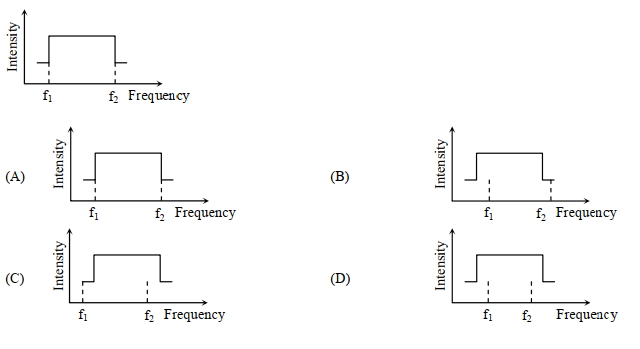
IIT 2007, Advanced


Download our appand get started for free
Experience the future of education. Simply download our apps or reach out to us for more information. Let's shape the future of learning together!No signup needed.*
Similar Questions
- 1Tone $A$ has frequency of $240 Hz.$ Of the following tones, the one which will sound least harmonious with $A$ isView Solution
- 2If the velocity of sound in air is $336 m/s$. The maximum length of a closed pipe that would produce a just audible sound will beView Solution
- 3View SolutionTransverse waves can propagate in
- 4A wire of length one metre under a certain initial tension emits a sound of fundamental frequency $256 \,Hz$. When the tension is increased by $1 \,kg$ wt, the frequency of the fundamental node increases to $320 \,Hz$. The initial tension is ........... $kg \,wt$View Solution
- 5For a solid rod, the Young's modulus of elasticity is $3.2 \times 10^{11}\,Nm ^{-2}$ and density is $8 \times 10^3\,kg\,m ^{-3}$. The velocity of longitudinal wave in the rod will be $......... \times 10^{3}\,ms^{-1}$View Solution
- 6An unknown frequency $x$ produces $8$ beats per seconds with a frequency of $250 Hz$ and $12$ beats with $270 Hz$ source, then $x$ is .... $Hz$View Solution
- 7Two identical flutes produce fundamental nodes of frequency $300\,Hz$ at $27\,^oC.$ If the temperature of air in one flute is increased to $31\,^oC,$ the numbe of the beats heard per second will beView Solution
- 8Velocity of sound in airView Solution
$I.$ Increases with temperature
$II.$ Decreases with temperature
$III.$ Increase with pressure
$IV.$ Is independent of pressure
$V.$ Is independent of temperature
Choose the correct answer.
- 9A source of unknown frequency gives $4\,\, beats/s$ when sounded with a source of known frequency $250\,\, Hz.$ The second harmonic of the source of unknown frequency gives five beats per second, when sounded with a source of frequency $513\,\, Hz.$ The unknown frequency is .... $Hz$View Solution
- 10When two sound waves with a phase difference of $\pi /2$, and each having amplitude $A$ and frequency $\omega $, are superimposed on each other, then the maximum amplitude and frequency of resultant wave isView Solution