Question
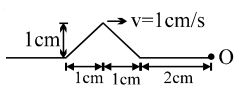
A wave pulse on a string has the dimension shown in figure. The waves speed is $v = 1 \,\,cm/s$. If point $O$ is a free end. The shape of wave at time $t = 3 \,\,s$ is :
Answer

In three seconds, the distance travelled by wave=1 $c m / s \times 3 s=3 c m$

Hence the center of the wave, the crest, reaches the point $O '$ in the time.

The amplitude of the wave becomes $1 \mathrm{cm}+1 \mathrm{cm}=2 \mathrm{cm}$

Hence correct answer is option $D.$

Need a full question paper?

Generate a complete, print-ready paper with questions like this in minutes — across 16+ boards, with answer keys.

Start Generating Free

Similar questions

Two long and parallel straight wires $A$ and $B$ carrying currents of $8.0\; A$ and $5.0\; A$ in the same direction are separated by a distance of $4.0\; cm$. Estimate the force on a $10\; cm$ section of wire $A.$
A coil of area $80$ square cm and $50$ turns is rotating with $2000$ revolutions per minute about an axis perpendicular to a magnetic field of $0.05$ Tesla. The maximum value of the e.m.f. developed in it is
A metal ball of radius $R$ is placed concentrically inside a hollow metal sphere of inner radius $2R $ and outer radius $3R$. The ball is given a charge $+2Q$ and the hollow sphere a total charge $- Q$. The electrostatic potential energy of this system is :
Which of the following most closely depicts the correct variation of the gravitational potential $V(r)$ due to a large planet of radius $R$ and uniform mass density ? (figures are not drawn to scale)
The mass of a neutron is the same as that of
This question contains statement$-1$ and statement$-2$. Of the four choices given after the statements, choose the one that best describes the two statements.

statement$-1$ : The temperature dependence of resistance is usually given as $R=R_{0}(1+\alpha \Delta t)$. The resistance of a wire changes from $100\; \Omega$ to $150\; \Omega$ when its temperature is increased from $27^{\circ} C$ to $227^{\circ} C$. This implies that $\alpha=2.5$ $\times 10^{-3} /{ }^{\circ} C$

statement$-2\;: R=R_{0}(1+\alpha \Delta t)$ is valid only when the change in the temperature $\Delta T$ is small and $\Delta R=\left(R-R_{0}\right) < < R_{0}$
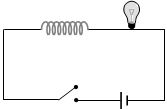
In the following circuit, the bulb will become suddenly bright if
A $12 \,m$ long vibrating string has the speed of wave $48 \,m / s$. To what frequency it will resonate ........... $cps$
A pure semiconductor behaves slightly as a conductor at
Work done by a frictional force is