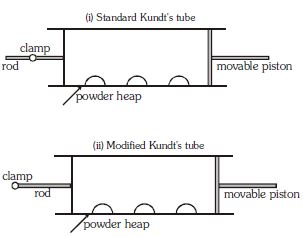
In the Kundts tube experiment (shown in fig. $(i)$), the rod is clamped at the end instead of clamping it at the center as shown in fig. $(ii).$ It is known that speed of sound in air is $330\ m/s$, powder piles up at successive distance of $0.6\ m$ and length of rod used is $1\ m$, speed of sound in rod is .... $\frac{m}{s}$
Diffcult
Download our app for free and get started
ln rod, $\frac{\lambda }{4} = l \Rightarrow \lambda = 4l \Rightarrow {v_r} = \lambda v = 4lv$
In air column ${{\rm{v}}_{\rm{a}}} = 2\Delta l{\rm{v}}$
$\frac{{{v_r}}}{{{v_a}}} = \frac{{2l}}{{\Delta l}} \Rightarrow {v_r} = \frac{{2 \times 1 \times 330}}{{0.6}} = 1100\,{\rm{m}}/{\rm{s}}$

Download our appand get started for free
Experience the future of education. Simply download our apps or reach out to us for more information. Let's shape the future of learning together!No signup needed.*
Similar Questions
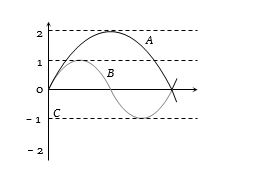
- 1The displacement-time graphs for two sound waves $A$ and $B$ are shown in the figure, then the ratio of their intensities ${I_A}/{I_B}$ is equal toView Solution
- 2A wave is represented by the equation : $y = a\sin (0.01x - 2t)$ where $a$ and $x$ are in $cm$. velocity of propagation of wave is .... $cm/s$View Solution
- 3A transverse pulse generated at the bottom of a uniform rope of length $L$, travels in upward direction. The time taken by it to travel the full length of rope will beView Solution
- 4Two waves of lengths $50 \;cm$ and $51\; cm$ produced $12$ beats per second. The velocity of sound is .... $m/s$View Solution
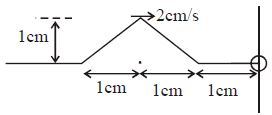
- 5A trianguler pulse moving at $2\ cm/s$ on a rope approches an end at which it is free to slide on vertical pole. What is the particle speed at the free end at $\frac{3}{4}\ sec$ from the instant shown ...... $cm/s$View Solution
- 6View SolutionIn stationary waves all particles between two nodes pass through the mean position
- 7A string is clamed at both the ends and it is vibrating in its $4^{th}$ harmonic. The equation of the stationary wave is $Y =0.3\,sin\,(0.157\,x) \,cos\,(200\pi t)$. The length of the string is ..... $m$ (all quantities are in $SI$ units)View Solution
- 8The expression $y = a\, sin\, bx\, sin\, \omega t$ represents a stationary wave. The distance between the consecutive nodes is equal toView Solution
- 9The wave described by $y=0.25 \,sin\left[ {10\pi x - 2\pi t} \right]$, where $x$ and $y$ are in meters and $t$ in seconds, is a wave travelling along theView Solution
- 10Two sound waves of wavelength ${\lambda _1}$ and ${\lambda _2}$ $\left( {{\lambda _2} > {\lambda _1}} \right)$ produce $n\, beats/s$, the speed of sound isView Solution