A wave travels in a medium according to the equation of displacement given by $y(x,\,t) = 0.03\sin \pi (2t - 0.01x)$ where $y$ and $x$ are in metres and $t$ in seconds. The wavelength of the wave is .... $m$
Easy


Download our appand get started for free
Experience the future of education. Simply download our apps or reach out to us for more information. Let's shape the future of learning together!No signup needed.*
Similar Questions
- 1A string of length $1\,\,m$ and linear mass density $0.01\,\,kgm^{-1}$ is stretched to a tension of $100\,\,N.$ When both ends of the string are fixed, the three lowest frequencies for standing wave are $f_1, f_2$ and $f_3$. When only one end of the string is fixed, the three lowest frequencies for standing wave are $n_1, n_2$ and $n_3$. ThenView Solution
- 2A person speaking normally produces a sound intensity of $40\,dB$ at a distance of $1\,m$. If the threshold intensity for reasonable audibility is $20\,dB,$ the maximum distance at which he can be heard clearly is ... $m$View Solution
- 3View SolutionA closed pipe and an open pipe have their first overtones identical in frequency. Their lengths are in the ratio
- 4Two tuning forks $A\,\, \& \,\,B$ produce notes of frequencies $256 Hz \,\,\& \,\,262 Hz$ respectively. An unknown note sounded at the same time as $A$ produces beats . When the same note is sounded with $B$, beat frequency is twice as large . The unknown frequency could be ... $Hz$View Solution
- 5A man can hear sounds in frequency range $120\,Hz$ to $12020\,Hz$. only. He is vibrating a piano string having a tension of $240\,N$ and mass of $3\,gm$ . The string has a length of $8\,m$ . How many different frequencies can he hear ?View Solution
- 6View SolutionWhich one of the following does not represent a travelling wave
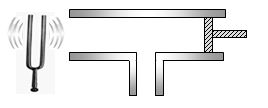
- 7Vibrating tuning fork of frequency $n$ is placed near the open end of a long cylindrical tube. The tube has a side opening and is fitted with a movable reflecting piston. As the piston is moved through $8.75 cm$, the intensity of sound changes from a maximum to minimum. If the speed of sound is $350 \,m/s. $ Then $n$ is .... $Hz$View Solution
- 8A wave represented by the equation $y_1 = a\,cos(Kx-\omega t)$ is superimposed with another wave to form a stationary wave such that the point $x = 0$ is a node. The equation for the other wave isView Solution
- 9The path Difference between the two waves ${y_1} = {a_1}\,\sin \,\left( {\omega t - \frac{{2\pi x}}{\lambda }} \right)$ and ${y_2} = {a_2}\,\cos \,\left( {\omega t - \frac{{2\pi x}}{\lambda } + \phi } \right)$ isView Solution
- 10Two waves of intensity ratio $1: 9$ cross each other at a point. The resultant intensities at the point, when $I_1(a)$ Waves are incoherent is $I_1(b)$ Waves are coherent is $I_2$ and differ in phase by $60^{\circ}$. If $\frac{I_1}{I_2}=\frac{10}{x}$ than $x$ =. . . . . . . . . . .View Solution