A string of length $1\,\,m$ and linear mass density $0.01\,\,kgm^{-1}$ is stretched to a tension of $100\,\,N.$ When both ends of the string are fixed, the three lowest frequencies for standing wave are $f_1, f_2$ and $f_3$. When only one end of the string is fixed, the three lowest frequencies for standing wave are $n_1, n_2$ and $n_3$. Then
Advanced


Download our appand get started for free
Experience the future of education. Simply download our apps or reach out to us for more information. Let's shape the future of learning together!No signup needed.*
Similar Questions
- 1A vibrating string of certain length $l$ under a tension $T$ resonates with a mode corresponding to the first overtone (third harmonic) of an air column of length $75\, cm$ inside a tube closed at one end. The string also generates $4\, beats$ per second when excited along with a tuning fork of frequency $n$. Now when the tension of the string is slightly increased the number of beats reduces to $2\, per second$. Assuming the velocity of sound in air to be $340\, m/s$, the frequency $n$ of the tuning fork in $Hz$ isView Solution
- 2A standing wave is formed by the superposition of two waves travelling in opposite directions. The transverse displacement is given by $y\left( {x,t} \right) = 0.5\sin\, \left( {\frac{{5\pi }}{4}x} \right)\,\cos\, \left( {200\,\pi t} \right)$. What is the speed of the travelling wave moving in the positive $x$ direction .... $m/s$ ? ($x$ and $t$ are in meter and second, respectively.)View Solution
- 3The ratio of the velocity of sound in hydrogen gas $(\gamma = 7/5)$ to that in helium gas $(\gamma = 5/3)$ at the same temperature will beView Solution
- 4View SolutionIt is possible to hear beats from the two vibrating sources of frequency
- 5View SolutionThe nature of sound waves in gases is
- 6View SolutionWhich of the following is not the transverse wave
- 7Two waves $y = 0.25\sin 316\,t$ and $y = 0.25\sin 310\,t$ are travelling in same direction. The number of beats produced per second will beView Solution
- 8A horizontal stretched string, fixed at two ends, is vibrating in its fifth harmonic according to the equation, $y(x$, $t )=(0.01 \ m ) \sin \left[\left(62.8 \ m ^{-1}\right) x \right] \cos \left[\left(628 s ^{-1}\right) t \right]$. Assuming $\pi=3.14$, the correct statement$(s)$ is (are) :View Solution
$(A)$ The number of nodes is $5$ .
$(B)$ The length of the string is $0.25 \ m$.
$(C)$ The maximum displacement of the midpoint of the string its equilibrium position is $0.01 \ m$.
$(D)$ The fundamental frequency is $100 \ Hz$.
- 9One end of a taut string of length $3 \ m$ along the $x$-axis is fixed at $x=0$. The speed of the waves in the string is $100 \ m / s$. The other end of the string is vibrating in the $y$-direction so that stationary waves are set up in the string. The possible waveform$(s)$ of these stationary waves is (are)View Solution
$(A)$ $y(t)=A \sin \frac{\pi x}{6} \cos \frac{50 \pi t}{3}$
$(B)$ $y(t)=A \sin \frac{\pi x}{3} \cos \frac{100 \pi t}{3}$
$(C)$ $y(t)=A \sin \frac{5 \pi x}{6} \cos \frac{250 \pi t}{3}$
$(D)$ $y(t)=A \sin \frac{5 \pi x}{2} \cos 250 \pi t$
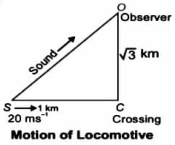
- 10A locomotive approaching a crossing at a speed of $20 \,ms ^{-1}$ sounds a whistle of frequency $640 \,Hz$ when $1 \,km$ from the crossing. There is no wind and the speed of sound in air is $330 \,ms ^{-1}$. What frequency is heard by an observer $\sqrt{3} \,km$ on the straight road from the crossing at right angle ......... $Hz$View Solution