Question
A wheel in uniform motion about an axis passing through its centre and perpendicular to its plane is considered to be in mechanical (translational plus rotational) equilibrium because no net external force or torque is required to sustain its motion. However, the particles that constitute the wheel do experience a centripetal acceleration directed towards the centre.How do you reconcile this fact with the wheel being in equilibrium?
How would you set a half-wheel into uniform motion about an axis passing through the centre of mass of the wheel and perpendicular to its plane? Will you require external forces to sustain the motion?
Answer

Wheel is a rigid rigid elastic body. It is in uniform motion about axis passing through it’s centre and perpendicular to the plane of wheel. Each particles of wheel which constitute the wheel are in circular motion about above axis and each particle will experience a centripetal acceleration directed towards axis of rotation due to elastic forces which are in pairs.
In a half wheel the distribution of mass of mass of half wheel is not symmetric about the axis of wheel. Therefore the direction of angular momentum and angular velocity does not coincide. Hence the external torque is required to maintain the motion in half wheel.

Need a full question paper?

Generate a complete, print-ready paper with questions like this in minutes — across 16+ boards, with answer keys.

Start Generating Free

Similar questions

In changing the state of a gas adiabatically from an equilibrium state A to another equilibrium state B, an amount of work equal to 22.3J is done on the system. If the gas is taken from state A to B via a process in which the net heat absorbed by the system is 9.35 cal, how much is the net work done by the system in the latter case? (Take 1 cal = 4.19J)
What is simple pendulum? Show that the motion of the pendulum is S.H.M. and hence deduce an expression for the time period of pendulum. Also define second's pendulum.
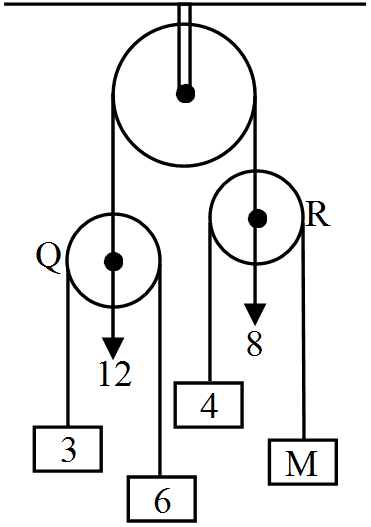
Two pulleys of masses $12kg$ and $8kg$ are connected by a fine string hanging over a fixed pulley as shown. Over the $8kg$ pulley is hung a fine string with masses $4kg$ and M. Over the $12kg$ pulley is hung another fine string with masses $3kg$ and $6kg$. Calculate M so that the string over the fixed pulley remains stationary.
A block of mass $15kg$ is placed on a long trolley. The coefficient of static friction between the block and the trolley is $0.18$. The trolley accelerates from rest with $0.5ms^{-2}$ for $20s$ and then moves with uniform velocity. Discuss the motion of the block as viewed by (a) a stationary observer on the ground, (b) an observer moving with the trolley.
  1. State first law of thermodynamics. What are its limitations? Why $C_p > C_v$?
  2. An electric heater supplies heat to a system at a rate 100W. If the system performs work at a rate of 75 joules per second at what rate is the internal energy increases.
OR
  1. Derive an expression for the work done during the isothermal expression of x mole of an ideal gas.
  2. A steam engine delivers $5.4 \times 10^8J$ of work per minute and services $3.6 \times 10^9J$ of heat per minute from its boiler. What is the efficiency of the engine? How much heat is wasted per minute?
A pump on the ground floor of a building can pump up water to fill a tank of volume $30m^3$ in $15min$. If the tank is $40m$ above the ground, and the efficiency of the pump is $30\%$, how much electric power is consumed by the pump?
Derive the formulas for the orbital velocity and rotation period of a satellite revolving near the Earth's surface and find their values. Establish a relation between escape velocity and orbital velocity.
A ball is thrown upward with an initial velocity of $100m/s$. After how much time will it return? Draw velocity$-$time graph for the ball and find from the graph.
  1. Maximum height attained by ball.
  2. Height of the ball after $15s$. Take, $g = 10ms^{-2}$
A $10g$ bullet with a charge of $4.00\mu\text{C}$ is fired at a speed of $270m/s^{-1}$ in a horizontal direction. A vertical magnetic field of $500\mu\text{T}$ exists in the space. Find the deflection of the bullet due to the magnetic field as it travels through 100m. Make appropriate approximations.
A long, straight wire is fixed horizontally and carries a current of $50.0A$. A second wire having linear mass density $1.0 \times 10^{-4}kg/m$ is placed parallel to and directly above this wire at a separation of $5.0mm$. What current should this second wire carry such that the magnetic repulsion can balance its weight?