Question
  1. State first law of thermodynamics. What are its limitations? Why $C_p > C_v$?
  2. An electric heater supplies heat to a system at a rate 100W. If the system performs work at a rate of 75 joules per second at what rate is the internal energy increases.
OR
  1. Derive an expression for the work done during the isothermal expression of x mole of an ideal gas.
  2. A steam engine delivers $5.4 \times 10^8J$ of work per minute and services $3.6 \times 10^9J$ of heat per minute from its boiler. What is the efficiency of the engine? How much heat is wasted per minute?
Answer

  1. According to the first law of thermodynamics, the total heat energy change dQ is the sum of the internal energy change dU and work done dW,
i.e. dQ = dU + dW
Limitations of the first law of thermodynamics:
  1. The first law does not indicate the direction in which the heat change can occur.
  2. The first law does not give any idea about the extent of heat change.
  3. The first law of thermodynamics gives no information about the source of heat, i.e. whether it is a hot or cold body.
The relation between two specific heats of a gas, i.e. $C_p$ and $C_v$ is given by $C_p - C_v = R$ where, R is the molar gas constant and is equal to $8.31J ~mole^{-1}K^{-1}$.
$C_p > C_v$ because a part of the energy supplied in the isobaric process goes to increase the volume of the gas and the remaining increases the temperature.
  1. According to first law of thermodynamics,
dQ = dU + dW
Differentiating w.r.t., time (t)
$\frac{\text{dQ}}{\text{dt}}=\frac{\text{dU}}{\text{dt}}+\frac{\text{dW}}{\text{dt}}$
$100\text{W}=\frac{\text{dU}}{\text{dt}}+75$
$[\because$ Given, system performs work at a rate of 75J/ sec.$]$
$\frac{\text{dU}}{\text{dt}}\rightarrow$ Rate of change of internal energy
$\frac{\text{dU}}{\text{dt}}=100-75=25\text{W}$
Alternate Answer
  1. For a small change in volume, work done is given by dW = PdV.
We know, PV = nRT
For T = Constant
$\text{dW}=\text{nRt}\cdot\frac{\text{dV}}{\text{V}}$
$\therefore\text{P}=\frac{\text{nRT}}{\text{V}}$
Net work done under isothermal condition to change the volume from $Y_i$ to $V_f$​​​​​​​ is,
$\text{W}=\int\limits^{\text{V}_\text{f}}_{\text{V}_\text{i}}\text{dW}$
$=\text{nRT}\int\limits^{\text{V}_\text{f}}_{\text{V}_\text{i}}\frac{\text{dV}}{\text{V}}=\text{nRT}|\log_\text{e}\text{V}|^{\text{V}_\text{f}}_{\text{V}_\text{i}}$
$=\text{nRT }\log_\text{e}\Big(\frac{\text{V}_\text{f}}{\text{V}_\text{i}}\Big)$
$\therefore\text{W}=2.3026\text{ nRT }\log_{10}\Big(\frac{\text{V}_\text{f}}{\text{V}_\text{i}}\Big)$
  1. Work done by a steam energy,
$W = 5.4 \times 10^8J, Q_1 = 3.6 \times 10^9J$
Efficiency of the engine, $\eta=?,\text{Q}_2=?$
$\eta=\frac{\text{W}}{\text{Q}_1}=\frac{5.4\times10^8\text{J}} {3.6\times10^9\text{J}}$
$=\frac{54}{36}\times10^{-1}=\frac{3}{20}=0.15$ or 15%
Heat wasted per minute,
$\text{Q}_2=\text{Q}_1-\text{W}$
$\text{Q}_2=3.6\times10^9\text{J}-5.4\times10^8\text{J}$
$=36\times10^8\text{J}-5.4\times10^8\text{J}$
$=10^8(36-5.4)\text{J}=30.6\times10^9\text{J}$

Need a full question paper?

Generate a complete, print-ready paper with questions like this in minutes — across 16+ boards, with answer keys.

Start Generating Free

Similar questions

A nucleus is at rest in the laboratory frame of reference. Show that if it disintegrates into two smaller nuclei the products must move in opposite directions.
A child running a temperature of $101°F$ is given an antipyrin (i.e. a medicine that lowers fever) which causes an increase in the rate of evaporation of sweat from his body. If the fever is brought down to $98°F$ in $20$ minutes, what is the average rate of extra evaporation caused, by the drug. Assume the evaporation mechanism to be the only way by which heat is lost. The mass of the child is $30kg$. The specific heat of human body is approximately the same as that of water, and latent heat of evaporation of water at that temperature is about $580cal\ g^{–1}$.
Two identical springs, each of spring factor k, may be connected in the following ways. Deduce the spring factor of the oscillation of the body in each case.
Derive a relation for work done in a gravitational field. Using it, (i) find potential difference between a pair of points. (ii) express whether gravitational force is conservative or non-conservative.
The speed of a motor launch w.r.t still water is $7ms^{-1}$ and the speed of the stream is $3ms^{-1}$. When the launch began travelling upstream, a float was dropped from it. The launch travelled $4.2km$ upstream, turned about and caught up with the float. How long is it, before the launch reached the float?
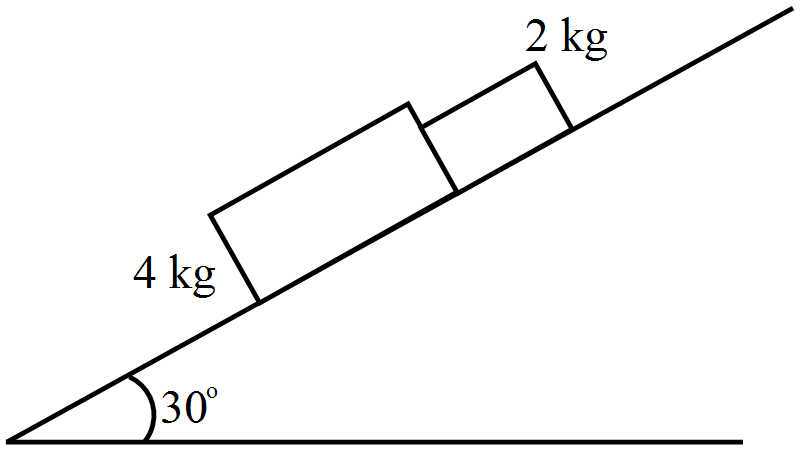
Figure shows two blocks in contact sliding down an inclined surface of inclination $30°$. The friction coefficient between the block of mass $2.0kg$ and the incline is $\mu_1,$ and that between the block of mass $4.0kg$ and the incline is $\mu_2.$ Calculate the acceleration of the 2.0kg block if:
  1. $\mu_1=0.20$ and $\mu_2=0.30$
  2. $\mu_1=0.30$ and $\mu_2=0.20$ Take $\text{g}=10\text{m/s}^2.$

A new system of units is proposed in which unit of mass is $\alpha\text{kg},$ unit of length $\beta$ m and unit of time $\gamma\text{ s}.$ How much will 5J measure in this new system?
$(n - 1)$ equal point masses each of mass m are placed at the vertices of a regular n-polygon. The vacant vertex has a position vector a with respect to the centre of the polygon. Find the position vector of centre of mass.
A tuning fork of unknown frequency makes 5 beats per second with another tuning fork which can cause a closed organ pipe of length 40cm to vibrate in its fundamental mode. The beat frequency decreases when the first tuning fork is slightly loaded with wax. Find its original frequency. The speed of sound in air is 320m/s.
A metal bar of length L and area of cross-section A, is rigidly clamped between two walls. The Young's modulus of its material is Y and the coefficient of linear expansion is $\alpha.$ The bar is heated so that its temperature is increased from 0 to $\theta^\circ\text{C}.$ Find the force exerted at the ends of the bar.