MCQ
A wheel initially at rest, is rotated with a uniform angular acceleration. The wheel rotates through an angle ${\theta _1}$ in first one second and through an additional angle ${\theta _2}$ in the next one second. The ratio $\frac{{{\theta _2}}}{{{\theta _1}}}$ is
  • A
    $4$
  • B
    $2$
  • $3$
  • D
    $1$

Answer

Correct option: C.
$3$
c
Angular displacement in first one second ${\theta _1} = \frac{1}{2}\alpha \,{(1)^2} = \frac{\alpha }{2}$  ......$(i)$      [From $\theta  = {\omega _1}t + \frac{1}{2}\alpha \,{t^2}$]

Now again we will consider motion from the rest and angular displacement in total two seconds

${\theta _1} + {\theta _2} = \frac{1}{2}\alpha \,{(2)^2} = 2\alpha $                                   ......$(ii)$

Solving $(i)$ and $(ii)$, we get ${\theta _1} = \frac{\alpha }{2}$ and ${\theta _2} = \frac{{3\alpha }}{2}$    $\therefore $  $\frac{{{\theta _2}}}{{{\theta _1}}} = 3$.

Need a full question paper?

Generate a complete, print-ready paper with questions like this in minutes — across 16+ boards, with answer keys.

Start Generating Free

Similar questions

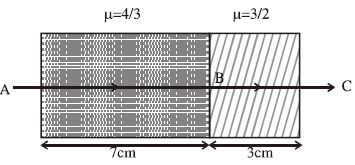
The given figure shows a ray of light passing through two media having refractive indices $4/3$ and $3/2$ respectively. The ratio of times taken by the ray in traversing the distances $AB$ and $BC$ is
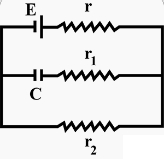
In the given circuit diagram when the current reaches steady state in the circuit, the charge on the capacitor of capacitance $C$ will be
A particle moves with constant angular velocity in circular path of certain radius and is acted upon by a certain centripetal force $F$. If the angular velocity is doubled, keeping radius the same, the new force will be
$A$ ball of mass $m$ is attached to the lower end of light vertical spring of force constant $k$. The upper end of the spring is fixed. The ball is released from rest with the spring at its normal (unstretched) length, comes to rest again after descending through a distance $x.$
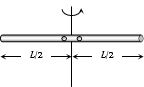
A smooth uniform rod of length $L$ and mass $M$ has two identical beads of negligible size, each of mass $m$, which can slide freely along the rod. Initially the two beads are at the centre of the rod and the system is rotating with angular velocity ${\omega _0}$ about an axis perpendicular to the rod and passing through the mid point of the rod (see figure). There are no external forces. When the beads reach the ends of the rod, the angular velocity of the system is
$X-$ ray will travel minimum distance in
Two speakers connected to the same source of fixed frequency are placed $2.0 m $ apart in a box. A sensitive microphone placed at a distance of $4.0m$ from their midpoint along the perpendicular bisector shows maximum response. The box is slowly rotated until the speakers are in line with the microphone. The distance between the midpoint of the speakers and the microphone remains unchanged. Exactly five maximum responses are observed in the microphone in doing this. The wavelength of the sound wave is .... $m$
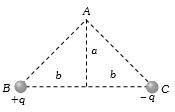
As shown in the figure, charges $ + q$ and $ - q$ are placed at the vertices $B$ and $C$ of an isosceles triangle. The potential at the vertex $A$ is
A glass concave lens is placed in a liquid in which it behaves like a convergent lens. If the refractive indices of glass and liquid with respect to air are $^a{\mu _g}$ and $^a{\mu _l}$ respectively, then
On increasing the plate separation of a charged condenser, the energy