MCQ
A wheel initially at rest, is rotated with a uniform angular acceleration. The wheel rotates through an angle ${\theta _1}$ in first one second and through an additional angle ${\theta _2}$ in the next one second. The ratio $\frac{{{\theta _2}}}{{{\theta _1}}}$ is
  • A
    $4$
  • B
    $2$
  • $3$
  • D
    $1$

Answer

Correct option: C.
$3$
c
Angular displacement in first one second ${\theta _1} = \frac{1}{2}\alpha \,{(1)^2} = \frac{\alpha }{2}$  ......$(i)$      [From $\theta  = {\omega _1}t + \frac{1}{2}\alpha \,{t^2}$]

Now again we will consider motion from the rest and angular displacement in total two seconds

${\theta _1} + {\theta _2} = \frac{1}{2}\alpha \,{(2)^2} = 2\alpha $                                   ......$(ii)$

Solving $(i)$ and $(ii)$, we get ${\theta _1} = \frac{\alpha }{2}$ and ${\theta _2} = \frac{{3\alpha }}{2}$    $\therefore $  $\frac{{{\theta _2}}}{{{\theta _1}}} = 3$.

Need a full question paper?

Generate a complete, print-ready paper with questions like this in minutes — across 16+ boards, with answer keys.

Start Generating Free

Similar questions

When the displacement is half the amplitude, the ratio of potential energy to the total energy is
If the body is moving in a circle of radius $ r$ with a constant speed $v$, its angular velocity is
Equations $y = 2A \cos ^2 \omega \,t$ and $y = A (\sin \omega t + \cos \omega t )$ represent the motion of two particles.
The coefficient of apparent expansion of a liquid when determined using two different vessels $A$ and  $B$ are $\gamma_1$ and $\gamma_2$ respectively. If the coefficient of linear expansion of vessel  $A$  is $\alpha$, the coefficient of linear expansion of vessel $B$ is
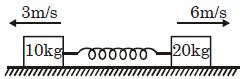
As shown in figure, two blocks are connected with a light spring. When spring was at its natural length, velocities are given to them as shown in figure. Choose the wrong alternative.
When volume of system is increased two times and temperature is decreased half of its initial temperature, then pressure becomes ...... times
The string of a pendulum of length $l$ is displaced through $90^o$ from the vertical and released. Then, the minimum strength of the string in order to withstand the tension as the pendulum passes through the mean position is
Trajectory of particle in a projectile motion is given as $y=x-\frac{x^2}{80}$. Here, $x$ and $y$ are in metre. For this projectile motion match the following with $g=10\,m / s ^2$.
$Column-I$ $Column-II$
$(A)$ Angle of projection $(p)$ $20\,m$
$(B)$ Angle of velocity with horizontal after $4\,s$ $(q)$ $80\,m$
$(C)$ Maximum height $(r)$ $45^{\circ}$
$(D)$ Horizontal range $(s)$ $\tan ^{-1}\left(\frac{1}{2}\right)$
Two moles of ideal helium gas are in a rubber balloon at $30^{\circ} C$. The balloon is fully expandable and can be assumed to require no energy in its expansion. The temperature of the gas in the balloon is slowly changed to $35^{\circ} C$. The amount of heat required in raising the temperature is nearly (take $R =8.31 J / mol$. $K$)
Planck's constant $h$, speed of light $c$ and gravitational constant $G$ are used to form a unit of length $L$ and a unit of mass $M$. Then the correct option$(s)$ is(are)

$(A)$ $M \propto \sqrt{ c }$ $(B)$ $M \propto \sqrt{ G }$ $(C)$ $L \propto \sqrt{ h }$ $(D)$ $L \propto \sqrt{G}$