Question
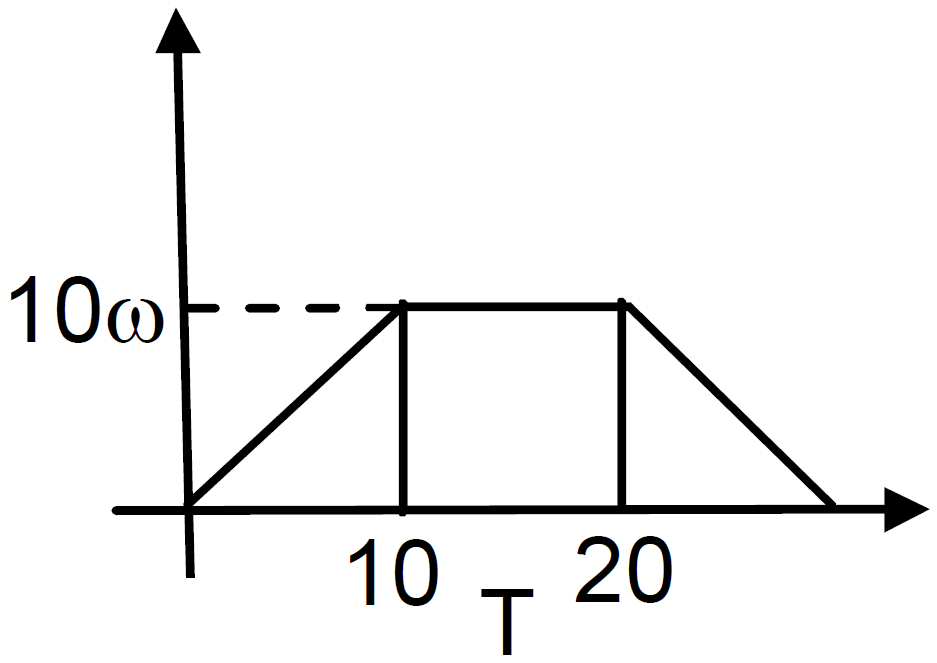
A wheel starting from rest is uniformly accelerated at $ 4\ rad/-s^2$ for 10 seconds.It is allowed to rotate uniformly for the next 10 seconds and is finally brought to rest in the next 10 seconds. Find the total angle rotated by the wheel.
Answer

Area under the curve will decide the total angle rotated
$\therefore$ Maximum angular velocity = 4 × 10 = 40 rad/-s
Therefore, area under the curve $=\frac{1}2{}\times10\times40+40\times10+\frac{1}{2}\times40\times10$
$=800\text{rad}$
$\therefore$ Total angle rotated = 800rad.

Need a full question paper?

Generate a complete, print-ready paper with questions like this in minutes — across 16+ boards, with answer keys.
Start Generating Free

Similar questions

State the law of radioactive decay.
Plot a graph showing the number (N) of undecayed nuclei as a function of time (t) for a given radioactive sample having half life $T_½.$
Depict in the plot the number of undecayed nuclei at (i) $t = 3 T_½$ and (ii) $t = 5 T_½.$
Suppose the platform with the kid in the previous problem is rotating in anticlockwise direction at an angular speed $\omega.$ The kid starts walking along the rim with a speed v relative to the platform also in the anticlockwise direction. Find the new angular speed of the platform.
  1. Draw the circuit diagram for studying the characteristics of a transistor in common emitter configuration. Explain briefly and show how input and output characteristics are drawn.
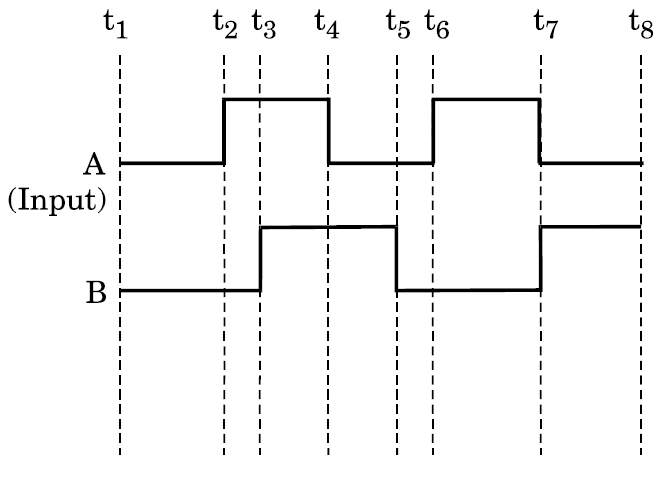
  2. The figure shows input waveforms A and B to a logic gate. Draw the output waveform for an OR gate. Write the truth table for this logic gate and draw its logic symbol.
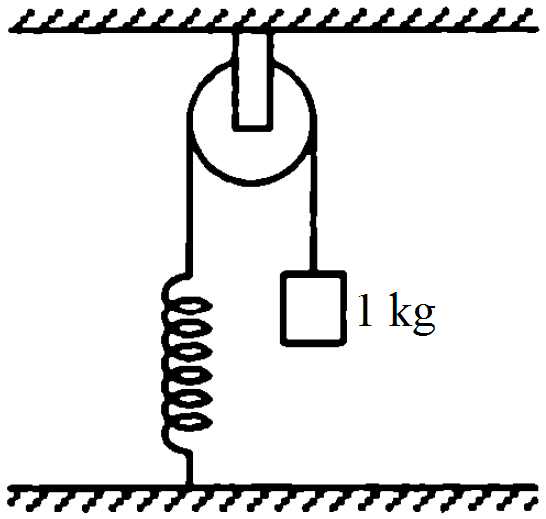
The pulley shown in figure has a radius of 20cm and moment of inertia $0.2kg-m^2.$ The string going over it is attached at one end to a vertical spring of spring constant 50N/m fixed from below, and supports a 1kg mass at the other end. The system is released from rest with the spring at its natural length. Find the speed of the block when it has descended through 10cm. Take $g = 10m/s^2.$​​​​​​​
A neutron is absorbed by a $^{6}_{3}\text{Li}$ nucleus with the subsequent emission of an alpha particle.
  1. Calculate the energy released, in MeV, in this reaction.
  2. Write the corresponding nuclear reaction.
Given: mass $^{6}_{3}\text{Li} =6015126 $ u; mass (neutron) =1.0086654 u; mass (alpha particle) = 4.0026044 u and mass (triton) = 3.0100000 u. Take $1\ u = 931\ MeV/C^2.$
Energy of electron in hydrogen atom expressed by the following formula :
$E _n=-\left(\frac{13.6 eV}{n^2}\right) ; $ Where $,  n=1,2,3, \ldots$ by using this formula, proved that :
$(a)$ The energy of electron $-6.8 eV$ cannot be in $H -$ atom.
$(b)$ The distance of attached lines in spectrum of hydrogen.
(a) Stars located very far away, which cannot be seen with the eye, can be seen through a telescope. Why?
(b) The magnifying power of two telescopes is the same but the apertures of their objective lenses are different. What will be the change in the final images formed by them?
State Kirchhoff's laws and explain them by giving examples.###Explain that first law of Kirchhoff is equivalent to law of conservation of charge and the second law is a descriptive form of Ohm's law.###For a current carrying conductor, write Kirchhoff's laws of charge and energy conservation.
The current in a long solenoid of radius R and having n turns per unit length is given by $\text{i}=\text{i}_0\sin\omega\text{t}.$ A coil having N turns is wound around it near the centre. Find
  1. The induced emf in the coil.
  2. The mutual inductance between the solenoid and the coil.
The time taken by Mars to revolve round the sun is 1.88 years. Find the ratio of average distance between Mars and the sun to that between the earth and the sun.