Question
Suppose the platform with the kid in the previous problem is rotating in anticlockwise direction at an angular speed $\omega.$ The kid starts walking along the rim with a speed v relative to the platform also in the anticlockwise direction. Find the new angular speed of the platform.
Answer

From a inertial frame of reference when we see the (man wheel) system, we can find that the wheel moving at a speed of $\omega$ and the man with $\Big(\omega+\frac{\text{V}}{\text{R}}\Big)$ after the man has started walking. $(\omega'=$ angular velocity after walking, $\omega=$ angular velocity of the wheel before walking$).$ Since $\sum\text{l}=0$ Extended torque = 0 Therefore, $(1+\text{MR}^2)\omega=\text{l}\omega'+\text{mR}^2\Big(\omega'+\frac{\text{V}}{\text{R}}\Big)$$\Rightarrow(1+\text{MR}^2)\omega=\text{l}\omega'+\text{mR}^2\omega'+\text{mVR}$
$\Rightarrow\omega'=\omega-\frac{\text{mVR}}{(1+\text{mR}^2)}.$

Need a full question paper?

Generate a complete, print-ready paper with questions like this in minutes — across 16+ boards, with answer keys.

Start Generating Free

Similar questions

In an experiment on photoelectric effect, the slope of the cut-off voltage versus frequency of incident light is found to be $4.12 \times 10^{–15}$ Vs. Calculate the value of Planck’s constant.
A proton and an α-particle move perpendicular to a magnetic field. Find the ratio of radii of the circular paths described by them when both (i) have equal momenta, and (ii) were accelerated through the same potential difference.
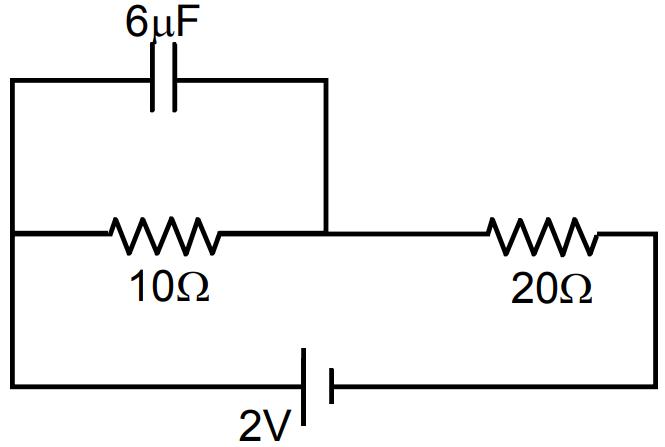
Find the charge on the capacitor shown in figure.
A thin conducting spherical shell of radius R has charge Q spread uniformly over its surface. Using Gauss’s law, derive an expression for an electric field at a point outside the shell.Draw a graph of electric field E(r) with distance r from the centre of the shell for $0\underline{<}\text{r}\underline{<}\infty.$
  1. Distinguish between a conductor and a semi conductor on the basis of energy band diagram.
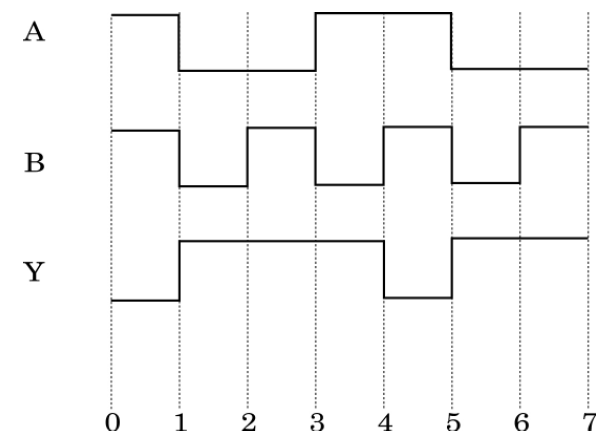
  2. The following figure shows the input waveforms (A, B) and the output waveform (Y) of a gate. Identify the gate, write its truth table and draw its logic symbol.
How does an unpolarised light get polarised when passed through a polaroid?
Two polaroids are set in crossed positions. A third polaroid is placed between the two making an angle θ with the pass axis of the first polaroid. Write the expression for the intensity of light transmitted from the second polaroid. In what orientations will the transmitted intensity be (i) minimum and (ii) maximum?
Answer the following questions.
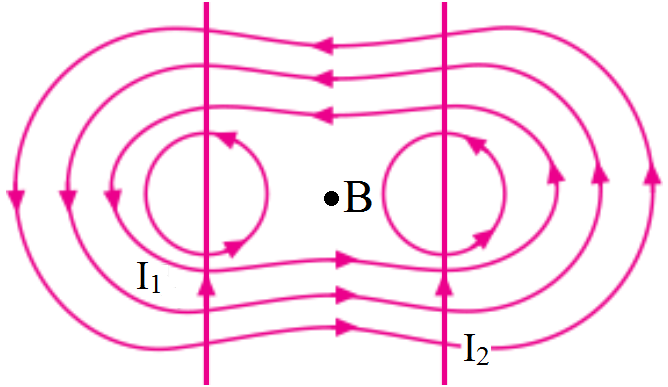
  1. Draw the magnetic field lines due to two straight, long, parallel conductors carrying currents $I_1$ and $I_2$ in the same direction. Write an expression for the force acting per unit length on one conductor due to other. Is this force attractive or repulsive?
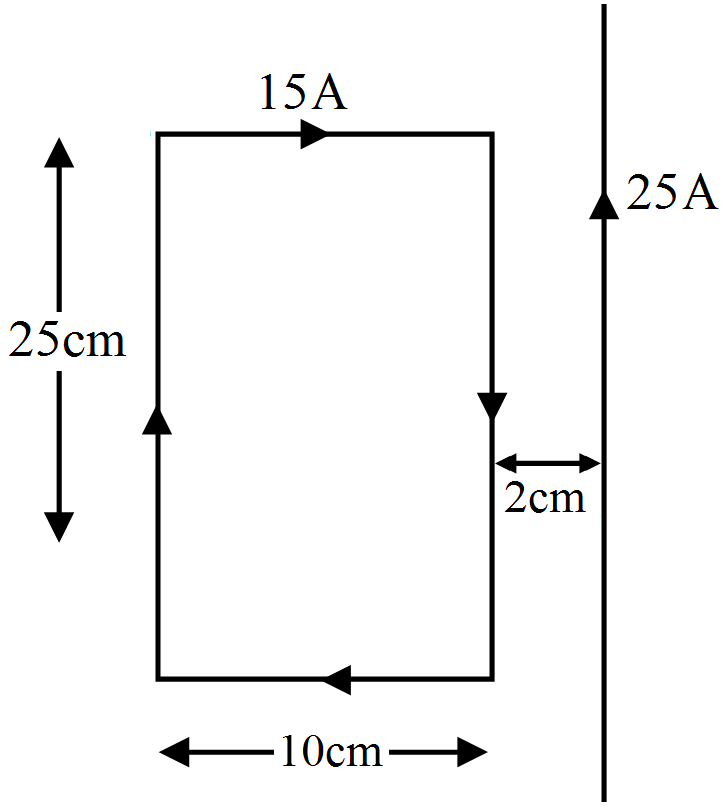
  1. Figure shows a rectangular current-carrying loop placed 2cm away from a long, straight, current-carrying conductor. What is the direction and magnitude of the net force acting on the loop?
Find the energy, the frequency and the momentum of an X-ray photon of wavelength 0.10nm.
A thin prism of crown glass $(\mu_\text{r}=1.515,\mu_\text{v}=1.525)$ and a thin prism of flint glass $(\mu_\text{r}=1.612,\mu_\text{v}=1.632)$ are placed in contact with each other. Their refracting angles are 5.0° each and are similarly directed. Calculate the angular dispersion produced by the combination.
The band gap for silicon is 1.1eV.
  1. Find the ratio of the band gap to kT for silicon at room temperature 300K.
  2. At what temperature does this ratio become one tenth of the value at 300K?
(Silicon will not retain its structure at these high temperatures.)