Question
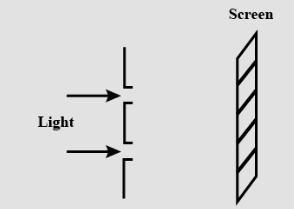
A white light is passed through the two narrow slits and produced a pattern of alternating bright and dark lines on the screen as shown above. What will effects on the central bright band , if the distance between screen and slits are increased?
Answer

  1. Become wider
Explanation:
The setup shown is that of Young's Double Slit Experiment.
The fringe width in the experiment is given as $\beta=\frac{\text{D}\lambda}{\text{d}}​$
where d is the distance between the slits, D is the distance between screen and slits.
Hence the central fringe also widens when distance between screen and slits increases.

Need a full question paper?

Generate a complete, print-ready paper with questions like this in minutes — across 16+ boards, with answer keys.

Start Generating Free

Similar questions

The equation of a light wave is written as $\text{y}=\text{A}\ \sin(\kappa\text{x}-\omega\text{t}).$ Here, y represents:
If a body is negatively charged, then it has.
A bar magnet of magnetic moment M is cut into two parts of equal length. The magnetic moment of either part is :
Two metallic charged spheres whose radii are $20 \ cm$ and $10 \ cm$ respectively, have each $150$ micro $-$ coulomb positive charge. The common potential after they are connected by a conducting wire is
A short-circuited coil is placed in a time-varying magnetic field. Electrical power is dissipated due to the current induced in the coil. If the number of turns were to be quadrupled and the wire radius halved, the electrical power dissipated would be(a) Halved(b) The same(c) Doubled(d) Quadrupled
       
It is easier to start  a car engine on a hot day than on a cold day. This is because the internal resistance of the car battery(a) Decreases with rise in temperature(b) Increases with rise in temperature(c) Decreases with a fall in temperature(d) Does not change with a change in temperature


In an oscillating system, a restoring force is a must. In an L-C circuit, the restoring force is provided by a/ an.
What is the order of magnitude of the resistance of a dry human body?
Consider the points lying on a straight line joining two fixed opposite charges. Between the charges there is (a) No point where electric field is zero(b) Only one point where potential is zero(c) Only one point where electric field is zero(d) a, b


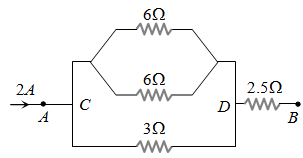
The equivalent resistance and potential difference between $A$ and $B$ for the circuit is respectively