Question
$a.$ Why did Hershey and Chase use radioactive $^{32}P$ and $^{35}S$ in their experiments? Explain.
$b.$ Following the experiments conducted by them, write what conclusion did they arrive at and how.
Answer

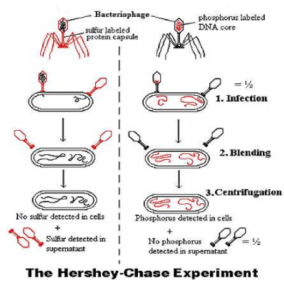
$a.-$ They grew some viruses on a medium that contained radioactive phosphorus and some others on a medium that contained radioactive sulfur.
$-$ Viruses grown in the presence of radioactive phosphorus contained radioactive $ \text{DNA}$ but not radioactive protein because $ \text{DNA}$ contains phosphorus but protein does not.
$-$ Similarly, viruses grown on radioactive sulfur contained radioactive protein but not radioactive $ \text{DNA}$ because $ \text{DNA}$ does not contain sulfur.
$b.$ Conclusion $- \text{DNA}$ is the genetic material.
Experiment:
$-$ Radioactive phages were allowed to attach to $E.$ coli bacteria. Then, as the infection proceeded, the viral coats were removed from the bacteria by agitating them in a blender.
$-$ The virus particles were separated from the bacteria by spinning them in a centrifuge.
$-$ Bacteria that were infected with viruses that had radioactive $ \text{DNA}$ were radioactive, indicating that $ \text{DNA}$ was the material that passed from the virus to the bacteria.
$-$ Bacteria that were infected with viruses that had radioactive proteins were not radioactive. This indicates that proteins did not enter the bacteria from the viruses.
$-$ $ \text{DNA}$ is, therefore, the genetic material that is passed from virus to bacteria. Bacteria which were infected with viruses having radioactive $ \text{DNA}$ $(^{32}P)$ were found to be radioactive, indicating that $ \text{DNA}$ was the material that passed from the virus to bacterium.
Image

Need a full question paper?

Generate a complete, print-ready paper with questions like this in minutes — across 16+ boards, with answer keys.

Start Generating Free