Questions

5 Marks Questions

🎯

Test yourself on this topic

6 questions · timed · auto-graded

Question 15 Marks
Answer the following questions with respect to recombinant DNA technology:
i. Why is plasmid considered to be an important tool in rDNA technology? From where can plasmids be isolated? (Any two sources)
ii. Explain the role of ori and selectable marker in a cloning vector.
iii. r-DNA technology cannot proceed without restriction endonuclease. Justify.
Answer
i. Plasmid considered to be an important tool in rDNA technology as it can act as vector/can self-replicate to form multiple copies/have selectable markers/ small in size will facilitate insertion/presence of 'Ori'- E. coli, Agrobacterium tumefaciens, Salmonella typhi, Bacteria.
ii. Role of 'Ori'- this is a sequence from where replication starts/any piece of DNA when linked to this sequence can be made to replicate with in the host cells/controls copy number of linked DNA.
Role of selectable marker helps in identifying and eliminating non-transformants, and selectively permitting the growth of transformants during recombinant DNA technology.
iii. Restriction endonuclease identifies a specific palindromic sequence of DNA and cut the DNA at the specific sites in both the host as well in desired/foreign DNA, thereby creates "sticky ends" facilitating ligation to form a recombinant DNA.
View full question & answer
Question 25 Marks
$a.$ Why did Hershey and Chase use radioactive $^{32}P$ and $^{35}S$ in their experiments? Explain.
$b.$ Following the experiments conducted by them, write what conclusion did they arrive at and how.
Answer
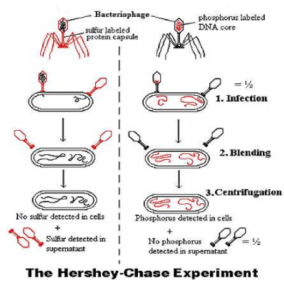
$a.-$ They grew some viruses on a medium that contained radioactive phosphorus and some others on a medium that contained radioactive sulfur.
$-$ Viruses grown in the presence of radioactive phosphorus contained radioactive $ \text{DNA}$ but not radioactive protein because $ \text{DNA}$ contains phosphorus but protein does not.
$-$ Similarly, viruses grown on radioactive sulfur contained radioactive protein but not radioactive $ \text{DNA}$ because $ \text{DNA}$ does not contain sulfur.
$b.$ Conclusion $- \text{DNA}$ is the genetic material.
Experiment:
$-$ Radioactive phages were allowed to attach to $E.$ coli bacteria. Then, as the infection proceeded, the viral coats were removed from the bacteria by agitating them in a blender.
$-$ The virus particles were separated from the bacteria by spinning them in a centrifuge.
$-$ Bacteria that were infected with viruses that had radioactive $ \text{DNA}$ were radioactive, indicating that $ \text{DNA}$ was the material that passed from the virus to the bacteria.
$-$ Bacteria that were infected with viruses that had radioactive proteins were not radioactive. This indicates that proteins did not enter the bacteria from the viruses.
$-$ $ \text{DNA}$ is, therefore, the genetic material that is passed from virus to bacteria. Bacteria which were infected with viruses having radioactive $ \text{DNA}$ $(^{32}P)$ were found to be radioactive, indicating that $ \text{DNA}$ was the material that passed from the virus to bacterium.
Image
View full question & answer
Question 35 Marks
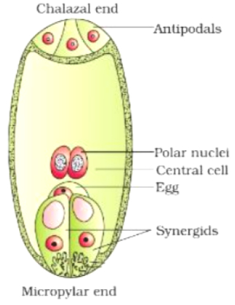
i. Describe the arrangement of nuclei and cells in a mature embryo sac of a typical angiosperm.
ii. Explain the devices the flowering plants have developed to prevent the following types of pollination:
1. Prevents both autogamy and geitonogamy
2. Prevents autogamy, but not geitonogamy
Answer
i. A typical mature embryo sac of Angiosperms is a 7-celled and 8-nucleate structure.
(i) At the micropylar end, an egg apparatus is present which consists of an egg cell and 2 synergid cells. Synergids contain filiform apparatus which guides the pollen tube entry into the embryo sac during fertilisation.
(ii) At the chalazal end, three antipodal cells are present.
(iii) In the centre, two polar nuclei are present which get fused prior to fertilisation to form a diploid secondary nucleus.
Hence, 8 nuclei are constituted within 7 cells. Thus, embryo sac is 7-celled and 8-nucleate.
Image
ii. 1. Male and Female flowers are present on different plants (dioecy)/ Self incompatibility
2. Production of unisexual flowers by the plant/ both male and female flowers are present on the same plant/Monoecious / non synchronization of pollen release and stigma receptivity/Anther and stigma are placed at different positions (Herkogamy)

View full question & answer
Question 45 Marks
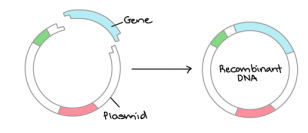
A vector is a way to take a sequence of DNA, usually, and introduce it into another place. So what vectors do is allow you to propagate the DNA you're interested in, in the organism you've chosen to propagate it in. So the simplest one is the origins of recombinant DNA technology: They made copies of RNAs, and they were able to insert these into what is known as plasmids.
Image
Unless the vector and source DNA are cut, fragments separated and joined, the desired recombinant vector molecule cannot be created.
i. How are the desirable DNA sequences cut?
ii. Explain the technique used to separate the cut fragments.
iii. How are the resultant fragments joined to the vector DNA molecule?
Answer
i. The desirable DNA sequences are cut by using resriction endonuclease enzyme. These enzymes cut at specific palindromic sites, between same two bases on both the strands.
ii. DNA fragments formed by the use of restriction endonucleases are separated by gel electrophoresis.
a. DNA fragments are negatively charged molecules Thus, they move towards the anode under electric field through the gel medium.
b. DNA fragments separate according to their size due to sieving effect of agarose gel.
c. The separated DNA fragments can be viewed by staining the DNA with ethidium bromide followed by exposure to UV radiation
d. The separated bands of DNA are cut and extracted from gel piece. This is known as elution.
iii. The resulting fragments are joined together with vector DNA by DNA ligase enzyme. It forms phosphodiester bonds between them.
View full question & answer
Question 55 Marks
$a.$ How did Meselson and Stahl reach the conclusion that $ \text{DNA}$ replication is semi$-$conservative while working with $E.$ coli in their experiment?
$b.$ Explain the contribution of Taylor and his colleagues in $ \text{DNA}$ replication in flowering plants.
Answer
$a.$ Matthew Meselson and Franklin Stahl performed the following experiment in $1958:$ they grew $E.$ coli in a medium containing $^{15}NH_4Cl$ as the only nitrogen source for many generations, $^{15}N$ was incorporated into newly synthesised $ \text{DNA}$ heavy $ \text{DNA}$ molecule could be distinguished from the normal $ \text{DNA}$ by centrifugation in a cesium chloride $(CsCl)$ density gradient, transferred the cells into a medium with normal $^{14}NH_4Cl,$ took samples at various definite time intervals $/20$ minutes, samples were separated independently on $CsCl$ gradients to measure the densities of $ \text{DNA}$ looking at the positions according to their respective densities of $^{15} \ \text{N DNA},^{14} \ \text{N DNA} $ and hybrid $(^{15} \ \text {N DNA} - ^{14} \ \text{N DNA})$ in the centrifuge tubes they reached their conclusion.
$b.$ Taylor and his colleagues worked on Vicia faba /faba beans, using radioactive thymidine to prove that $ \text{DNA}$ in the chromosomes also replicates semi conservatively.
View full question & answer
Question 65 Marks
Vivipary automatically limits the number of offsprings in a litter. How?
Answer
Viviparity is a condition that is presented in both animals and plants. In the case of animals; viviparity means an animal gives birth to young ones. In case of plants, viviparity means germination of the embryo on the plant itself; without the normal sequence of development of the seed. Viviparity involves too much drain of resources on the mother. In case of animals; a female has to constantly supply the nutrients and oxygen to the growing foetus if the foetus developing in the womb. Enough resources are not available to support a large litter and hence viviparity automatically limits the number of offsprings in a litter. This is true in the case of plants also because a germinating embryo on the plant would require resources from the mother plant.
View full question & answer
5 Marks Questions - BIOLOGY STD 12 Science Questions - Vidyadip