MCQ
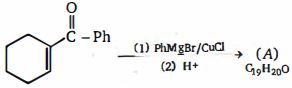
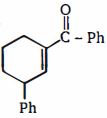
$A$ will be
- A
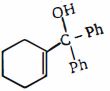
- ✓
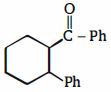
- C
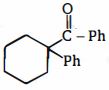
- D

Generate a complete, print-ready paper with questions like this in minutes — across 16+ boards, with answer keys.
| List-I (Complex)} | List-II (Hybridisation of central metal ion) |
| (A) $\left[\mathrm{CoF}_{6}\right]^{3-}$ | (I) $ d^2 sp ^3$ |
| (B) $\left[\mathrm{NiCl}_{4}\right]^{2}$ | (II) $sp ^3$ |
| (C) $\left[\mathrm{Co}\left(\mathrm{NH}_{3}\right)_{6}\right]^{3+}$ | (III) $ sp ^3 d^2$ |
| (D) $\left[\mathrm{Ni}(\mathrm{CN})_{4}\right]^{2-}$ | (IV) $dsp ^2$ |
Method $1\,:\,$ $RBr\xrightarrow[diethyl\,\,ether]{Mg}RMgBr\xrightarrow[2.\,{{H}_{3}}{{O}^{+}}]{1.\,C{{O}_{2}}}RC{{O}_{2}}H$
Method $2\,:\,$ $RBr\xrightarrow{NaCN}RCN\xrightarrow[heat]{{{H}_{2}}O,HCl}RC{{O}_{2}}H$
Which one of the following statements correctly describes this conversion ?
$2NO_2(g) + O_3(g) \to N_2O_5(g) + O_2(g)$
rate law is $R = K\, [NO_2]' [O_3]'$.
Which of these possible reaction mechanisms is consistent with the rate law?
Mechanism $I :$
$NO_2(g) + O_3(g) \to NO_3(g) + O_2(g)$ (slow)
$NO_3(g) + NO_2(g) \to N_2O_5(g)$ (fast)
Mechanism $II :$
$O_3(g) \rightleftharpoons O_2(g) + [O]$ (fast)
$NO_2(g) + [O] \to NO_3$ (slow)
$NO_3(g) + NO_2(g) \to N_2O_5$ (fast)