A wire $100\,cm$ long and $2.0\,mm$ diameter has a resistance of $0.7\, ohm$, the electrical resistivity of the material is ...........$ \times {10^{ - 6}}\,ohm \times m$
Easy


Download our appand get started for free
Experience the future of education. Simply download our apps or reach out to us for more information. Let's shape the future of learning together!No signup needed.*
Similar Questions
- 1Current of $4.8\,A$ is flowing through a conductor. The number of electrons per second will beView Solution
- 2A flow of $10^{7}$ electrons per second in a conducting wire constitutes a current ofView Solution
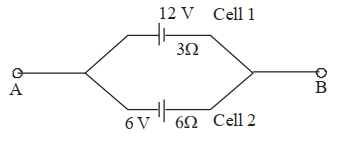
- 3Two cells are connected between points $A$ and $B$ as shown. Cell $1$ has emf of $12\,V$ and internal resistance of $3\,\Omega$. Cell $2$ has emf of $6\,V$ and internal resistance of $6\,\Omega$. An external resistor $R$ of $4\,\Omega$ is connected across $A$ and $B$. The current flowing through $R$ will be $.............A$.View Solution
- 4View SolutionWhen the length and area of cross-section both are doubled, then its resistance
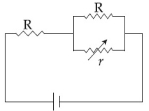
- 5In the circuit shown, the resistance $r$ is a variable resistance. If for $r = fR,$ the heat generation in $r$ is maximum then the value of $f$ isView Solution
- 6A cell of negligible resistance and $e.m.f.$ $2$ $volts$ is connected to series combination of $2$, $3$ and $5\, ohm$. The potential difference in volts between the terminals of $3\, ohm$ resistance will beView Solution
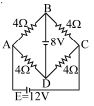
- 7The given figure shows $a$ network of resistances and $a$ battery. Which of the two batteries is getting charged?View Solution
- 8The temperature coefficient of resistance of tungsten is $4.5 \times 10^{-3}{ }^{\circ} C ^{-1}$ and that of germanium is $-5 \times 10^{-2}{ }^{\circ} C ^{-1}$. A tungsten wire of resistance $100 \,\Omega$ is connected in series with a germanium wire of resistance $R$. The value of $R$ for which the resistance of combination does not change with temperature is .......... $\Omega$View Solution
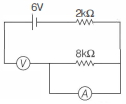
- 9In the circuit shown below, a student performing Ohm's law experiment accidently puts the voltmeter and the ammeter as shown in the circuit below. The reading in the voltmeter will be close to .......... $V$View Solution
- 10What amount of heat will be generated in a coil of resistance $R$ due to a charge $q$ passing through it if the current in the coil decreases to zero uniformly during a time interval $\Delta t$View Solution