A wire in the form of a circular loop of one turn carrying a current produces a magnetic field $B$ at the centre. If the same wire is looped into a coil of two turns and carries the same current, the new value of magnetic induction at the centre is
AIPMT 2002, Medium
Download our app for free and get started
(d) $B' = {n^2}B = {(2)^2}B = 4B$

Download our appand get started for free
Experience the future of education. Simply download our apps or reach out to us for more information. Let's shape the future of learning together!No signup needed.*
Similar Questions
- 1View SolutionIf the direction of the initial velocity of the charged particle is neither along nor perpendicular to that of the magnetic field, then the orbit will be
- 2A thin circular wire carrying a current $I$ has a magnetic moment $M$. The shape of the wire is changed to a square and it carries the same current. It will have a magnetic momentView Solution
- 3A circular coil having $N$ $turns$ is made from a wire of length $L$ $meter$. If a current $I$ $ampere$ is passed through it and is placed in a magnetic field of $B$ $Tesla$, the maximum torque on it isView Solution
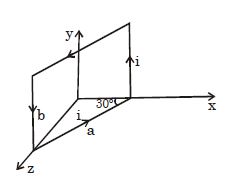
- 4Current $'i'$ is flowing in the rectangular loop placed in the $xyz$ plane as shown in the figure. Find the magnetic moment of the loopView Solution
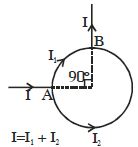
- 5A current $I$ enters a circular coil of radius $R$, branches into two parts and then recombines as shown in the circuit diagram. The resultant magnetic field at the centre of the coil isView Solution
- 6In a circuit for finding the resistance of a galvanometer by half deflection method, a $6\,V$ battery and a high resistance of $11\,k\Omega $ are used. The figure of merit of the galvanometer $60\,\mu A/$ division. In the absence of shunt resistance, the galvanometer produces a deflection of $\theta = 9$ divisions when current flows in the circuit. The value of the shunt resistance that can cause the deflection of $\theta /2 ,$ is closest to .................. $\Omega$View Solution
- 7View SolutionAn electron is travelling horizontally towards east. A magnetic field in vertically downward direction exerts a force on the electron along
- 8An electron, a proton and an alpha particle having the same kinetic energy are moving in circular orbits of radii $r_e,r_p$ and ${r_\alpha }$ respectively in a uniform magnetic field $B$. The relation between $r_e,r_p$ and $\;{r_\alpha }$ isView Solution
- 9View SolutionThe magnetic field near a current carrying conductor is given by
- 10View SolutionA charged particle is projected in a plane perpendicular to a uniform magnetic field. The area bounded by the path described by the particle is proportional to