Question
A wire-loop confined in a plane is rotated in its own plane with some angular velocity. A uniform magnetic field exists in the region. Find the emf induced in the loop.

Answer

$\text{i}=\text{v}(\text{B}\times\text{l})$
$=\text{vBl}\cos\theta$
$\theta$ is angle between normal to plane and $\vec{\text{B}}=90^{\circ}$
$=\text{vBl}\cos90^{\circ}=0.$

Need a full question paper?

Generate a complete, print-ready paper with questions like this in minutes — across 16+ boards, with answer keys.
Start Generating Free

Similar questions

A charged particle oscillates about its mean (equilibrium) position with a frequency of $10^9Hz.$ What is the frequency of the electromagnetic waves produced by the oscillator?
A spherical surface of radius 30cm separates two transparent media A and B with refractive indices 1.33 and 1.48 respectively. The medium A is on the convex side of the surface. Where should a point object be placed in medium A so that the paraxial rays become parallel after refraction at the surface?
A bob suspended from the ceiling of a car which is accelerating on a horizontal road. The bob stays at rest with respect to the car with the string making an angle $\theta$ with the vertical. The linear momentum of the bob as seen from the road is increasing with time. Is it a violation of conservation of linear momentum? If not, where is the external force which changes the linear momentum?
In a resonance column experiment, a tuning fork of frequency 400Hz is used. The first resonance is observed when the air column has a length of 20.0cm and the second resonance is observed when the air column has a length of 62.0cm.
  1. Find the speed of sound in air.
  2. How much distance above the open end does the pressure node form?
A person is painting his house walls. He stands on a ladder with a bucket containing paint in one hand and a brush in other. Suddenly the bucket slips from his hand and falls down on the floor. If the bucket with the paint had a mass of 6.0kg and was at a height of 2.0m at the time it slipped, how much gravitational potential energy is lost together with the paint?
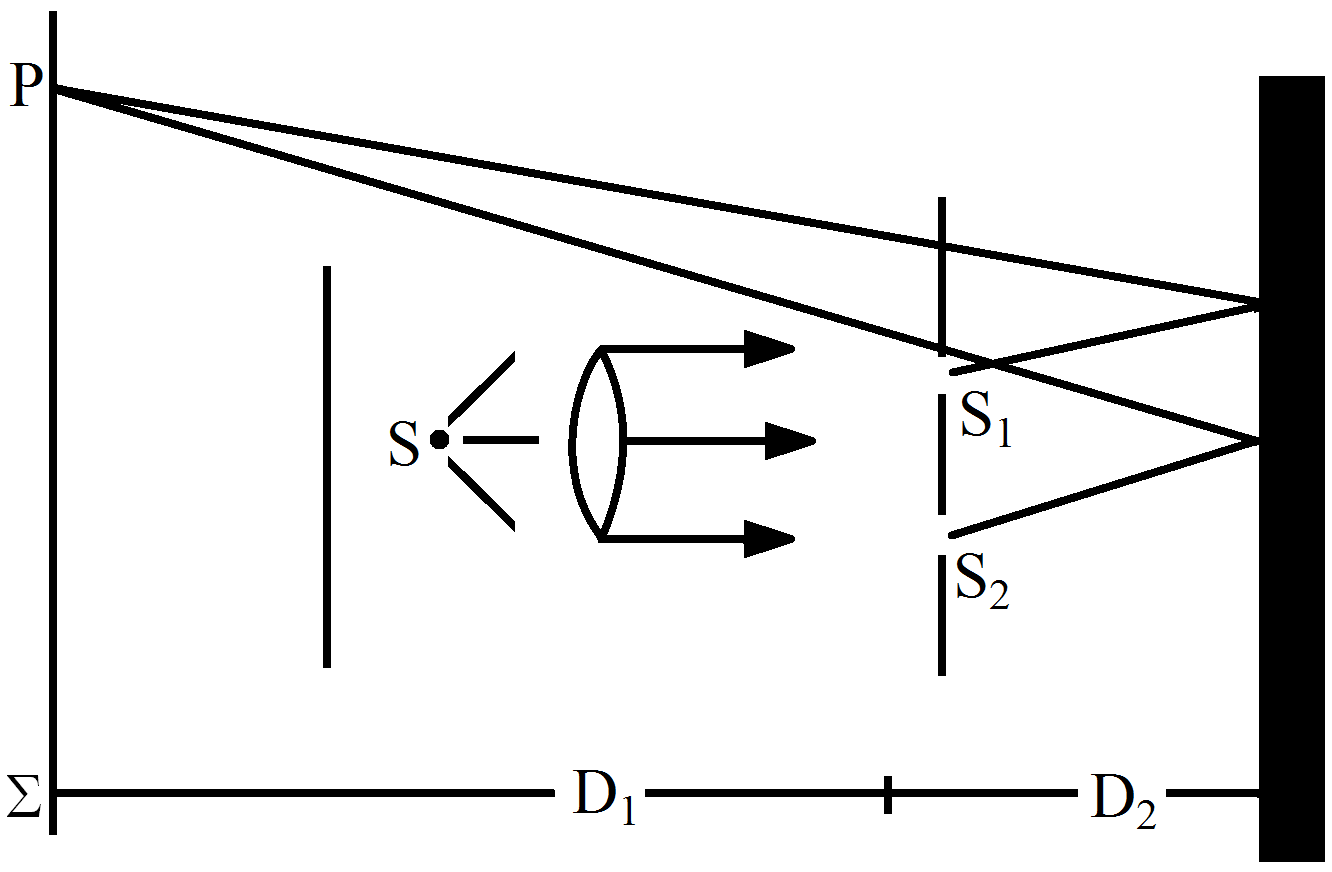
A double slit $S_1-S_2$ is illuminated by a coherent light of wavelength $\lambda$. The slits are separated by a distance $d$. A plane mirror is placed in front of the double slit at a distance $D_1$ from it and a screen $\sum$ is placed behind the double slit at a distance $D_2$ from it (figure $17-E_2$ ). The screen E receives only the light reflected by the mirror. Find the fringe-width of the interference pattern on the screen.
Derive $D_m=A\left(n_{21}-1\right)$ for thin lens.
A smooth block loosely fits in a circular tube placed on a horizontal surface. The block moves in a uniform circular motion along the tube (figure). Which wall (inner or outer) will exert a nonzero normal contact force on the block?
Is it true that the reaction of a gravitational force is always gravitational, of an electromagnetic force is always electromagnetic and so on?
Let $\overrightarrow{\text{A}}=5\vec{\text{i}}-4\vec{\text{j}}$ and $\overrightarrow{\text{B}}=-7.5\vec{\text{i}}+6\vec{\text{j}}.$
  1. Do we have $\overrightarrow{\text{B}}\text{k}\vec{\text{A}}?$
  2. Can we say $\frac{\overrightarrow{\text{B}}}{\overrightarrow{\text{A}}}=\text{k}?$