Question
Let $\overrightarrow{\text{A}}=5\vec{\text{i}}-4\vec{\text{j}}$ and $\overrightarrow{\text{B}}=-7.5\vec{\text{i}}+6\vec{\text{j}}.$
  1. Do we have $\overrightarrow{\text{B}}\text{k}\vec{\text{A}}?$
  2. Can we say $\frac{\overrightarrow{\text{B}}}{\overrightarrow{\text{A}}}=\text{k}?$
Answer

  1. yes, If you multiply (-1.5) to A you get B
⇒ B = -1.5A
  1. But that doesn’t mean $-1.5=\frac{\text{B}}{\text{A}},$ Because division of a vector with another vector is not defined.

Need a full question paper?

Generate a complete, print-ready paper with questions like this in minutes — across 16+ boards, with answer keys.

Start Generating Free

Similar questions

Explain the refraction by two transparent spherically curved surface.
Can virtual image be formed on the retina in a seeing process?
Think over the experiment number 2 of Faraday and Henry and tell :
(a) What will you do to obtain more deflection in the galvanometer?
(b) How will you show the presence of current in the absence of a galvanometer?
Find the electric force between two protons separated by a distance of 1 fermi (1 fermi $= 10^{-15}$m). The protons in a nucleus remain at a separation of this order.
From what it can be said that the electric charge on any object is always an integral multiple of 'e' ?
When vs potential difference is applied across a wire of length 0.1 m , the drift speed of electrons is $2.5 \times 10^{-4} \mathrm{~m} / \mathrm{s}$. If the electron density in the wire is $8 \times 10^{28} \mathrm{m}^{-3}$, calculate the resistivity of the material of wire.
An electric dipole of length 2 cm, when placed with its axis making an angle of $60^\circ$with a uniform electric field, experiences a torque of $8\sqrt{3}$ Nm. Calculate the potential energy of the dipole, if it has a charge of $\pm4\text{nC}.$
Explain the proof of validity of Einstein's equation of photoelectric effect.
Give explanation about polaroid and its passaxis, and give uses of the polaroid.
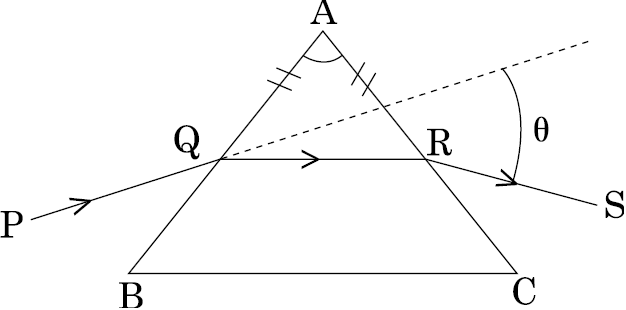
A ray PQ incident on the refracting face BA is refracted in the prism BAC as shown in the figure and emerges from the other refracting face AC as RS such that AQ = AR. If the angle of prism $A = 60^\circ$ and refractive index of material of prism is$\sqrt{3}$, calculate angle $\theta.$