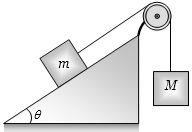
A wire of $9.8 \times {10^{ - 3}}kg{m^{ - 1}}$ passes over a frictionless light pulley fixed on the top of a frictionless inclined plane which makes an angle of $30°$ with the horizontal. Masses $m$ and $M$ are tied at the two ends of wire such that $m$ rests on the plane and $M$ hangs freely vertically downwards. The entire system is in equilibrium and a transverse wave propagates along the wire with a velocity of $100 ms^{-1}$. Chose the correct option $m =$ ..... $kg$
Diffcult
Download our app for free and get started
(a) $v = \sqrt {\frac{T}{\mu }} $
For equilibrium $Mg = mg \,sin 30 = T$
==> $M = \frac{m}{2}$==> $100 = \sqrt {\frac{{Mg}}{{9.8 \times {{10}^{ - 3}}}}} = \sqrt {\frac{{M(9.8)}}{{9.8 \times {{10}^{ - 3}}}}} $
==> $100 = \sqrt {M(1000)} $ ==> $M = 10kg$ and $m = 20kg$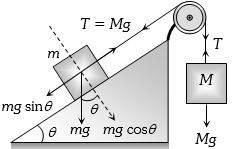

Download our appand get started for free
Experience the future of education. Simply download our apps or reach out to us for more information. Let's shape the future of learning together!No signup needed.*
Similar Questions
- 1Sound wave travels with a velocity of $300\, m\, s^{-1}$ through a gas. $9\, beats$ are produced in $3\, s$ when two waves pass through it simultaneously. If one of the waves has $2\, m$ wavelength, the wavelength of the other wave is ..... $m$View Solution
- 2The vibrations of a string of length $60\, cm$ fixed at both the ends are represented by the equation $y = 2\,\sin \,\left( {\frac{{4\pi x}}{{15}}} \right)\,\cos \,\left( {96\pi t} \right)$ where $x$ and $y$ are in $cm$. The maximum number of loops that can be formed in it isView Solution
- 3A source of frequency $\nu$ gives $5$ beats/second when sounded with a source of frequency $200 \;Hz$. The second harmonic of frequency $2\nu$ of source gives $10$ beats/second when sounded with a source of frequency $420\; Hz$. The value of $v$ is .... $Hz$View Solution
- 4A train moving at a speed of $220\,\, m s^{-1}$ towards a stationary object, emits a sound of frequency $1000\,\, Hz.$ Some of the sound reaching the object gets reflected back to the train as echo. The frequency of the echo as detected by the driver of the train is ...... $Hz$View Solution
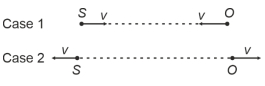
(Speed of sound in air is $330 \,\, m s^{-1}$) - 5A source $(S)$ of sound has frequency $240 \ Hz$. When the observer $(O)$ and the source move towards each other at a speed $v$ with respect to the ground (as shown in Case $1$ in the figure), the observer measures the frequency of the sound to be $288 \ Hz$. However, when the observer and the source move away from each other at the same speed $v$ with respect to the ground (as shown in Case $2$ in the figure), the observer measures the frequency of sound to be $n Hz$. The value of $n$ is. . . . . .View Solution
- 6A point source emits sound equally in all directions in a non-absorbing medium, Two points $P$ and $Q $ are at distance of $2m$ and $3m$ respectively from the source. The ratio of the intensities of the waves at $P$ and $ Q$ isView Solution
- 7If the velocity of sound in air is $350 m/s$. Then the fundamental frequency of an open organ pipe of length $50\,cm,$ will be ............... $\mathrm{Hz}$View Solution
- 8A whistle of frequency $500 Hz$ tied to the end of a string of length $1.2 m$ revolves at $400 \,rev/min$. A listener standing some distance away in the plane of rotation of whistle hears frequencies in the range (speed of sound $= 340 m/s$)View Solution
- 9View SolutionStanding stationary waves can be obtained in an air column even if the interfering waves are
- 10A man is watching two trains, one leaving and the other coming in with equal speeds of $4\, m/sec$. If they sound their whistles, each of frequency $240 Hz$, the number of beats heard by the man (velocity of sound in air $= 320 m/sec$) will be equal toView Solution