MCQ
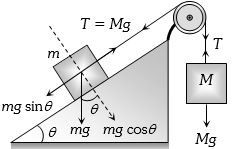
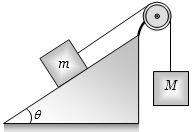
A wire of $9.8 \times {10^{ - 3}}kg{m^{ - 1}}$ passes over a frictionless light pulley fixed on the top of a frictionless inclined plane which makes an angle of $30°$ with the horizontal. Masses $m$ and $M$ are tied at the two ends of wire such that $m$ rests on the plane and $M$ hangs freely vertically downwards. The entire system is in equilibrium and a transverse wave propagates along the wire with a velocity of $100 ms^{-1}$. Chose the correct option $m =$ ..... $kg$
  • $20$
  • B
    $5$
  • C
    $ 2$
  • D
    $ 7$

Answer

Correct option: A.
$20$
a
(a) $v = \sqrt {\frac{T}{\mu }} $ 

For equilibrium $Mg = mg \,sin 30 = T$ 

==> $M = \frac{m}{2}$==> $100 = \sqrt {\frac{{Mg}}{{9.8 \times {{10}^{ - 3}}}}} = \sqrt {\frac{{M(9.8)}}{{9.8 \times {{10}^{ - 3}}}}} $ 

==> $100 = \sqrt {M(1000)} $ ==> $M = 10kg$ and $m = 20kg$

Need a full question paper?

Generate a complete, print-ready paper with questions like this in minutes — across 16+ boards, with answer keys.

Start Generating Free

Similar questions

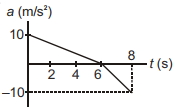
The acceleration-time graph for a particle moving along $x$-axis is shown in figure. If the initial velocity of particle is $-5 \,m / s$, the velocity at $t=8 \,s$ is ....... $m / s$
The angular velocity of the engine $($and hence of the wheel$)$ of a scooter is proportional to the petrol input per second. The scooter is moving on a frictionless road with uniform velocity. If the petrol input is increased by $10\%, $the linear velocity of the scooter is increased by:
A body $A$ of mass $\mathrm{m}$ is moving in a circular orbit of radius $\mathrm{R}$ about a planet. Another body $\mathrm{B}$ of mass $\frac{\mathrm{m}}{2}$ collides with $\mathrm{A}$ with a velocity which is half $\left(\frac{\overrightarrow{\mathrm{v}}}{2}\right)$ the instantaneous velocity $\overrightarrow{\mathrm{v}}$ of $\mathrm{A}$ The collision is completely inelastic. Then, the combined body
If radius of earth becomes $n$ times its present value, without change in mass, then duration of day becomes
Ideal mono-atomic gas is taken through process such that $dQ= 3dU.$ The molar heat capacity for this process is
Match List-$I$ with List-$II$ :

List-$I$ List-$II$
$(A)$  A force thatrestores anelastic body of unit area to its original state $(I)$ Bulkmodulus
$(B)$  Two equal andopposite forcesparallel toopposite faces $(II)$Young'smodulus
$(C)$Forcesperpendiculareverywhere tothe surface perunit areasameeverywhere $(III)$ Stress
$(D)$Two equal andopposite forceperpendicular toopposite faces $(IV)$ Shearmodulus

Choose the correct answer from the options given below:

A compass needle which is allowed to move in a horizontal plane is taken to a geomagnetic pole. It:
Match List $I$ with List $II$.

  List $I$   List $II$
$(A)$ Torque $(I)$ $Nms^{-1}$
$(B)$ Stress $(II)$ $J\,kg^{-1}$
$(C)$ Latent Heat $(III)$ $Nm$
$(D)$ Power $(IV)$ $Nm^{-2}$

Choose the correct answer from the options below.

Diatomic molecule $($rigid rotator$)$ has:
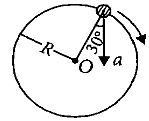
In the given figure, $a = 15 \,m s^{- 2}$ represents the total acceleration of a particle moving in the clockwise direction in a circle of radius $R = 2.5\, m$ at a given instant of  time. The speed of the particle is ........ $m/s$