A wire of area of cross-section ${10^{ - 6}}{m^2}$ is increased in length by $0.1\%$. The tension produced is $1000 N$. The Young's modulus of wire is
Medium
Download our app for free and get started
(a) $Y = \frac{{FL}}{{Al}} = \frac{{1000 \times 100}}{{{{10}^{ - 6}} \times 0.1}} = {10^{12}}N/{m^2}$

Download our appand get started for free
Experience the future of education. Simply download our apps or reach out to us for more information. Let's shape the future of learning together!No signup needed.*
Similar Questions
- 1Two wires $‘A’$ and $‘B’$ of the same material have radii in the ratio $2 : 1$ and lengths in the ratio $4 : 1$. The ratio of the normal forces required to produce the same change in the lengths of these two wires isView Solution
- 2An increases in pressure required to decreases the $200\,litres$ volume of a liquid by $0.004\%$ in container is ............ $kPa$ (Bulk modulus of the liquid $= 2100\,MPa$ )View Solution
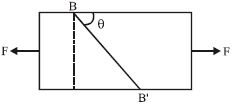
- 3A bar of cross-sectional area $A$ is subjected two equal and opposite tensile forces at its ends as shown in figure. Consider a plane $BB'$ making an angle $\theta $ with the length The ratio of tensile stress to the shearing stress on the plane $BB'$ isView Solution
- 4View SolutionThe isothermal bulk modulus of a gas at atmospheric pressure is
- 5The stress-strain curves are drawn for two different materials $X$ and $Y$. It is observed that the ultimate strength point and the fracture point are close to each other for material $X$ but are far apart for material $Y$. We can say that materials $X$ and $Y$ are likely to be (respectively)View Solution
- 6Two separate wires $A$ and $B$ are stretched by $2 \,mm$ and $4\, mm$ respectively, when they are subjected to a force of $2\, N$. Assume that both the wires are made up of same material and the radius of wire $B$ is 4 times that of the radius of wire $A$. The length of the wires $A$ and $B$ are in the ratio of $a : b$. Then $a / b$ can be expressed as $1 / x$ where $x$ isView Solution
- 7Under the same load, wire $A$ having length $5.0\,m$ and cross section $2.5 \times 10^{-5}\,m ^2$ stretches uniformly by the same amount as another wire $B$ of length $6.0\,m$ and a cross section of $3.0 \times 10^{-5}\,m ^2$ stretches. The ratio of the Young's modulus of wire $A$ to that of wire $B$ will beView Solution
- 8The Young's modulus of a wire is $Y.$ If the energy per unit volume is $E$, then the strain will beView Solution
- 9View SolutionThe Poisson's ratio cannot have the value
- 10The upper end of a wire of diameter $12\,mm$ and length $1\,m$ is clamped and its other end is twisted through an angle of $30^{\circ}$. The angle of shear is$........^{\circ}$View Solution