A wire of cross section $4 \;mm^2$ is stretched by $0.1\, mm$ by a certain weight. How far (length) will be wire of same material and length but of area $8 \;mm^2$ stretch under the action of same force......... $mm$
Medium
Download our app for free and get started
(a) $l = \frac{{FL}}{{AY}}$
$l \propto \frac{1}{A}$ $(F,L$ and $Y$ are constant$)$
$\frac{{{l_2}}}{{{l_1}}} = \frac{{{A_1}}}{{{A_2}}} = \frac{4}{8} = \frac{1}{2}$$ \Rightarrow {l_2} = \frac{{{l_1}}}{2} = \frac{{0.1}}{2} = 0.05mm$

Download our appand get started for free
Experience the future of education. Simply download our apps or reach out to us for more information. Let's shape the future of learning together!No signup needed.*
Similar Questions
- 1Which of the following curve represents the correctly distribution of elongation $(y)$ along heavy rod under its own weight $L \rightarrow$ length of rod, $x \rightarrow$ distance of point from lower end?View Solution
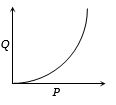
- 2The graph shows the behaviour of a length of wire in the region for which the substance obeys Hook’s law. $P$ and $Q$ representView Solution
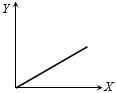
- 3A student plots a graph from his reading on the determination of Young’s modulus of a metal wire but forgets to label. The quantities on $X$ and $Y$ axes may be respectively.View Solution
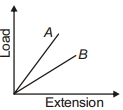
- 4In the given figure, if the dimensions of the two wires are same but materials are different, then Young's modulus is $ ........$View Solution
- 5Two steel wires of same length but radii $r$ and $2r$ are connected together end to end and tied to a wall as shown. The force stretches the combination by $10\ mm$. How far does the midpoint $A$ move ............ $mm$View Solution

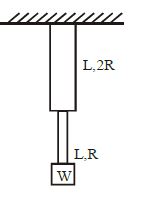
- 6Two wires of the same material (Young's modulus $Y$ ) and same length $L$ but radii $R$ and $2R$ respectively are joined end to end and a weight $W$ is suspended from the combination as shown in the figure. The elastic potential energy in the system isView Solution
- 7A bar is subjected to axial forces as shown. If $E$ is the modulus of elasticity of the bar and $A$ is its crosssection area. Its elongation will beView Solution

- 8An aluminum rod (Young's modulus $ = 7 \times {10^9}\,N/{m^2})$ has a breaking strain of $0.2\%$. The minimum cross-sectional area of the rod in order to support a load of ${10^4}$Newton's isView Solution
- 9View SolutionStress to strain ratio is equivalent to
- 10The length of an iron wire is $L$ and area of cross-section is $A$. The increase in length is $l$ on applying the force $F$ on its two ends. Which of the statement is correctView Solution