Which of the following curve represents the correctly distribution of elongation $(y)$ along heavy rod under its own weight $L \rightarrow$ length of rod, $x \rightarrow$ distance of point from lower end?
Medium
Download our app for free and get started
For elongation of rod under its own weight
We know $\Delta x=\frac{\rho g x^2}{2 Y}$ $\left\{\begin{array}{l}\text { Where, } \\ \Delta x=\text { Elongation } \\ \rho=\text { Density of rod } \\ Y=\text { Young's modulus } \\ L=\text { Length } \\ g=\text { Acceleration due to gravity } \\ x=\text { Distance of point from lower end }\end{array}\right.$
We can clearly see that elongation $\propto\left(x^2\right)$
So graph of $\Delta x$ vs $x$ should be a upward parabola.
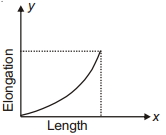
We know $\Delta x=\frac{\rho g x^2}{2 Y}$ $\left\{\begin{array}{l}\text { Where, } \\ \Delta x=\text { Elongation } \\ \rho=\text { Density of rod } \\ Y=\text { Young's modulus } \\ L=\text { Length } \\ g=\text { Acceleration due to gravity } \\ x=\text { Distance of point from lower end }\end{array}\right.$
We can clearly see that elongation $\propto\left(x^2\right)$
So graph of $\Delta x$ vs $x$ should be a upward parabola.

Download our appand get started for free
Experience the future of education. Simply download our apps or reach out to us for more information. Let's shape the future of learning together!No signup needed.*
Similar Questions
- 1The Young's modulus of a rubber string $8\, cm$ long and density $1.5\,kg/{m^3}$ is $5 \times {10^8}\,N/{m^2}$, is suspended on the ceiling in a room. The increase in length due to its own weight will beView Solution
- 2A copper solid cube of $60\,\, mm$ side is subjected to a pressure of $2.5 \times 10^7\, Pa$. If the bulk modulus of copper is $1.25 \times 10^{11}\, N/m^2$, the change in the volume of cube isView Solution
- 3$Assertion :$ Hollow shaft is found to be stronger than a solid shaft made of same equal material.View Solution
$Reason :$ Torque required to produce a given twist in hollow cylinder is greater than that required to twist a solid cylinder of same length and material. - 4The area of a cross-section of steel wire is $0.1\,\,cm^2$ and Young's modulus of steel is $2\,\times \,10^{11}\,\,N\,\,m^{-2}.$ The force required to stretch by $0.1\%$ of its length is ......... $N$.View Solution
- 5View SolutionWhich of the following is true for elastic potential energy density
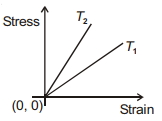
- 6View SolutionFigure shows graph between stress and strain for a uniform wire at two different femperatures. Then
- 7An $8\,m$ long copper wire and $4\,m$ long steel wire, each of cross section $0.5\,cm^2$ are fastened end to end and stretched by $500\,N$ force. The elastic potential energy of the system is (Youngs mod $: Y_{cu}= 1\times 10^{11}\,N/m^2,$ $Y_{steel} = 2\times 10^{11}\,N/m^2$ ) :View Solution
- 8The pressure of a medium is changed from $1.01 × 10^5$ $Pa$ to $1.165 × 10^5$ $Pa$ and change in volume is $10\% $ keeping temperature constant. The Bulk modulus of the medium isView Solution
- 9A sample of a liquid has an initial volume of $1.5\,L$ . The volume is reduced by $0.2\,mL$ , when the pressure increases by $140\,kP$ . What is the bulk modulus of the liquidView Solution
- 10The elastic energy stored in a wire of Young's modulus $Y$ isView Solution