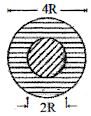
A wire of circular cross section has inner portion of radius $R$ made of material of resisitivity $\rho$ and is surrounded by an outer portion of thickness $R$ made of a material of double resisitivity. Find the resistance of length $l$ of such wire
Medium
Download our app for free and get started
${\rm{R}} = \frac{{{{\rm{R}}_1}{{\rm{R}}_2}}}{{{{\rm{R}}_1} + {{\rm{R}}_2}}} = \frac{{\frac{{\rho \times l}}{{\pi {{\rm{R}}^2}}} \times \frac{{2\rho \times l}}{{\pi \left( {{{(2{\rm{R}})}^2} - {{\rm{R}}^2}} \right)}}}}{{\frac{{\rho l}}{{\pi {{\rm{R}}^2}}} + \frac{{2\rho l}}{{\left( {{{(2{\rm{R}})}^2} - {{\rm{R}}^2}} \right)}}}}$
$\frac{{\frac{{2{p^2}{l^2}}}{{3\pi {{\rm{R}}^4}}}}}{{\frac{{\rho l}}{{\pi {{\rm{R}}^2}}}\left( {1 + \frac{2}{3}} \right)}} = \frac{{2\rho {\rm{l}}}}{{3\pi {{\rm{R}}^2}}} \times \frac{3}{5}$

Download our appand get started for free
Experience the future of education. Simply download our apps or reach out to us for more information. Let's shape the future of learning together!No signup needed.*
Similar Questions
- 1The length of a potentiometer wire is $\ell $. A cell of emf $E$ is balanced at a length $\ell /3$ from the positive end of the wire. If the length of the wire is increased by $\ell /2$ at what distance will the same cell give a balanced pointView Solution
- 2There are $n$ similar conductors each of resistance $R$. The resultant resistance comes out to be $x$ when connected in parallel. If they are connected in series, the resistance comes out to beView Solution
- 3An electric current is passed through a circuit containing two wires of the same material, connected in parallel. If the lengths and radii of the wires are in the ratio of $4/3$ and $2/3$, then the ratio of the currents passing through the wire will beView Solution
- 4A potentiometer wire of length $1\,m$ and resistance $10\,\Omega$ is connected in series with a cell of $emf$ $2\,V$ with internal resistance $1 \,\Omega$ and a resistance box including a resistance $R$. If potential difference between the ends of the wire is $1\, mV$, the value of $R$ is ............. $\Omega $View Solution
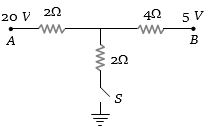
- 5As the switch $S$ is closed in the circuit shown in figure, current passed through it is .................. $A$View Solution
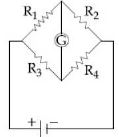
- 6The Wheatstone bridge shown in Fig. here, gets balanced when the carbon resistor used as $R_1$ has the colour code (Orange, Red, Brown). The resistors $R_2$ and $R_4$ are $80\, \Omega $ and $40\,\Omega $, respectively. Assuming that the colour code for the carbon resistors gives their accurate values, the colour code for the carbon resistor, used as $R_3$ would beView Solution
- 7View SolutionThere are three resistance coils of equal resistance. The maximum number of resistances you can obtain by connecting them in any manner you choose, being free to use any number of the coils in any way is
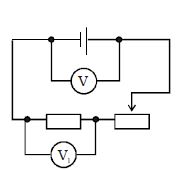
- 8If the rheostat slider were to move from the extreme right to the far left, How will the reading of voltmeter $V_1$ change?View Solution
- 9View SolutionIn the circuit as shown in figure the
- 10The potential difference between $A$ and $B$ in the Figure is ................... $\mathrm{V}$View Solution
