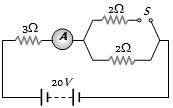
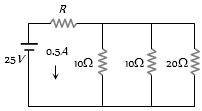
In the circuit as shown in figure the
Medium
Download our app for free and get started
$\frac{1}{{R'}} = \frac{1}{{10}} + \frac{1}{{10}} + \frac{1}{{20}}$$ \Rightarrow R' = \frac{{20}}{5} = 4\;\Omega $
Now using ohm’s law $i = \frac{{25}}{{R + R'}}$$ \Rightarrow 0.5 = \frac{{25}}{{R + 4}}$
$ \Rightarrow R + 4 = \frac{{25}}{{0.5}} = 50$ $ \Rightarrow R = 50 - 4 = 46\;\Omega $
Current through $20\,\Omega $ resistor $ = \frac{{0.5 \times 5}}{{20 + 5}} = \frac{{2.5}}{{25}} = 0.1\,A$
Potential difference across middle resistor
$=$ Potential difference across $20\,\Omega $$ = 20 \times 0.1 = 2\,V$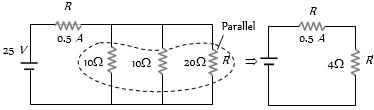

Download our appand get started for free
Experience the future of education. Simply download our apps or reach out to us for more information. Let's shape the future of learning together!No signup needed.*
Similar Questions
- 1A student in a town in India, where the price per unit ( $1$ unit $=1 \,kWh$ ) of electricity is $₹ 5.00$, purchases a $1 \,kVA$ $UPS$ (uninterrupted power supply) battery. A day before the exam, $10$ friends arrive to the student's home with their laptops and all connect their laptops to the $UPS$. Assume that each laptop has a constant power requirement of $90 \,W$. Consider the following statements.View Solution
$I.$ All the $10$ laptops can be powered by the $UPS$, if connected directly.
$II.$ All the $10$ laptops can be powered, if connected using an extension box with a $3 \,A$ fuse.
$III.$ If all the $10$ friends use the laptop for $5 \,h$, then the cost of the consumed electricity is about $₹ 22.50.$
Select the correct option with the true statements.
- 2The Kirchhooff's first law $\left(\sum i=0\right)$ and second law ( $\left.\sum i R=\sum E\right)$, where the symbols have their usual meanings, are respectively based onView Solution
- 3What is the number density of donor atoms which must be added to a pure germanium semiconductor to make $n-$ type semiconductor of conductivity $6.4\ {\Omega ^{ - 1}}\,c{m^{ - 1}}$? The mobility of electr ons in $n-$ type germanium is $4 \times {10^3}\ cm^2\ V^{-1}\ s^{-1}$. Neglect the contribution of holes to conductivityView Solution
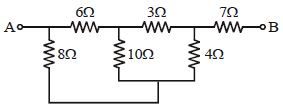
- 4The equivalent resistance between the points $A$ and $B$ is :-View Solution
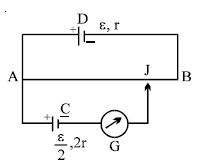
- 5In the figure, the potentiometer wire $AB$ of length $L$ and resistance $9r$ is joined to the cell $D$ of $\mathrm{emf}$ $\varepsilon$ and internal resistance $r$. The cell $C’s$ $\mathrm{emf}$ is $\varepsilon /2$ and its internal resistance is $2r$. The galvanometer $G$ will show no deflection when the length $AJ$ isView Solution
- 6A current of $2\, mA$ was passed through an unknown resistor which dissipated a power of $4.4\, W$. Dissipated power when an ideal power supply of $11\, V$ is connected across it isView Solution
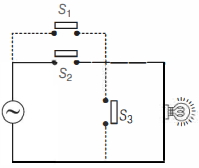
- 7View SolutionConsider the following circuit given below. The bulb will light up, if
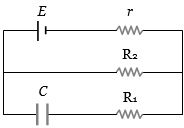
- 8In the given figure each plate of capacitance $C$ has partial value of chargeView Solution
- 9If an electric heater is rated at $1000\, W$, then the time required to heat one litre of water from $20\,^oC$ to $60\,^oC$ isView Solution
- 10In the circuit shown, the reading of ammeter when switch $S$ is open and when switch $S$ is closed respectively areView Solution