A wire of length $10 \mathrm{~cm}$ and radius $\sqrt{7} \times 10^{-4} \mathrm{~m}$ connected across the right gap of a meter bridge. When a resistance of $4.5 \ \Omega$ is connected on the left gap by using a resistance box, the balance length is found to be at $60 \mathrm{~cm}$ from the left end. If the resistivity of the wire is $\mathrm{R} \times 10^{-7} \Omega \mathrm{m}$, then value of $\mathrm{R}$ is :
JEE MAIN 2024, Diffcult
Download our app for free and get started
For null point,
$ \frac{4.5}{60}=\frac{R}{40} $
$ \text { Also, } R=\frac{\rho \ell}{A}=\frac{\rho \ell}{\pi r^2} $
$ 4.5 \times 40=\rho \times \frac{0.1}{\pi \times 7 \times 10^{-8}} \times 60 $
$ \rho=66 \times 10^{-7} \Omega \times \mathrm{m}$

Download our appand get started for free
Experience the future of education. Simply download our apps or reach out to us for more information. Let's shape the future of learning together!No signup needed.*
Similar Questions
- 1Find the number of photons emitted per second from of source of light which results in a photocurrent with drift velocity of $1.5\ m/s$ in a conductor with cross-section area $0.25\ m^2$ , volume density of electrons $10^{20}\ per \ m^3$ , (Assume that $60\%$ of photons emitted result in electron emission)View Solution
- 2$n$ equal cell having emf $E$ and internal resistance $r$, are connected in a circuit of a resistance $R$ . Same current flows in circuit either they are connected in series or parallel, ifView Solution
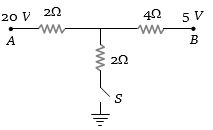
- 3As the switch $S$ is closed in the circuit shown in figure, current passed through it is .................. $A$View Solution
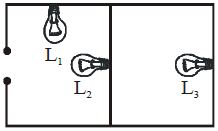
- 4Figure shows three similar lamps $L_1, L_2$ and $L_3$ connected across a power supply. If the lamp $L_3$ fuses, how will the light emitted by $L_1$ and $L_2$ change ?View Solution
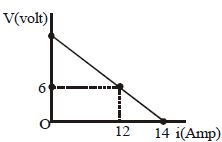
- 5$10\,Cells$, each of emf $'E'$ and internal resistance $'r'$, are connected in series to a variable external resistance. Figure shows the variation of terminal potential difference of their combination with the current drawn from the combination.$Emf$ of each cell is ............. $V$View Solution
- 6If six identical cells each having an $e.m.f.$ of $6\,V$ are connected in parallel, the $e.m.f.$ of the combination is ................ $V$View Solution
- 7View SolutionThe figure shows a network of four resistances and three batteries Which of the battery is getting charged.
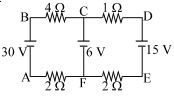
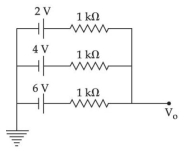
- 8In the given figure, the value of $V_{0}$ will be $.....V$.View Solution
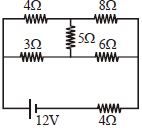
- 9In the given figure the ratio of current in $8\,\Omega $ and $3\,\Omega $ will beView Solution
- 10A $60\, watt$ bulb carries a current of $0.5\, amp$. The total charge passing through it in $1$ hour is ............ $coulomb$View Solution