MCQ
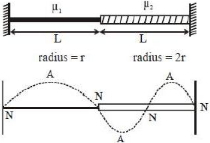
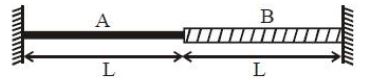
A wire of length $2\,L$ is made by joining two wires $A$ and $B$ of same lengths but different radii $r$ and $2r$ and made of the same material. It is vibrating at a frequency such that the joint of the two wires forms a node. If the number of antinodes in wire $A$ is $p$ and that in $B$ is $q$ then the ratio $p : q$ is
  • A
    $1 : 4$
  • $1 : 2$
  • C
    $3 : 5$
  • D
    $4 : 9$

Answer

Correct option: B.
$1 : 2$
b
Let mass per unit length of wires are $\mu_{1}$ and $\mu_{2}$ respectively.

$\because$ Materials are same, so density $\rho$ is same.

$\mu_{1}=\frac{\rho \pi r^{2} L}{L}=\mu \text { and } \mu_{2}=\frac{\rho 4 \pi r^{2} L}{L}=4 \mu$

Tension in both are same $=\mathrm{T},$ let speed of wave in wires are $V_{1}$ and $V_{2}$

$V_{1}=\frac{V_{1}}{2 L}=\frac{V}{2 L} \& f_{02}=\frac{V_{2}}{2 L}=\frac{V}{4 L}$

Frequency at which both resonate is $L.C.M.$ of both frequencies i.e. $\frac{\mathrm{V}}{2 \mathrm{L}}$

Hence number of loops in wires are $1$ and $2$ respectively

So, ratio of number of antinodes is $1:2$

Need a full question paper?

Generate a complete, print-ready paper with questions like this in minutes — across 16+ boards, with answer keys.

Start Generating Free

Similar questions

Two Carnot engines $A$ and $B$ are operated in succession. The first one, $A$ receives heat from a source at ${T_1} = 800K$ and rejects to sink at ${T_2}K.$. The second engine $B$ receives heat rejected by the first engine and rejects to another sink at ${T_3} = 300K.$ If the work outputs of two engines are equal, then the value of ${T_2}$ is .... $K$
The work done in increasing the size of a soap film from $10 \mathrm{~cm} \times 6 \mathrm{~cm}$ to $10 \mathrm{~cm} \times 11 \mathrm{~cm}$ is $3 \times 10^{-4} \mathrm{~J}$ The surface tension of the film is:
Let $\vec{\text{F}}$ be a force acting on a particle having position vector $\vec{\text{r}}.$ Let $\vec{\tau}$ be the torque of this force about the origin, then:
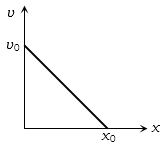
The given graph shows the variation of velocity with displacement. Which one of the graph given below correctly represents the variation of acceleration with displacement
The force required to separate two glass plates of $10^{-2}m^2$ with a film of water $0.05\ mm$ thick between them, is $($surface tension of water is $70 \times 10^{-3} \mathrm{Nm}^{-1}):$
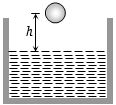
A ball of radius $r $ and density $\rho$ falls freely under gravity through a distance $h$ before entering water. Velocity of ball does not change even on entering water. If viscosity of water is $\eta$, the value of $h$ is given by
Let $\vec{\text{F}}$ be a force acting on a particle having position vector $\vec{\text{r}}.$ Let $\vec{\tau}$ be the torque of this force about the origin, then:
If a vector $\overrightarrow P $ making angles $\alpha, \beta\  and\ \gamma$ respectively with the $X, Y$ and $Z$ axes respectively. Then ${\sin ^2}\alpha + {\sin ^2}\beta + {\sin ^2}\gamma = $
If two soap bubbles of different radii are connected by a tube,
A man can jump to a height of $1.5 \,m$ on a planet $A$. What is the height he may be able to jump on another planet whose density and radius are, respectively, one-quarter and one-third that of planet $A$ .......  $m$