A wire of length $L,$ area of cross section $A$ is hanging from a fixed support. The length of the wire changes to $L_{1}$ when mass $M$ is suspended from its free end. The expression for Young's modulus is
NEET 2020, Easy
Download our app for free and get started
$Y=\frac{F L }{A \Delta L}=\frac{M g L}{A\left(L_{1}-L\right)}$

Download our appand get started for free
Experience the future of education. Simply download our apps or reach out to us for more information. Let's shape the future of learning together!No signup needed.*
Similar Questions
- 1A uniform heavy rod of mass $20\,kg$. Cross sectional area $0.4\,m ^{2}$ and length $20\,m$ is hanging from a fixed support. Neglecting the lateral contraction, the elongation in the rod due to its own weight is $x \times 10^{-9} m$. The value of $x$ isView Solution
(Given. Young's modulus $Y =2 \times 10^{11} Nm ^{-2}$ અને $\left.g=10\, ms ^{-2}\right)$
- 2View SolutionYoung's modulus of elasticity of material depends upon
- 3View SolutionHooke's law is applicable for ....
- 4A steel rod of length $\ell$, cross sectional area $A$, young's modulus of elasticity $Y$, and thermal coefficient of linear expansion $'a'$ is heated so that its temperature increases by $t\,^oC$. Work that can be done by rod on heating will beView Solution
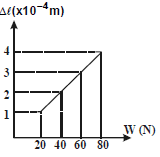
- 5The adjacent graph shows the extension $(\Delta l)$ of a wire of length $1\, m$ suspended from the top of a roof at one end and with a load $W$ connected to the other end. If the cross-sectional area of the wire is $10^{-6}\, m^2$, calculate the Young’s modulus of the material of the wire.View Solution
- 6View SolutionYoung's modulus depends upon
- 7The increase in length is $l$ of a wire of length $L$ by the longitudinal stress. Then the stress is proportional toView Solution
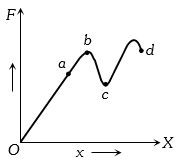
- 8The graph is drawn between the applied force $F$ and the strain $(x)$ for a thin uniform wire. The wire behaves as a liquid in the partView Solution
- 9$Assertion :$ Strain causes the stress in an elastic body.View Solution
$Reason :$ An elastic rubber is more plastic in nature. - 10A bar is subjected to axial forces as shown. If $E$ is the modulus of elasticity of the bar and $A$ is its crosssection area. Its elongation will beView Solution
