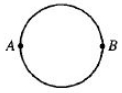
A wire of resistance $12\,ohms$ per meter is bent to form a complete circle of radius $10\, cm.$ The resistance between its two diametrically opposite points, $A$ and $B$ as shown in the figure is
AIPMT 2009, Medium
Download our app for free and get started
Wire of length $2\, \pi \times 0.1\, \mathrm{m}$ of $12 \,\Omega / \mathrm{m}$ is bent to a circle.
Resistance of each part
$=12 \times \pi \times 0.1=1.2\, \pi \,\Omega$
$\therefore \quad$ Resistance between $A$ and $B = 0.6\,\pi \Omega .$

Download our appand get started for free
Experience the future of education. Simply download our apps or reach out to us for more information. Let's shape the future of learning together!No signup needed.*
Similar Questions
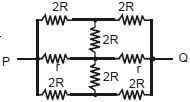
- 1A uniform metallic wire has a resistance of $18\,\Omega $ and is bent into an equilateral triangle. Then, the resistance between any two vertices of the triangle is .................. $\Omega$View Solution
- 2The resistances of a wire at temperatures $t\,^oC$ and $0\,^oC$ are related byView Solution
- 3Two identical heaters rated $220\, volt$, $1000\, watt$ are placed in series with each other across $220 \,volt$ lines. If resistance do not change with temperature, then the combined power is ............. $watt$View Solution
- 4Two electric bulbs marked $25\ W - 220\ V$ and $100\ W - 220\ V$ are connected in series to a $440\ V$ supply. Which of the bulbs will fuse?View Solution
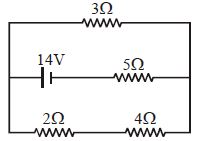
- 5Find out current in $3\,\Omega $ resistance in given circuitView Solution
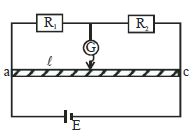
- 6Fig. shows rough sketch of meter bridge. $(G)$ deflects zero at length $l\, cm$. Now $R_1$ and $R_2$ are interchanged then balancing length increases by $25\, cm$. Find $R_1/R_2$View Solution
- 7The $H$ amount of thermal energy is developed by a resistor in $10\,s$ when a current of $4\,A$ is passed through it. If the current is increased to $16\,A$, the thermal energy developed by the resistor in $10\,s$ will be $........\,H$View Solution
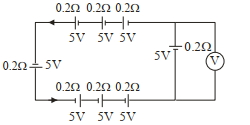
- 8The reading in the ideal voltmeter $(V)$ shown in the given circuit diagram is :View Solution
- 9A strip of copper and another of germanium are cooled from room temperature to $80\, K$. The resistance ofView Solution
- 10The effective resistance between points $P$ and $Q$ of the electrical circuit shown in the figure isView Solution