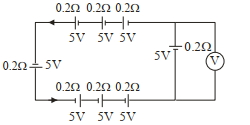
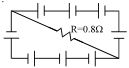
The reading in the ideal voltmeter $(V)$ shown in the given circuit diagram is :
JEE MAIN 2024, Diffcult
Download our app for free and get started
${i}=\frac{\mathrm{E}_{\text {eq }}}{\mathrm{r}_{\text {eq }}}=\frac{8 \times 5}{8 \times 0.2}$
$I=25 \mathrm{~A}$
$V=E-1 \mathrm{r}$
$=5-0.2 \times 25$
$=0$

Download our appand get started for free
Experience the future of education. Simply download our apps or reach out to us for more information. Let's shape the future of learning together!No signup needed.*
Similar Questions
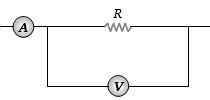
- 1The ammeter $A$ reads $2\, A$ and the voltmeter $V$ reads $20\, V$. the value of resistance $R$ is (Assuming finite resistance's of ammeter and voltmeter)View Solution
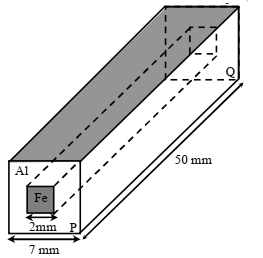
- 2In an aluminium $(A1)$ bar of square cross section, a square hole is drilled and is filled with iron ( $Fe$ ) as shown in the figure. The electrical resistivities of $A 1$ and $Fe$ are $2.7 \times 10^{-8} \ \Omega m$ and $1.0 \times 10^{-7} \ \Omega m$, respectively. The electrical resistance between the two faces $P$ and $Q$ of the composite bar isView Solution
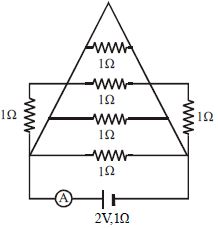
- 3In the circuit shown in Figure the ammeter reads a current ............. $A$View Solution
- 4$\mathrm{A}$ circuit is comprised of eight identical batteries and a resistor $R = 0.8\,\Omega$ . Each battery has an $\mathrm{emf}$ of $1.0\, V$ and internal resistance of $0.2\,\Omega$ . The voltage difference across any of the battery is ............. $V$View Solution
- 5In the given potentiometer circuit length of the wire $AB$ is $3\,m$ and resistance is $R = 4.5 \,\Omega.$ The length $AC$ for no deflection in galvanometer is ................ $\mathrm{m}$View Solution
- 6View SolutionConductivity increases in the order of
- 7In order to increase the resistance of a given wire of uniform cross section to four times its value, a fraction of its length is stretched uniformly till the full length of the wire becomes $\frac{3}{2}$ times the original length what is the value of this fraction?View Solution
- 8Two bulbs of $500\, watt$ and $200\, watt$ are manufactured to operate on $220\, volt$ line. The ratio of heat produced in $500\, W$ and $200\, W$, in two cases, when firstly they are joined in parallel and secondly in series, will beView Solution
- 9Two resistances ${R_1}$ and ${R_2}$ are made of different materials. The temperature coefficient of the material of ${R_1}$ is $\alpha $ and of the material of ${R_2}$ is $ - \beta $. The resistance of the series combination of ${R_1}$ and ${R_2}$ will not change with temperature, if ${R_1}/{R_2}$ equalsView Solution
- 10In a potentiometer arrangement, a cell gives a balancing point at $75\, cm$ length of wire. This cell is now replaced by another cell of unknown emf. If the ratio of the emf's of two cells respectively is $3: 2$, the difference in the balancing length of the potentiometer wire in above two cases will be.........$cm .$View Solution