A wire suspended vertically from one of its ends is stretched by attaching a weight of $200\, N$ to the lower end. The weight stretches the wire by $1\, mm$ Then the elastic energy stored in the wire is ........ $J$
AIEEE 2003, Easy


Download our appand get started for free
Experience the future of education. Simply download our apps or reach out to us for more information. Let's shape the future of learning together!No signup needed.*
Similar Questions
- 1A metal wire of length $L_1$ and area of cross section $A$ is attached to a rigid support. Another metal wire of length $L_2$ and of the same cross sectional area is attached to the free end of the first wire. A body of mass $M$ is then suspended from the free end of the second wire. If $Y_1$ and $Y_2$ are the Youngs moduli of the wires respectively, the effective force constant of the system of two wires is :View Solution
- 2View SolutionWhen compared with solids and liquids, the gases have
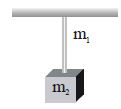
- 3One end of a uniform rod of mass $m_1$ and crosssectional area $A$ is hung from a ceiling. The other end of the bar is supporting mass $m_2$. The stress at the midpoint isView Solution
- 4View SolutionTwo identical wires of rubber and iron are stretched by the same weight, then the number of atoms in the iron wire will be
- 5Three bars having length $l, 2l$ and $3l$ and area of cross-section $A, 2 A$ and $3 A$ are joined rigidly end to end. Compound rod is subjected to a stretching force $F$. The increase in length of rod is (Young's modulus of material is $Y$ and bars are massless)View Solution
- 6The area of cross-section of a railway track is $0.01\, {m}^{2}$. The temperature variation is $10^{\circ} {C}$. Coefficient of linear expansion of material of track is $10^{-5} /{ }^{\circ} {C}$. The energy stored per meter in the track is ...... ${J} / {m} .$View Solution
(Young's modulus of material of track is $10^{11} \,{Nm}^{-2}$ ))
- 7A steel wire $1.5\,m$ long and of radius $1\,mm$ is attached with a load $3\,kg$ at one end the other end of the wire is fixed it is whirled in a vertical circle with a frequency $2\,Hz$ . Find the elongation of the wire when the weight is at the lowest position $(Y = 2 \times 10^{11}\,N/m^2$ and $g = 10\,m/s^2)$View Solution
- 8A wire is stretched by $0.01$ $m$ by a certain force $F.$ Another wire of same material whose diameter and length are double to the original wire is stretched by the same force. Then its elongation will beView Solution
- 9A glass slab is subjected to a pressure of $10\, atm$. The fractional change in its volume is (Bulk modulus of glass $= 37 \times 10^9\, N\, m^{-2}$, $1\, atm = 1 \times 10^5\, N\, m^{-2}$)View Solution
- 10The breaking stress of a wire of length $L$ and radius $r$ is $5$ $kg - wt/{m^2}$. The wire of length $2l$ and radius $2r$ of the same material will have breaking stress in $kg - wt/{m^2}$View Solution