Question
A1. Simple Factual Activities:
Complete the following web-chart :
Image

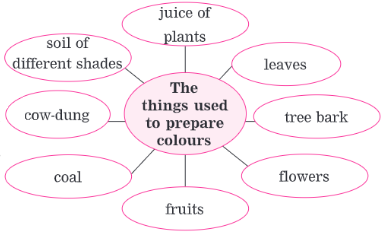
     This richness is reflected in the choice of their medium. In the days of past, several things in nature such as soils of different shades, the juice of plants, leaves, tree bark, flowers, fruits and even things like coal and cow-dung were used to prepare colours. The different colours, various textures and patterns were used year after year, lending a simplicity to the art. When we see these pictures, we realise that a picture drawn this way or the other can look equally beautiful. What a deep thought this art conveys - and so easily !
      In the Gond style of art, we see that the outlines may vary a little from artist to artist but the designs that fill it make the whole picture look lively and attractive. The designs include simple textures achieved using dots, straight lines, dotted lines, curvy shapes and circles. Special attention is given to the choice of various colours so that the total effect is amazing and beautiful.
      In today’s age of commercialisation many men have taken up Gond art. But the roots of folk arts probably lie in women’s daily chores like cleaning and decorating the house, dealing with natural colours in the course of cooking and in their leisure time activities.

A2. Complex Factual Activity:
Write down the special features of the Gond style of art :
A3. Activities based on Vocabulary:
(1) Spot the error in the spelling of the following words and rewrite them correctly:
(i) dicided (ii) diffarent
(2) Write related words with 'Artist'.
A4. Activities based on Contextual Grammar:
Do as directed:
(1) What a deep thought this art conveys! (Make it assertive.)
(2) Creating folk art is a very enriching experience. (Make it exclamatory.)
A5. Personal Response:
Why does the author think that the roots of folk art lie in women's chores?
Answer

A1. Simple Factual Activities:
Image
A2. Complex Factual Activities:

The special features of the Gond style of art:
(1) Different colours, various textures and patterns are used year after year.
(2) Even if it is simple it conveys a deep thought.
A3. Activities based on Vocabulary:
(1) (i) dicided (ii) diffarent
(2) design, outlines, picture, texture, pattern, style.
A4. Activities based on Contextual Grammar: 
(1) This art conveys a very deep thought.
(2) What an enriching experience creating folk art is!
A5. Personal Response:
In the past, it was the duty of women to look after her home and hearth. It included decorating the house with different things like flowers, rangolis. They handled it very creatively while shouldering the other responsibilities of their home. They used their own creativity while doing it, so the author thinks that the roots of folk art lies in women's chores.

Need a full question paper?

Generate a complete, print-ready paper with questions like this in minutes — across 16+ boards, with answer keys.

Start Generating Free

Similar questions

A1. Simple Factual Activities:
Complete the following sentences with the help of the given passage:
(1) The real name of Mark Twain was ______________.
(2) Mark Twain went to ______________ for a shave.
(3) ______________ are told and enjoyed even today.
(4) The young Mark Twain ran over early to say goodbye to ______________.

    Mark Twain was the pen name of Samuel Langhome Clemens, a popular American writer. He was famous for his humorous stories, novels and other writings. His ready wit shone through everyday conversations. Many anecdotes related to Mark Twain are told and enjoyed even today.
     It should be noted that he was a great defender of human values like liberty, equality and fraternity. He opposed wars and imperialism and supported the cause of labourers and of the black people in his country, America. Given below are some anecdotes from his life and some quotations from his speeches and writings.
     One day during a lecture tour, Mark Twain entered a local barber shop for a shave. This, Twain told the barber, was his first visit to the town.
     "You've chosen a good time to come," he declared.
     "Oh?" Twain replied.
     "Mark Twain is going to lecture here tonight. You'll want to go, I suppose?"
     "I guess so..."
     "Have you bought your ticket yet?"
     "No, not yet."
     "Well, it's sold out, so you'll have to stand."
     "Just my luck," said Twain with a sigh. "I always have to stand when that fellow lectures!"
     Mrs Stowe was leaving for Florida one morning, and Clemens (the young Mark Twain) ran over early to say goodbye. On his return Mrs Clemens regarded him disapprovingly: 
     “Why”, she said, “you haven’t on any collar and tie.” 
     He said nothing, but went up to his room, did up these items in a neat package, and sent it over to Mrs Stowe by a servant, with a line: 
     ‘Herewith receive a call from the rest of me.’

A2. Complex Factual Activities:
(1) Was Twain particular about how he dressed when he was visiting friends?
A3. Activities based on Vocabulary:
Find out similar meaning words (synonyms) for the following from the passage:
(1) freedom - ______________
(2) protector -  ______________
(3) brotherhood - ______________
(4) considered - ______________
A4. Activities based on Contextual Grammar:
Change the following sentences in indirect speech:
(1) "You have chosen a good time to come," the barber said to Mark Twain.
(2) The barber said to Mark Twain, "Have you bought your ticket?"
A5. Personal Response:
(1) What is the importance of humour in our life?
A1. Simple Factual Activities:
State whether the following statements are True or False:
Statements
(1) The huge wooden horse was an offering to the god of the sea.
(2) The man left by the Greeks told the false story of the horse.
(3) Their wise priest told the Trojans not to make a hole in the wall.
(4) The Greeks were tired of the long war and had sailed away.

     As they were wondering how the horse had been built and why it had been left behind, they found a Greek with his hands tied together lying under it. When the Trojans dragged him out, the man pretended to be very frightened of them. When he was commanded to tell them why the Greeks had gone and why they had left this horse behind, he pretended to tremble very much and refused to speak. When at last they threatened to kill him, he spoke and told them this false tale.
     “The Greeks are tired of the long war and have sailed away in their ships,” he said. “But they are afraid of the long voyage home too, and so they have made this horse and left it as an offering to the god of the sea. They wanted also to kill me and offer me as a sacrifice to the sea-god; but I escaped and hid from them.”
      “But why did the Greeks make such a huge horse ?” some of the Trojans asked. And the cunning Greek made this reply : “If they had made a smaller offering, you might have taken it into your city. Then the luck would have gone to the Trojans and not to the Greeks. That is why they made it too big to go inside your gates.”
     The Trojans were delighted to hear this. “The Greeks have gone,” they said, “and the walls are no longer necessary. Let us make a hole in the wall and drag the horse in.”
     Their wise priest warned them not to do so. “It may be a trick that will ruin us,” he said. “You will bring disaster on the city if you break down the walls.” But they were so excited that they paid no attention to his words. They broke down part of their strong wall in order to drag the horse in.
     All that day the Trojans feasted and drank and celebrated. After all their celebrations, they went to sleep and slept soundly. But that day of rejoicing was soon followed by a night of terror and death.ss

A2. Complex Factual Activities:
Put the following events in the order in which they took place. Number them accordingly:
(1) The priest warned the Trojans not to break the wall.
(2) The Trojans found a Greek man under the big wooden horse.
(3) They broke down a part of the wall and brought the horse in.
(4) The Trojans slept soundly.
A3. Activities based on Vocabulary:
Write the meaningful sentences from the jumbled words:
(1) the Greeks did a large such Why horse make?
(2) wise their them priest warned not so to do.
A4. Activities based on Contextual Grammar:
Read the following constructions carefully and then use them to express your ideas:
(1) They went to sleep. (Write the sentence in past progressive tense.)
(2) Why did the Greeks make such a huge horse? (Rewrite the sentence using past perfect tense.)
A5. Personal Response:
Was the big wooden horse really an offering to the god of the sea? 
A1. Simple Factual Activities:
Complete the following sentences:
(1) The house in which the thief peered through the hole belonged to ______________.
(2) According to the merchant, ______________ had carelessly built the wall of his house.

King : Let the court begin !
Fourth Guard Messenger : The first complainant !
Thief : (rushes forward and wails loudly) Justice ! Oh, Most Great King ! I beg for Justice.
King : And what is your complaint ?
Thief : In this great land of Andher Nagari, my friend and I have been truly hard-working honest thieves. All these years we have been true to our profession. And what is our reward ? Last night, with great efforts, we made a hole in the wall of a merchant’s house, when all his family were away. My friend peered through that hole into the house, when suddenly the wall collapsed (Wails louder).... and .... and my friend was instantly killed. I’ve lost my only friend and partner. O King ! It’s the merchant’s fault for living in a house with such weak walls.
King : Fetch the merchant at once. A life for life ! The merchant must be hanged ! (Third Guard leaves and returns with the merchant who bows before the king.)
Merchant : Mercy, O Noble King ! I had no intention of killing these skilled professionals. It is not my fault that the wall of my house collapsed. My house has been recently built. It is the fault of the bricklayer, who carelessly built such a weak wall.
King : Bring the careless bricklayer immediately. He must hang for his fault.
Bricklayer : O Most Kind Lord and King ! (kneeling to the king) Have mercy. I beg you, don’t send me to the gallows. I agree that I built the wall which collapsed and killed a man. But it was not due to my carelessness. The mortar which I used to lay the bricks was of very poor quality. There was too much of water mixed in it. It is entirely the mortar-maker’s fault.

A2. Complex Factual Activities:
(1) List the characters that have appeared so far in the passage. 
A3. Activities based on Vocabulary:
Pick out the verbs and state their kind:
(1) My friend peered through the hole.
(2) The merchant was living in a house.
A4. Activities based on Contextual Grammar:
(1) There was too much of water mixed in it. (Frame Verbal Questions)
(2) It is the fault of the bricklayer. He carelessly built such a weak wall.
(Combine the sentence with 'who')
A5. Personal Response:
If you had been the merchant, what would you have said? 
A1. Simple Factual Activities:
Complete the following sentences with the information given in the passage:
(1) She remained in her ball dress all night, ______________.
(2) At the end of one week they ______________.
(3) The husband and wife were sick with ______________.
(4) Mr. Loisel said, ______________.

     They looked in the folds of her dress, in the folds of her cloak, in her pockets, everywhere. But they could not find it.
     “Are you sure you still had it on when you left the hall ?” he asked.
     “Yes. I touched it in the hall at the Ministry.”
     “But if you had lost it in the street we would have heard it fall. It must be in the cab.”
     “Yes. That’s probably it. Did you take his number ?”
     “No.”
     They stared at each other, stunned. At last Loisel put his clothes on again. “I’m going back,” he said, “Over the whole route we walked, and see if I can find it.”
     He left. She remained in her ball dress all night, her mind blank. Her husband returned at about seven o’clock. He had found nothing.
     He went to the police, to the newspapers to offer a reward, to the cab companies, everywhere the tiniest glimmer of hope led him.
     She waited all day, in despair at this frightful disaster.
     Loisel returned in the evening, a hollow, pale figure; he had found nothing. “You must write to your friend,” he said, “tell her you have broken the clasp of her necklace and that you are having it mended. It will give us time to look some more.”
     She wrote as he dictated.
     At the end of one week they had lost all hope. And Loisel, who suddenly looked aged, declared, “We must consider how to replace the jewel.”
     And so, they went from jeweller to jeweller, looking for a necklace like the other one, consulting their memories, both sick with grief and anguish.

A2. Complex Factual Activities:
Complete the following table:

Utterance

Who said it

To whom

When

(1) I touched it in the hall at the Ministry

_________

_________

_________

(2) It will give us time to look some more.

_________

_________

_________

A3. Activities based on Vocabulary:
Write the meanings of:
(1) glimmer of hope : ______________.
(2) a hollow, pale figure :  ______________.
(3) sick with grief and anguish : ______________.
(4) cloak : ______________.
A4. Activities based on Contextual Grammar:
Do as directed:
(1) They could not find it. (Begin with; It could not ... and change the voice.)
(2) He said to Mathilde, "Tell her you have broken the clasp of the necklace." (Change into Indirect speech.)
A5. Personal Response:
Write what you think about the following actions of Mathilde :
(a) Mathilde was shocked and despaired over the loss of her necklace.

A1. Simple Factual Activities:
State whether the following statements are True or False:
(1) The sage wanted to die on that day.
(2) The sage wanted to save his disciple.
(3) The king wanted to be king again in his next birth.
(4) The old man was a wise and learned sage.

Voices and shouts heard from outside. All re-enter in a rush with another elderly man.
King : What ? Why have you all returned with this  stranger alive ? And who is this man ?
First Guard : I beg your pardon, Your highness but we  are confused indeed. This old man rushed towards  us as we were about to hang the young stranger  and begged and pleaded that he should be hanged  instead.
Second Guard : At first we thought the old man had  lost his mental balance. What sane man would  wish to suffer such a drastic death willingly ?
First Guard : But this young man says that he is a  wise and learned sage from the forest yonder and  he himself was this man’s disciple.
Sage : O Noble King, You are most generous. Be kind  and allow me to be hanged in place of my  disciple. I beg of you.
King : What a strange appeal ! And why  does such a wise and holy man wish to  obstruct the course of justice, may I ask ? 
Sage : (showing reluctance to let out his  secret) Your Majesty.... the truth is... no....  no.... I cannot say it.
King : I demand an explanation or I shall  not have you hanged in place of your  disciple.
Sage : You see........ uh........ it has been  predicted by the great prophets..... uh......  no...... no..... I shouldn’t say this.
King : (annoyed) Speak out at once or your disciple  will be hanged.
Sage : The.... the great prophets have foretold that the one who will be hanged on this day, in this kingdom, shall .... shall become the next king and conquer many more nations. I want to become the next great king, Your Majesty, and reign over a greater country ... I will go down in history as a famous royal monarch. The future generations will read about me and my greatness for milleniums to come. I shall never earn that fame if I remain a recluse - a sage. So do grant me this favour, O King, let me die at the gallows today.
King : Humm ...... The next king ? And this kingdom will expand ? Glory for milleniums to come ! Why, no one but I should be entitled to this privilege. Guards ! Take me to the gallows and hang me at once without any delay. Hurry up ! Don’t waste time. What a wonderful fate in my next life - a king once again ! Goodbye, world. See you again.

A2. Complex Factual Activities:
(1) What was the sage's request? Why did he make such a strange request? 
(2) List the characters that appear for the first time in this part of the passage. Write one- two lines about each of them.
A3. Activities based on Vocabulary:
Write any suitable noun from the passage for the given adjectives to make correct combination!
(1) generous 
(2) wonderful
(3) great
(4) learned
A4. Activities based on Contextual Grammar:
(1) Make the following sentences Assertive:
What a strange appeal!
(2) Rewrite using 'as well as':
 He is a wise and learned sage from the forest.
A5. Personal Response:
Was the King willing to hang the Sage?Why?
A1. Simple Factual Activities:
Answer the following in words:
(1) Mark Twain received a letter from the editor of a small Missouri newspaper.
(2) Finding a spider in a paper is good luck for the reader according to Mark Twain.
(3) Mark Twain's birth was heralded by the return of Halley's comet.
(4) Mark Twain died in November 1835.

      One day during his tenure as the editor of a small Missouri newspaper, Mark Twain received a letter from a reader who had found a spider in his paper. He wondered whether this portended good or bad luck.
       “Finding a spider in your paper,” Twain replied, “is neither good luck nor bad. The spider was merely looking over our paper to see which merchant was not advertising so that he could go to that store, spin his web across the door, and lead a life of undisturbed peace ever afterward.”
      Mark Twain’s birth in November 1835 was heralded by the return of Halley’s comet. Twain, who often remarked upon this curiosity, came to think of himself and the comet as ‘unaccountable freaks,’ cosmically linked: having come in together, he declared, they would go out together.
      In fact, Twain was proven right. On the night of his death in April 1910, Halley’s comet once again blazed through the sky...
Some Quotations
April Fool’s Day - This is the day upon which we are reminded of what we are on the other three hundred and sixty-four.
 A man cannot be comfortable without his own approval.
A person with a new idea is a crank until the idea succeeds.
Age is an issue of mind over matter. If you don’t mind, it doesn’t matter.
All generalizations are false, including this one 
Be careful about reading health books. You may die of a misprint.
Be careless in your dress if you will, but keep a tidy soul.
‘Classic’ - A book which people praise and don’t read. Humour is mankind’s greatest blessing.
I am an old man and have known a great many troubles, but most of them never happened.
I must have a prodigious quantity of mind; it takes me as much as a week sometimes to make it up.
If you tell the truth, you don’t have to remember anything.
 It is better to deserve honours and not have them than to have them and not deserve them.
It is better to keep your mouth closed and let people think you are a fool than to open it and 
remove all doubt.
It’s no wonder that truth is stranger than fiction. Fiction has to make sense.
Whenever you find yourself on the side of the majority, it is time to pause and reflect.
Why is it that we rejoice at a birth and grieve at a funeral? It is because we are not the person 
involved.
Thousands of geniuses live and die undiscovered either by themselves or by others.
Thunder is good, thunder is impressive; but it is lightning that does the work.
When I was younger I could remember anything, whether it happened or not.
When your friends begin to flatter you on how young you look, it’s a sure sign you’re getting old.

A2. Complex Factual Activities:
Which episode shows that Mark Twain did not believe in superstitions? 
A3. Activities based on Vocabulary:
Classify the following words in the given table:
reader, remind, wonder, spider, merchant, return, declare, comet.
A4. Activities based on Contextual Grammar:
Make the sentences affirmative:
(1) Mark Twain received a letter from a reader.
(2) Mark Twain's birth was heralded by the return of Halley's comet.
A5. Personal Response:
(1) Why should we take part in humorous sessions? 
A1. Simple Factual Activities:
Find the following matter in the passage and copy the missing words:
(1) He went on to prove that ______________________ .
(2) It was Maxwell ______________________ .

      He then took the age - old experiment of sprinkling iron filings on a sheet of paper near a magnet, making circular patterns. He went on to prove that these patterns were not a property of the iron filings; in fact they were due to the invisible magnetic fields that filled the empty space around the magnet and hence disturbed the filings. This is where his lack of formal education went against him. Faraday did not know much about advanced mathematics, so he just copied the iron filing patterns with his hand. He was unable to explain them in the form of mathematical equations. He made hundreds of such drawings but without equations, they were not accepted.
      Fortune favoured the brave Faraday once again when he met James Maxwell, a wealthy, educated physicist well versed in mathematics. He was willing to work with Faraday. It was Maxwell who translated Faraday’s idea into a set of equations that are now called Maxwell’s equations. Their combined work has helped us in many ways. Electronics and communication system today are designed around their discoveries. Some day, we might even be able to communicate with aliens across different galaxies using the products of these discoveries.
     Faraday’s life started with difficulties, but as a great scientist he met each difficulty with perseverance and conviction. He was given impossible tasks, which he undertook as challenges and opportunities. He epitomises what the Walt Disney character Pinocchio said : ‘
When you wish upon a star
It does not matter who you are’.

A2. Complex Factual Activity:
Why were Faraday's drawings not accepted? Does it mean they were wrong?
A3. Activities based on Vocabulary:
Find and write the past tense verbs with '-ed' from the passage:
A4. Activities based on Contextual Grammar:
Do as directed:
(1) He was unable to explain them. (Make it a negative sentence without changing meaning.)
(2) He made hundreds of such drawings. (Choose the correct sentence of passive voice.)
(a) Hundreds of such drawings are made by him.
(b) Hundreds of such drawings will be made by him.
(c) Hundreds of such drawings were made by him.
(d) Hundreds of such drawings have made by him.
A5. Personal Response:
When you wish to achieve some goal, does it matter what you are?
A1. Simple Factual Activities:
Complete the following sentences:
(1) The mortar-maker's family comprised of ______________.
(2) According to the mortar-maker excess water poured down into ______________.

King : Summon the mortar-maker at once. He must pay with his life for his thoughtlessness.
(First Guard exits and returns with the mortar-maker who rushes and throws himself before the king.)
Mortar-maker : (wailing loudly) Forgive me, O Merciful King. Please do not hang me to death. I have a wife and two young children. Who will look after them ?
King : Your carelessness has cost a life. You must pay with your life.
Mortar-maker : No... no... no, my Royal Lord. I am not to blame. The pot which I used to pour water into the mortar had an extra-ordinarily large mouth. So excess water poured down into the mortar mixture. I was helpless. It is the potter’s fault for making such a useless pot.
King : Let the potter be brought here at once. He must be executed for moulding such useless pots.
(Fourth Guard leaves and re-enters with the potter.)
Potter : (cowering before the king) Your Majesty, show mercy to this humble potter. I agree the pot I made and sold to the mortar-maker was a defective one. But I am not guilty. As I was moulding that pot, I heard the sweet delicate tinkling of anklets. It was the money-lender’s daughter. She distracted me just as I was shaping the mouth and it became too wide.
King : Bring the money-lender’s daughter here, this very instant. She must be sent to the gallows for disturbing this poor potter at work.
(First Guard leaves and enters with the money-lender and his daughter.)
Money-lender : (in a desperate voice) O Just King ! Spare my daughter. She is my only child and to be wedded next Monday.
Daughter : Oh, do not fret, father. The king will not hang me. (To the king) Your Most Esteemed 
Highness, I rarely step outside the threshold of my home. But as my father said, I am to be married next week and my jewellery is not ready. I had to go to the goldsmith’s shop to urge him to work faster and hand over my ornaments on time ... The potter’s shop is on the way. I could not help it. It is all the goldsmith’s fault. Had he delivered my ornaments on time. I would not have been forced to go past the potter’s shop.
King : Then send for the goldsmith and without any delay, he must be hanged.

A2. Complex Factual Activities:
(1) Is the Daughter's complaint about the Goldsmith true? 
A3. Activities based on Vocabulary:
(1) Find out minimum four infinitives from the passage:
A4. Activities based on Contextual Grammar:
Read the following sentences and separate the subject and the verb in each:

SentenceSubjectverb
 (1) You are a stranger.  
 (2) I am a visitor here.  

A5. Personal Response:
Why is the daughter so confident that the king will not hang her? Does her prediction come true?

A1. Simple Factual Activities:
Complete the following statements by giving reasons:
(1) Faraday forgot to applaud with the rest of the crowd because  ______________________.
(2) Faraday didn't just want to sell books because ______________________.

      That day in 1812 Faraday was spellbound by Davy’s lecture. He kept taking notes about the ‘mysterious force of electric fluid’. He was so engrossed in the lecture that he forgot to applaud with the rest of the crowd. When he went back, his notes were so comprehensive that he bound them into a book, meaning to gift it to Davy some day. Faraday decided that day that he didn’t just want to sell books, he wanted to be a great scientist - good enough to write his own books. Davy became his role model. But there was a problem. He did not have the social status, money or the education to pursue science. Faraday thought it would be wonderful if Davy became his mentor, but Davy did not agree initially. Faraday was not dejected; he just kept trying.
        Destiny had a strange plan in store for him. A few years later, a chemical explosion happened inside Davy’s lab and he was temporarily blinded. He now needed an assistant with an excellent memory to help him. He was reminded of Faraday and decided to hire him as his secretary. Davy never believed Faraday could do anything in the field of science going by his social status and education. He therefore dismissed Faraday’s aspirations and advised him to stick to bookbinding. But Faraday was relentless. He worked day and night and learnt as much as he could about Davy’s experiments. Soon Faraday became indispensable to Davy, and was promoted to his lab assistant. This was his first step towards a scientific career. Though much of his job now was cleaning labs, at least he got to see some of Davy’s leading experiments.

A2. Complex Factual Activity:
Was Davy fair in his treatment of Faraday? How did Faraday respond to that treatment?
A3. Activities based on Vocabulary:
Write four words from the passage that tell us the state of mind of a person:
A4. Activities based on Contextual Grammar:
Find and write from the passage the adjectives used for the following nouns:
(1) force (2) notes (3) explosion (4) memory
A5. Personal Response:
Is it necessary to have social status, money to pursue your goal? Explain why.
A1. Simple Factual Activities:
Complete the following sentences:
(1) Margie's great grandfather told that in old times all stories ______________. 
(2) According to Margie, 'a real book' means ______________.

     Margie even wrote about it that night in her diary. On the page headed 17 May 2157, she wrote, "Today Tommy found a real book!'
      It was a very old book. Margie's grandfather once said that when he was a little boy his grandfather told him that there was a time when all stories were printed on paper.
      They turned the pages, which were yellow and crinkly, and it was awfully funny to read words that stood still instead of moving the way they were supposed toon a screen, you know. And then when they turned back to the page before, it had the same words on it that it had when they read it the first time.
      "Gee," said Tommy, "what a waste! When you're through with the book, you just throw it away, I guess. Our television screen must have had a million books on it and it's good for plenty more. I wouldn't throw it away."

A2. Complex Factual Activities:
Complete the following:
Image
A3. Activities based on Vocabulary:

(1) Write at least  ten words related to book:
A4. Activities based on Contextual Grammar:
Underline the verbs and choose the correct options from the brackets:
(1) Margie even wrote about it. (present tense/past tense)
(2) Today Tommy found a new book. (present tense/past tense)
A5. Personal Response:
About what did Tommy say, "What a waste!" Why do you think, did he say so?