Question
A1. Simple Factual Activities:
State whether the following statements are True or False:
(1) The sage wanted to die on that day.
(2) The sage wanted to save his disciple.
(3) The king wanted to be king again in his next birth.
(4) The old man was a wise and learned sage.

Voices and shouts heard from outside. All re-enter in a rush with another elderly man.
King : What ? Why have you all returned with this  stranger alive ? And who is this man ?
First Guard : I beg your pardon, Your highness but we  are confused indeed. This old man rushed towards  us as we were about to hang the young stranger  and begged and pleaded that he should be hanged  instead.
Second Guard : At first we thought the old man had  lost his mental balance. What sane man would  wish to suffer such a drastic death willingly ?
First Guard : But this young man says that he is a  wise and learned sage from the forest yonder and  he himself was this man’s disciple.
Sage : O Noble King, You are most generous. Be kind  and allow me to be hanged in place of my  disciple. I beg of you.
King : What a strange appeal ! And why  does such a wise and holy man wish to  obstruct the course of justice, may I ask ? 
Sage : (showing reluctance to let out his  secret) Your Majesty.... the truth is... no....  no.... I cannot say it.
King : I demand an explanation or I shall  not have you hanged in place of your  disciple.
Sage : You see........ uh........ it has been  predicted by the great prophets..... uh......  no...... no..... I shouldn’t say this.
King : (annoyed) Speak out at once or your disciple  will be hanged.
Sage : The.... the great prophets have foretold that the one who will be hanged on this day, in this kingdom, shall .... shall become the next king and conquer many more nations. I want to become the next great king, Your Majesty, and reign over a greater country ... I will go down in history as a famous royal monarch. The future generations will read about me and my greatness for milleniums to come. I shall never earn that fame if I remain a recluse - a sage. So do grant me this favour, O King, let me die at the gallows today.
King : Humm ...... The next king ? And this kingdom will expand ? Glory for milleniums to come ! Why, no one but I should be entitled to this privilege. Guards ! Take me to the gallows and hang me at once without any delay. Hurry up ! Don’t waste time. What a wonderful fate in my next life - a king once again ! Goodbye, world. See you again.

A2. Complex Factual Activities:
(1) What was the sage's request? Why did he make such a strange request? 
(2) List the characters that appear for the first time in this part of the passage. Write one- two lines about each of them.
A3. Activities based on Vocabulary:
Write any suitable noun from the passage for the given adjectives to make correct combination!
(1) generous 
(2) wonderful
(3) great
(4) learned
A4. Activities based on Contextual Grammar:
(1) Make the following sentences Assertive:
What a strange appeal!
(2) Rewrite using 'as well as':
 He is a wise and learned sage from the forest.
A5. Personal Response:
Was the King willing to hang the Sage?Why?
Answer

A1. Simple Factual Activities:
(1) True
(2) True
(3) True
(4) True
A2. Complex Factual Activities:
(1) The sage's request was that he should be hanged instead of his disciple because he wanted to save his disciple at any cost by using some tricks.
(2) Sage: A wise man from a neighbouring forest who smartly saved his disciple from the punishment given by King Choupat.
A3. Activities based on Vocabulary :
(1) king
(2) prophet
(3) fate
(4) sage
A4. Activities based on Contextual Grammar:
(1) It was indeed a strange appeal.
(2) He is a wise as well as learned sage from the forest.
A5. Personal Response:
No, the King was not willing to hang the sage because the sage told him that the one who would be hanged on that day, in that kingdom, would become the next king. So to become the next great king of Andher Nagari, he didn't want to hang the sage whereas he wanted himself to be hanged.

Need a full question paper?

Generate a complete, print-ready paper with questions like this in minutes — across 16+ boards, with answer keys.

Start Generating Free

Similar questions

A1. Simple Factual Activities:
Who said to whom? Complete the table:

DialogueWho saidTo whom
 (1) "Here's something for you."  
 (2) "What do you want me to do with that?"  


      Mathilde was a pretty and charming girl, born, as if by an error of fate, into a family of clerks. She had no means of becoming known, understood, loved or be wedded to an aristocrat; and so she let herself be married to a minor official at the Ministry of Education.
      She dressed plainly, because she had never been able to afford anything better. She suffered endlessly, feeling she was entitled to all the luxuries of life. She suffered because of her shabby, poorly furnished house. All these things, that another woman of her class would not even have noticed, tormented her and made her resentful. She dreamed of a grand, palatial mansion, with vast rooms and inviting smaller rooms, perfumed for afternoon chats with close friends.
      Yet, she had no rich dresses, no jewels, nothing; and these were the only things she loved. She wanted so much to charm, to be envied, to be sought after.
      She had a rich friend, a former schoolmate at the convent, whom she avoided visiting, because afterwards she would weep with regret, despair and misery.
      One evening her husband came home with an air of triumph, holding a large envelope in his hand. “Look,” he said, “here’s something for you.”
      She tore open the paper and drew out a card, on which was printed the words:
      “The Minister of Education and Mme. Georges Rampouneau request the pleasure of M. and Mme. Loisel’s company at the Ministry, on the evening of Monday, January 18th.”   
      Instead of being delighted, as her husband had hoped, she threw the invitation on the table resentfully, and muttered, “What do you want me to do with that ? And what do you expect me to wear if I go ?”

A2. Complex Factual Activities:
(1) Why did Mathilde weep with misery after visiting her schoolmate? 
A3. Activities based on Vocabulary:
(1) Write any four words from the passage that show the feeling of great pain:
(2) Write English terms that stand for the French terms Monsieur and Mme:
A4. Activities based on Contextual Grammar:
Do as directed:
(1) She had no rich dresses. (Make the sentence affirmative without changing the meaning.)
(2) These were the only things she loved. (Make the sentence negative without changing the meaning.)
A5. Personal Response:
Write what you think about the following thoughts and actions of Mathilde :
(1) Mathilde felt that her house was shabby and poorly furnished.
(2) Mathilde wanted other people to envy her.

A1. Simple Factual Activities:
Complete the following sentences using the information from the passage:
(1) The most popular beverage in the world is ______________.
(2) ______________ is an evergreen plant that grows in tropical and sub-tropical climates.
(3) Tea plants require at least ______________ cm of rainfall a year.
(4) The teas we buy are usually classified according to the ______________.

      Let us begin with a question : can you name the most widely consumed beverage in the world, after water?
      Perhaps many of you have guessed the answer : the most popular beverage in the world is tea - the fresh, aromatic brew with which people like to begin their day. It has a refreshing, astringent flavour. It is actually made by brewing, that is by infusing in boiling water, the leaves and shoots of a plant whose botanical name is the Camellia sinensis. The leaves are at first dried, cured and processed before they are packed and sold to us.
      Camellia sinensis is an evergreen plant that grows in tropical and sub-tropical climates. Tea plants require at least 100-125 cm of rainfall a year and prefer acidic soils. Many of the world’s best tea estates are located on hill slopes at elevations of up to 1500 metres : it is said that the tea plants grow slowly and acquire a richer flavour at this height.
      When the plants mature, only the top 1-2 inches of the plant are picked. These buds and leaves are called flushes. A new flush appears on the plant every seven to ten days during the peak growing season. Left to grow on its own, the tea plant may actually grow into a small tree. But in all tea gardens, the plants are pruned and kept at a height of about three feet (waist high) to enable easy plucking of the leaves. The teas we buy are usually classified according to their leaf size. Accordingly we have (1) Assam type of tea, characterised by the largest leaves; (2) China type, characterised by the smallest leaves; and (3) Cambod, characterised by leaves of intermediate size.
      We have three very distinct and different tea growing regions in India. Each of these regions is famous for the special type of tea it produces, which are unique in taste, aroma, strength and flavour. The three regions are : Darjeeling in North-Eastern India, Assam in far North-East India and Nilgiris in South India.

A2. Complex Factual Activities:
(1) Why are tea plants pruned? 
(2) How is tea the beverage made?
A3. Activities based on Vocabulary:
(1) List all the names of geographical places mentioned in the passage:
(2) List the qualities of the special type of tea.
A4. Activities based on Contextual Grammar:
(1) A new flush ______________ on the plant every seven to ten days. (appear/appears)
(2) Tea plants ______________ at least 100-125 cm of rainfall a year. (require/requires)
(3) Each of these regions ______________ famous for the specialtype of tea. (is/are)
(4) It ______________ said that the tea plants grow slowly. (are/is)
A5. Personal Response:
What are botanical names? How are they decided?
A1. Simple Factual Activities:
Complete the following:
(1) The two lips are like a fence because ______________________.
(2) Once you have spoken a word you ______________________.

     Man was meant to listen more and talk less. That is why as the great British statesman Benjamin Disraeli said: “Nature has endowed man with two ears and one mouth. If man was meant to talk more and listen less, he would have two mouths and only one ear.” Imagine how we would have looked, how strange with two mouths on the two sides and one ear at the centre.
      And mind you, the ears are like funnels, open all the time. There is no door with which you can close them. Whereas if you have to speak even one single word, that word must pass through two walls - two fences. There is firstly the fence of these two rows of teeth. There is secondly the fence of the two lips. Before a word can be spoken, it has to pass, it has to pierce through these two walls, through these two fences. Therefore we must think at least twice before we utter a word. 
       A very wise man once remarked that of the unspoken word you are a master, of the spoken word, you are a slave. Once you have spoken a word you cannot get it back, do what you will. Therefore you must be very careful about the words that you speak. Once the word has left your lips, you will not be able to get it back.
       What are unspoken words? They are things you want to say, but remain unsaid, as thoughts in your mind. Once you have put the thoughts into words, once the words have left your lips, you cannot change them or control them

A2. Complex Factual Activities:
(1) What were a wise man's thoughts about our spoken word? 
A3. Activities based on Vocabulary :
(1) Write from the passage the words related to our body parts:
(2) Write four words that have 'un-' as prefix:
Example: unspoken
A4. Activities based on Contextual Grammar:
Make two sentences of your own with each of the words given below, using the same word as a noun in one and as a verb in another :
(1) Show :
A5. Personal Response:
(1) Write the biological reasons why man's ears and mouth have developed the way they are now.
A1. Simple Factual Activities:
Say whether the following statements are True or False:
Statements
(1) One day young Helen understood that everything has a name.
(2) Young Helen did not try to put the pieces of the doll together.
(3) Young Helen felt sorry that she had broken the doll.
(4) Helen's eyes filled with tears when she realised what she had done.

     We walked down the path to the well-house, attracted by the fragrance of the honeysuckle with which it was covered. Someone was drawing water and my teacher placed my hand under the spout. As the cool stream gushed over one hand she spelled into the other the word water, first slowly, then rapidly. I stood still, my whole attention fixed upon the motions of her fingers. Suddenly I felt a misty consciousness as of something forgotten - a thrill of returning thought; and somehow the mystery of language was revealed to me. I knew then that ‘w-a-t-e-r’ meant the wonderful cool something that was flowing over my hand. That living word awakened my soul, gave it light, hope, joy, set it free ! There were barriers still, it is true, but barriers that could in time be swept away.
     I left the well-house eager to learn. Everything had a name, and each name gave birth to a new thought. As we returned to the house, every object that I touched seemed to quiver with life. That was because I saw everything with the strange, new sight that had come to me. On entering the door I remembered the doll I had broken. I felt my way to the hearth and picked up the pieces. I tried vainly to put them together. Then my eyes filled with tears; for I realised what I had done, and for the first time I felt repentance and sorrow.
     I learned a great many new words that day. I do not remember what they all were; but I do know that mother, father, sister, teacher were among them - words that were to make the world blossom for me ‘like Aaron’s rod, with flower.’ It would have been difficult to find a happier child than I was as I lay in my crib at the close of that eventful day and lived over the joys it had brought me, and for the first time longed for a new day to come.
     Helen went on to become a graduate cum laude from Radcliffe. She then devoted the rest of her life to teaching and giving hope to the blind and deaf, as her teacher had done. She and Anne remained friends until  Anne’s death.

A2. Complex Factual Activities:
(1) What were the barriers? How could they be swept away? 
A3. Activities based on Vocabulary:
Classify the following words in the given columns:
fragrance, attract, stream, learn, hearth, enter, sorrow, realise
A4. Activities based on Contextual Grammar:
Rewrite the following sentences using 'Helen Keller/Young Helen' appropriately in place of 'T' and making other necessary changes in the sentences:
(1) On entering the door, I remembered the doll I had broken
(2) Then my eyes filled with tears: for I realised what I had done, and for the first time I felt repentance and sorrow.
A5. Personal Response:
(1) Why should we help disabled people?
A1. Simple Factual Activities:
Complete the following sentences with the help of the given passage:
(1) The real name of Mark Twain was ______________.
(2) Mark Twain went to ______________ for a shave.
(3) ______________ are told and enjoyed even today.
(4) The young Mark Twain ran over early to say goodbye to ______________.

    Mark Twain was the pen name of Samuel Langhome Clemens, a popular American writer. He was famous for his humorous stories, novels and other writings. His ready wit shone through everyday conversations. Many anecdotes related to Mark Twain are told and enjoyed even today.
     It should be noted that he was a great defender of human values like liberty, equality and fraternity. He opposed wars and imperialism and supported the cause of labourers and of the black people in his country, America. Given below are some anecdotes from his life and some quotations from his speeches and writings.
     One day during a lecture tour, Mark Twain entered a local barber shop for a shave. This, Twain told the barber, was his first visit to the town.
     "You've chosen a good time to come," he declared.
     "Oh?" Twain replied.
     "Mark Twain is going to lecture here tonight. You'll want to go, I suppose?"
     "I guess so..."
     "Have you bought your ticket yet?"
     "No, not yet."
     "Well, it's sold out, so you'll have to stand."
     "Just my luck," said Twain with a sigh. "I always have to stand when that fellow lectures!"
     Mrs Stowe was leaving for Florida one morning, and Clemens (the young Mark Twain) ran over early to say goodbye. On his return Mrs Clemens regarded him disapprovingly: 
     “Why”, she said, “you haven’t on any collar and tie.” 
     He said nothing, but went up to his room, did up these items in a neat package, and sent it over to Mrs Stowe by a servant, with a line: 
     ‘Herewith receive a call from the rest of me.’

A2. Complex Factual Activities:
(1) Was Twain particular about how he dressed when he was visiting friends?
A3. Activities based on Vocabulary:
Find out similar meaning words (synonyms) for the following from the passage:
(1) freedom - ______________
(2) protector -  ______________
(3) brotherhood - ______________
(4) considered - ______________
A4. Activities based on Contextual Grammar:
Change the following sentences in indirect speech:
(1) "You have chosen a good time to come," the barber said to Mark Twain.
(2) The barber said to Mark Twain, "Have you bought your ticket?"
A5. Personal Response:
(1) What is the importance of humour in our life?
A1. Simple Factual Activities:
Answer the following in words:
(1) Henry Irving asked Mark Twain if he had heard the story before ______________
(2) Mark Twain could not lie the third time at any cost because ______________

     One day Henry Irving, in the midst of telling Mark Twain a humorous story, abruptly stopped and examined his friend’s face. “You haven’t heard this, have you ?” he asked. Twain assured him that he had not. 
     When, some time later, Irving again paused, and again posed the question, Twain again reassured him. Then, approaching the climax, Irving broke off once more. “Are you quite sure you haven’t heard this?” he demanded suspiciously. “I can lie once,” Twain finally replied. “I can lie twice for courtesy’s sake, but I draw the line there. I can’t lie the third time at any price. I not only heard the story, I invented it !”
Mark Twain once proposed a ‘Plan for the Improvement of English Spelling’: 
     For example, in Year 1 that useless letter ‘c’ would be dropped to be replased either by ‘k’ or 
‘s,’ and likewise, ‘x’ would no longer be part of the alphabet. 
The only kase in which ‘c’ would be retained  would be the ‘ch’ formation, which will be dealt with later.
     Year 2 might reform ‘w’ spelling, so that ‘which’ and ‘one’ would take the same konsonant, wile Year 3 might well abolish ‘y’ replasing it with ‘i’ and Iear 4 might fiks the ‘g/j’ anomali wonse and for all. 
     Jenerally, then, the improvement would kontinue iear bai iear with Iear 5 doing awai with useless double konsonants, and Iears 6-12 or so modifaiing vowlz and the rimeining voist and unvoist konsonants. Bai Iear 15 or sou, it wud fainali bi posibl to meik ius ov thi ridandant letez ‘c,’ ‘y’ and ‘x’ — bai now jast a memori in the maindz ov ould doderez — tu riplais ‘ch,’ ‘sh,’ and ‘th’ rispektivli. 
     Fainali, xen, aafte sam 20 iers ov orxogrefkl riform, wi wud hev a lojikl, kohirnt speling in ius xrewawt xe Ingliy-spiking werld. 

A2. Complex Factual Activities:
(1) Was Twain particular about what words he used?
(2) What did Mark Twain propose? What was his plan at the year 6-12?
A3. Activities based on Vocabulary:
Find out words from the passage that are used in place of the following words:
(1) world - ______________
(2) replace - ______________
(3) respectively - ______________
(4) modifying - ______________
A4. Activities based on Contextual Grammar:
Identify the tense:"
(1) Henry Irving was telling a humorous story.
(2) Mark Twain proposed a plan for the improvement of English Spelling.
A5. Personal Response:
(1) How can you improve English spellings?
A1. Simple Factual Activities:
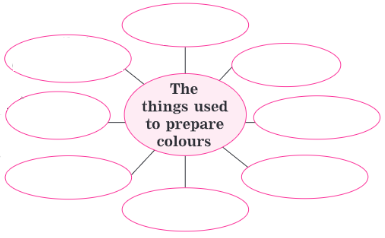
Complete the following web-chart :
Image

     This richness is reflected in the choice of their medium. In the days of past, several things in nature such as soils of different shades, the juice of plants, leaves, tree bark, flowers, fruits and even things like coal and cow-dung were used to prepare colours. The different colours, various textures and patterns were used year after year, lending a simplicity to the art. When we see these pictures, we realise that a picture drawn this way or the other can look equally beautiful. What a deep thought this art conveys - and so easily !
      In the Gond style of art, we see that the outlines may vary a little from artist to artist but the designs that fill it make the whole picture look lively and attractive. The designs include simple textures achieved using dots, straight lines, dotted lines, curvy shapes and circles. Special attention is given to the choice of various colours so that the total effect is amazing and beautiful.
      In today’s age of commercialisation many men have taken up Gond art. But the roots of folk arts probably lie in women’s daily chores like cleaning and decorating the house, dealing with natural colours in the course of cooking and in their leisure time activities.

A2. Complex Factual Activity:
Write down the special features of the Gond style of art :
A3. Activities based on Vocabulary:
(1) Spot the error in the spelling of the following words and rewrite them correctly:
(i) dicided (ii) diffarent
(2) Write related words with 'Artist'.
A4. Activities based on Contextual Grammar:
Do as directed:
(1) What a deep thought this art conveys! (Make it assertive.)
(2) Creating folk art is a very enriching experience. (Make it exclamatory.)
A5. Personal Response:
Why does the author think that the roots of folk art lie in women's chores?
A1. Simple Factual Activities:
Fill in the blanks with one word:
(1) Prospero took the prince to a ___________.
(2) Ferdinand wanted to be the king of ___________.
(3) Many more tricks were played on Prospero's enemies by ___________.
(4) Antonio wanted to kill king ___________.

      In reality, Ariel informed Prospero, the ship was  safely anchored in one corner of the island; Ferdinand  was all alone on the beach, and Alonso, Antonio,  Gonzalo and the others were wandering about on the  island, not knowing where to go.
      “Ariel, my joyful spirit,” Said Prospero. “Bring Ferdinand here at once, for my daughter must see him.”
      “Remember, Master, I have served you joyfully all these years. And you promised me that you would set me free one day.”             
      “Obey my commands now,” Prospero said to him “and in two days I shall set you free!”
       Ariel, assuming a form invisible to Ferdinand enchanted the prince with a beautiful song, leading him carefully into the presence of Prospero and Miranda And, all happened exactly as Prospero had planned.
       Miranda, who had never ever seen any human being except her father, looked at the handsome young prince and was thrilled.
      “I might call him a thing divine,” she exclaimed “for nothing natural I ever saw so noble!”
       Ferdinand too, was astonished to see such a beautiful young girl in a desolate place like the island “Most sure, she is the goddess of the island !” he thought to himself.
       As they gazed at each other in wonder, admiration and love, Prospero was secretly pleased. But outwardly he pretended to be angry. He accused the Prince of spying on the island, to capture it for himself. “Follow me,” he said to the Prince, “I shall tie you up, neck and feet together.”
      The brave prince drew his sword to defend himself - but Prospero waved his magic stick, and the prince was forced to stand like a statue, as still as stone..

A2. Complex Factual Activity:
How did Ferdinand and Miranda react on seeing each other?
A3. Activities based on Vocabulary:

(1) Write down minimum four infinitives from the passage:
A4. Activities based on Contextual Grammar:
Rewrite the following sentences in polite request in form of question :
(1) Obey my commands now!
(2) Bring Ferdinand here at once.
A5. Personal Response:

Do you think the power of magic can make you successful? Why?
A1. Simple Factual Activities:
Complete the following sentences:
(1) The mortar-maker's family comprised of ______________.
(2) According to the mortar-maker excess water poured down into ______________.

King : Summon the mortar-maker at once. He must pay with his life for his thoughtlessness.
(First Guard exits and returns with the mortar-maker who rushes and throws himself before the king.)
Mortar-maker : (wailing loudly) Forgive me, O Merciful King. Please do not hang me to death. I have a wife and two young children. Who will look after them ?
King : Your carelessness has cost a life. You must pay with your life.
Mortar-maker : No... no... no, my Royal Lord. I am not to blame. The pot which I used to pour water into the mortar had an extra-ordinarily large mouth. So excess water poured down into the mortar mixture. I was helpless. It is the potter’s fault for making such a useless pot.
King : Let the potter be brought here at once. He must be executed for moulding such useless pots.
(Fourth Guard leaves and re-enters with the potter.)
Potter : (cowering before the king) Your Majesty, show mercy to this humble potter. I agree the pot I made and sold to the mortar-maker was a defective one. But I am not guilty. As I was moulding that pot, I heard the sweet delicate tinkling of anklets. It was the money-lender’s daughter. She distracted me just as I was shaping the mouth and it became too wide.
King : Bring the money-lender’s daughter here, this very instant. She must be sent to the gallows for disturbing this poor potter at work.
(First Guard leaves and enters with the money-lender and his daughter.)
Money-lender : (in a desperate voice) O Just King ! Spare my daughter. She is my only child and to be wedded next Monday.
Daughter : Oh, do not fret, father. The king will not hang me. (To the king) Your Most Esteemed 
Highness, I rarely step outside the threshold of my home. But as my father said, I am to be married next week and my jewellery is not ready. I had to go to the goldsmith’s shop to urge him to work faster and hand over my ornaments on time ... The potter’s shop is on the way. I could not help it. It is all the goldsmith’s fault. Had he delivered my ornaments on time. I would not have been forced to go past the potter’s shop.
King : Then send for the goldsmith and without any delay, he must be hanged.

A2. Complex Factual Activities:
(1) What is the Mortar-maker's excuse? Is it believable? 
A3. Activities based on Vocabulary:
(1) Find out minimum four infinitives from the passage:
A4. Activities based on Contextual Grammar:
(1) Copy four imperative sentences from the passage:
A5. Personal Response:
Do you think the potter is telling the truth? Why? 
A1. Simple Factual Activities:
Complete the following :
(1) Harsh words are like scattered bits of paper carried away by the wind because ______________________.
(2) The young man said that he had spoken very harsh and unkind words to his friend and ______________________.

     A young man went to his spiritual teacher and said, “I have spoken very harsh and unkind words to my friend, and he is deeply hurt. I am afraid I have lost my friendship with him. How can I make amends?”
      The wise teacher gave him a fresh sheet of blank paper and a pen; he said to the young man, “Write down on this paper all the harsh things you said to him.”
      The young man did as he was told, and showed the paper to the teacher.
      “Now tear up this sheet of paper into as many small bits as you can,” the wise teacher said. Soon, the single sheet was torn into a hundred tiny bits of paper.
     “Throw the bits out of this window,” the teacher told him. 
      That was easily done! It was a windy day and the tiny bits were scattered far and wide even as the young man watched. 
     “Now, go out into the street and collect as many bits of the paper as you can,” the teacher ordered him.
     The young man was taken aback. “But…but, that will be difficult …” he stammered.
     “It will be difficult indeed, but do give it a try,” the teacher suggested. 
      The young man went out. He returned half an hour later, exhausted. He had not been able to get hold of a single torn bit from the paper he had torn up just a while earlier! 
     “This is what happens with the spoken word,” the teacher said to him. “Once you have spoken the words aloud, it is very difficult to take them back. Therefore, learn to think before you speak in anger.

A2. Complex Factual Activities:
(1) How did the spiritual teacher teach a lesson to the young man about his harsh and unkind words to his friend? 
A3. Activities based on Vocabulary :
Match the following words in column 'A' with their antonyms in column 'B':

'A'

'B'

(1) harsh

(a) easy

(2) earlier

(b) narrow

(3) difficult

(c) soft

(4) wide

(d) later

A4. Activities based on Contextual Grammar:
Make two sentences of your own with each of the words given below, using the same words as a noun and as a verb in another:
(1) throw:
A5. Personal Response:

(1) What do you do when someone speaks to you angrily. Do you also speak angrily?