Question
A1. Simple Factual Activities:
Complete the following:
(i) Singh had successfully led ..................... .
(ii) Singh played a major role in transforming the IAF into ................... globally and the fourth biggest in the world.
(iii) Singh was honoured with the rank of Marshal ........................ .
(iv ) Singh's contribution was most outstanding during ....................... .
   
   Air Force Marshal Arjan Singh, an icon of India’s military history, will always be remembered as a war hero who had successfully led a young IAF during the 1965 Indo-Pak war.
   The only officer to attain the highest post of Marshal, the Air Force equivalent to the Army’s five star field marshal, Singh was a fearless and exceptional pilot who had flown more than 60 different types of aircraft.
   He played a major role in transforming the IAF into one of the most potent air forces globally and the fourth biggest in the world. “His contribution to the Indian Air Force is monumental to the least. The IAF grew with him. He was the epitome of military leadership in classical sense and it is, therefore, not surprising that he was honoured with the rank of Air Force Marshal,” former Vice Chief of IAF Kapil Kak
said.
   Singh was honoured with the rank of Marshal on the Republic Day in 2002. Sam Hormusji Framji Jamshedji Manekshaw and K M Cariappa were the only two army generals honoured with the rank of Field Marshal.
   Known as a man of few words, Singh was not only a fearless pilot but also had profound knowledge about air power and applied it in a wide spectrum of areas. Singh had assiduously led the IAF during the 1965 war and denied success to Pakistani Air Force though it was better equipped with American support.“His most outstanding contribution was during that war,” said Kak.

A2. Complex Factual Activities:

(i) Explain why Air Force Marshal Arjan Singh is considered an outstanding military personality.
A3. Activities based on Vocabulary:
(i) Pick out the adjectives ending in -al' from the extract and give their noun forms:
A4. Activities based on Contextual Grammar:
(i) Singh was not only a fearless pilot but had profound knowledge about field power.
(Rewrite without using 'not'.)
(ii) He will always be remembered as a war hero. (Rewrite using 'never'.)
A5. Personal Response:
(i) Would you like to be a part of the IAF? Give reasons for your answer.

Answer

A1. Simple Factual Activity:
(i) Singh had successfully led a young IAF during the 1965 Indo-Pak war.
(ii) Singh played a major role in transforming the IAF into one of the most potent air forces globally and the fourth biggest in the world.
(iii) Singh was honoured with the rank of Marshal on the Republic Day in 2002.
(iv ) Singh's contribution was most outstanding during the 1965 Indo-Pak war.
A2. Complex Factual Activities:
(i) Air Force Marshal Arjan Singh successfully led the IAF during the 1965 Indo-Pak war. He played a major role in making the IAF one of the most powerful air forces in the world. He was not only a fearless and exceptional pilot but he also had a deep knowledge of air power, which he applied where necessary. He was the perfect example of military leadership. It is for these reasons that he is considered an outstanding military personality.
A3. Activities based on Vocabulary:

Adjectives ending in '-al'The noun forms
 exceptional exception
 monumental monument
 classical classic

A4. Activities based on Contextual Grammar:
(i) Besides being a fearless pilot, Singh also had profound knowledge about field power.
(ii) As a war hero, he will never be forgotten.
A5. Personal Response:
(i) Yes, I would like to be a part of the IAF. Besides my love for flying. I would also like to defend my motherland during times of enemy attack. My grandfather was a part of the IAF and he has inspired me.

Need a full question paper?

Generate a complete, print-ready paper with questions like this in minutes — across 16+ boards, with answer keys.

Start Generating Free

Similar questions

A1.Simple Factual Activities:
Complete the following :
(i) The couple's prized possessions were ____________ .
(ii) Della's beautiful hair fell about __________ .
(iii) __________  could have outshone the Queen of Sheba's jewels.
(iv) Della sold her lovely long hair __________ .

   Now, there were two possessions of James Dillingham Young in which they both took a mighty pride. One was Jim’s gold watch that had been his father’s and his grandfather’s.The other was Della’s hair. Had the queen of Sheba lived in the flat across the airshaft, Della would have let her hair hang out the window some day to dry just to depreciate Her Majesty’s jewels and gifts. Had King Solomon been the janitor, with all his treasures piled up in the basement, Jim would have pulled out his watch every time he passed, just to see him pluck at his beard from envy.
   So now Della’s beautiful hair fell about her rippling and shining like a cascade of brown waters. It reached below her knee and made itself almost a garment for her. And then she did it up again nervously and quickly. Once she faltered for a minute and stood still while a tear or two splashed on the worn red carpet.
   On went her old brown jacket; on went her old brown hat. With a whirl of skirts and with the brilliant sparkle still in her eyes, she fluttered out the door and
down the stairs to the street.
   Where she stopped the sign read: “Mme. Sofronie. Hair Goods of All Kinds.” One flight up Della ran, and collected herself, panting. Madame, large, too white, chilly, hardly looked the “Sofronie.”
   “Will you buy my hair?” asked Della.
   “I buy hair,” said Madame. “Take yer hat off and let’s have a sight at the looks of it.”
Down rippled the brown cascade.
   “Twenty dollars,” said Madame, lifting the mass with a practiced hand.
    “Give it to me quick,” said Della.

A2. Complex Factual Activity:

(i)  Why and how did Della sell her hair? Do you think she did it willingly?
A3. Activity based on Vocabulary:
Write the adjective forms of the following words and pick out those that are participles :
(i) possessions
(ii) treasures
(iii) envy
(iv) sparkle
A4. Activities based on Contextual Grammar:
(i) Frame a 'Wh'-question to get the underlined part as the answer :
Her hair reached below her knee.
(ii)  Add a question tag.
Give it to me quick, _________?
A5. Personal Response:
(i) Gifts that you buy have fixed prices. Explain how the buyer can increase the value of a gift bought for someone very dear in the family.
A1.Simple Simple l Factual Activities:
Select the correct alternative and completeate the following:
(i) Wants to do this, so that no one is left behind in any corner of the world : ................ .
(walk together/remember his ancestors)
(ii) Wants to do this, to show respect to his late parents: ............... . (bow to them/speak to them)
(iii) Feels if we do this, our minds will come together: ................. . (smile/speak together)
(iv) Feels this, each time he frees a child from slavery : ............... .(honoured/liberated)

   My dear children of the world ... Your Majesties,Your Royal Highnesses, Excellencies, distinguished members of the Norwegian Nobel Committee, dear brother Tom Harkin, brothers and sisters, and my dear daughter Malala.
   From this podium of peace and humanity, I am deeply honoured to recite a mantra from the ancient texts of wisdom, Vedas. This mantra carries a prayer, an aspiration and a resolve that has the potential to liberate humanity from all man-made crises.
   Let’s walk together. In the pursuit of global progress, not a single person should be left out or left behind in any corner of the world, from East to West, from South to North.
   Let’s speak together, let our minds come together! Learning from the experiences of our ancestors, let us together create knowledge for all that benefits all.
   I bow to my late parents, to my motherland India, and to the mother earth.
   With a warm heart I recall how thousands of times, I have been liberated, each time I have freed a child from slavery. In the first smile of freedom on their beautiful faces, I see the Gods smiling.
   I give the biggest credit of this honour to my movement’s Kaalu Kumar, Dhoom Das and Adarsh Kishore from India and Iqbal Masih from Pakistan who made the supreme sacrifice for protecting the freedom and dignity of children. I humbly accept this award on behalf of all such martyrs, my fellow activists across the world and my countrymen. 

A2. Complex Factual Activity:

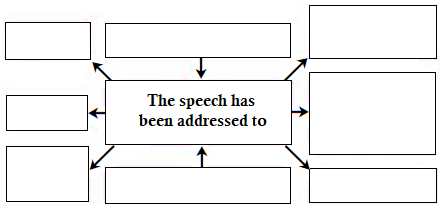
Complete the web-chart:
Image
A3. Activities based on Vocabulary:
(i) Choose the correct meaning of : dignity
(a) self-pride  (b) self-support  (c) self-esteem
(ii) Pick out from the passage the noun forms of the following words:
(a) dignified (b) pursue
A4. Activities based on Contextual Grammar:
Rewrite the following sentences using 'not only....but also...':
(i) This mantra carries a prayer, an aspiration and a resolve that has the potential to liberate humanity from all man-made crises.
(ii) I bow to my late parents, to my motherland India and to the mother earth.
A5. Personal Response:
(i) Write about the various problems that children are facing today.
A1. Simple Factual Activities:
Fill in the blanks with the correct alternatives:
(i) The .................. is called a 'blockhead' by the squire.(Robert/steward)
(ii) The squire's name is .................... . (Robert/Dauphin)
(iii)The price of a horse is ................... .(17 to 18 francs/sixteen francs)
(iv) The ................. will give the girl whatever she needs to free Orleans. (Dauphin/Squire)

   The war fought between England and France from 1337 to 1453 has come to be known as the Hundred Years War. Joan was a peasant girl born in eastern France, who
led the French army to several victories during this war.
   This play begins at the time when all of northern France and some parts of the south-west were under foreign control. The English controlled some parts and the Burgundians controlled the others. The city of New Orleans, one of the few remaining French cities was held by the English. The year is 1429. Captain Robert de Baudricourt, a military officer is seated at the table.His steward stands facing him.

Robert :
I told you to throw the girl out. You have fifty armed soldiers and dozens of
strong servants to carry out my orders. Are they afraid of her ?
Steward : No sir, we are afraid of you, but she puts courage in us. She really doesn’t
seem to be afraid of anything. Perhaps you could frighten her, sir.
Robert : (grimly) Perhaps, where is she now?
Steward : Down in the courtyard, sir.(Robert goes to the window and asks the soldiers to send the girl up.)
(The girl enters. She is a well-built,strong country girl of 17 to 18 years.The squire’s glare neither frightens hernor stops her. She speaks confidently.)
Joan : Good morning, Captain Squire. You are to give me a horse and armour
and some soldiers, and send me to the Dauphin.
Robert : This girl is mad. Why didn’t you tell me so, you blockhead?
Steward : Sir, do not anger her. Give her what she wants.
Robert : I shall send you back to your father with orders to put you under lock and key.
Joan : You think you will, squire. But it won’t happen that way. You said you would
not see me. But here I am.
Robert : So, you are assuming that I’ll give you what you want.
Joan : Yes, squire. (Continues busily) A horse will cost sixteen francs. It is a big amount of money. But I can save it on the armour. I don’t need beautiful armour made to my measure. I can find a soldier’s armour that will fit me well enough. I shall not want many soldiers. The Dauphin will give me, all I need, to free Orleans.

A2. Complex Factual Activities:
Give reasons:
(i) Explain why Joan wanted to meet Captain Squire.
A3. Activities based on Vocabulary:
Classify the following words into adjectives and nouns and complete the table given below:
armed, courage, brave, armour, orders, well-built, squire, strong, amount, beautiful. Orleans
A4. Activities based on Contextual Grammar: 
Make the following sentences affirmative without changing the meaning:

(i) Sir, do not anger her.
(ii) I shall not want many soldiers.
A5. Personal Response:
(i) What, according to you, is the steward's opinion about Joan?<
A1. Simple Factual Activities:
Complete the following :
Image

    Ten years later, when we were designing the first Macintosh computer, it all came back to me. And we designed it all into the Mac. If I had never dropped in on that course in college the Mac would have never had multiple typefaces or for that matter even proportionally spaced fonts.
   And since Windows just copied Mac, it’s likely no personal computer would have them. Of course it was impossible to connect the dots looking forward when I was in college. But it was very clear looking backwards 10 years later.
   You can’t connect the dots looking forward; you can only connect them looking backwards. So you have to trust that the dots will somehow connect in your future. You have to trust in some things - your gut,destiny, life, karma, whatever. This approach has never let me down, and it has made all the difference in my life.

A2. Complex Factual Activities:
Say how:
(i) You can connect dots.
A3. Activities based on Vocabulary:
Match the words/phrases in column A with their meanings in column B:

(A)(B)
 (i) gut (a) Macintosh computer.
 (ii) destiny (b) having several parts.
 (iii) Mac (c) the power believed to control events.
 (iv) multiple (d) courage and determination.

A4. Activities based on Contextual Grammar:
(i) It was impossible to connect the dots looking forward.(Pick out the verbs and say if they are finite or non-finite.)
(ii) It was very clear.(Rewrite as an exclamatory sentence.)
A5. Personal Response:
(i) Write about something which you learned in the past and which has helped you in the present.

A1. Simple Factual Activities:
Fill in the blanks:
(i) Arjan Singh held the post of AOC for ................ years.
(ii) Arjan Singh took over the reins of the IAF on ................. .

     For his role in successfully leading the squadron in combat, he was awarded the Distinguished Flying Cross (DFC) in 1944. On August 15, 1947, he achieved the unique honour of leading a fly-past of over a hundred IAF aircraft over the Red Fort in Delhi.
   After his promotion to the rank of Wing Commander, he attended the Royal Staff College at the UK.Immediately after Indian independence, he commanded Ambala in the rank of Group Captain. In 1949, he was promoted to the rank of Air Commodore and took over as Air Officer Commanding (AOC) of an operational command, which later came to be known as Western Air Command.
   Singh had the distinction of having the longest tenure as AOC of an operational base, initially from 1949-1952 and then again from 1957-1961. After his promotion to the rank of Air Vice Marshal, he was appointed as the AOC-in-C of an operational command.
  Towards the end of the 1962 war, he was appointed as the Deputy Chief of the Air Staff and he became the Vice Chief of the Air Staff in 1963. He was the overall
commander of the joint air training exercise “Shiksha” held between IAF, RAF (Royal Air Force) and RAAF (Royal Australian Air Force)."
   On August 1, 1964, in the rank of Air Marshal, the Marshal of the Air Force Arjan Singh took over reins of IAF, at a time when it was still rebuilding itself and was gearing up to meet new challenges.

A2. Complex Factual Activities:
(i) Describe the uphill task that Singh faced when he took over as Air Marshal.
A3. Activities based on Vocabulary:Give the complete forms of the following:
(i) IAF (ii) RAF (iii) AOC (iv) RAAF
A4. Activities based on Contextual Grammar: 
(i) After his promotion to the rank of Wing Commander, he attended the Royal Staff College at the UK. (Rewrite using the verb form of the underlined word.)
(ii) He was the overall commander of the joint air training exercise 'Shiksha'.(Rewrite using the noun 'command".)
A5. Personal Response:
(i) Describe briefly a brave person whom you have met.
A1. Simple Factual Activity:
Complete the following sentences with the help of the given passage:
(i) The narrator was thinking of catching .......................... .
(ii) When Anil was sleeping peacefully, his face was .......................... .
(iii) The narrator slid his hands under the mattress to .......................... .
(iv) The narrator thought that if he didn't take the money. Anil would only waste .......................... .

   I had been working for Anil for almost a month and, apart from cheating on the shopping, had not done anything in my line of work. I had every opportunity for doing so. Anil had given me a key to the door, and I could come and go as I pleased. He was the most trusting person I had ever met.
    And that is why it was so difficult to rob him. It’s easy to rob a greedy man, because he can afford to be robbed; but it’s difficult to rob a careless man sometimes he doesn’t even notice he’s been robbed and that takes all the pleasure out of the work.
   Well, it’s time I did some real work, I told myself; I’m out of practice. And if I don’t take the money, he’ll only waste it on his friends. After all, he doesn’t even pay me.
   Anil was asleep. A beam of moonlight stepped over the balcony and fell on the bed. I sat up on the floor, considering the situation. If I took the money, I could catch the 10.30 Express to Lucknow. Slipping out of the blanket, I crept up to the bed. Anil was sleeping peacefully. His face was clear and unlined; even I had more marks on my face, though mine were mostly scars.
   My hand slid under the mattress, searching for the notes. When I found them, I drew them out without a sound. Anil sighed in his sleep and turned on his side, towards me. I was startled and quickly crawled out of the room.
   When I was on the road, I began to run. I had the notes at my waist, held there by the string of my pyjamas. I slowed down to a walk and counted the notes: 600 rupees in fifties! I could live like an oil-rich Arab for a week or two.

A2. Complex Factual Activities:
(i) Explain how Hari justified his intention of stealing the money.
A3. Activities based on Vocabulary:
Find from the passage the collocation for the following:
(i) ............... man
(ii) ............... opportunity
A4. Activities based on Contextual Grammar:
Rewrite the following sentences by adding the correct tail tag from those given in the brackets:

(does he?, didn't he?, isn't it?, wasn't he?)
(i) Anil was sleeping peacefully.
(ii) He doesn't even notice he's been robbed.
A5. Personal Response:

(i) What will you do if you are robbed by someone you know very well?
A1. Simple Factual Activities:
Complete the table given below:

 EventYear
(1) The birth of Arjan Singh ..............
(2) Selected for the Empire Pilot Training Course ..............
(3) Promoted to the rank of Squadron Leader ..............
(4) Retired from service ..............

   Commending his role in the war, Y B Chavan, the then Defence Minister had written: “Air Marshal Arjan Singh is a jewel of a person, quite efficient and firm; unexcitable but a very able leader.”
   In 1944, the Marshal had led a squadron against the Japanese during the Arakan Campaign, flying close air support missions during the crucial Imphal Campaign and later assisted the advance of the Allied Forces to Yangoon (formerly Rangoon).
   In recognition of his feat, he was awarded the Distinguished Flying Cross (DFC) on the spot by the Supreme Allied Commander of South East Asia, the first Indian pilot to have received it. Singh was selected for the Empire Pilot training course at Royal Air Force
(RAF) Cranwell in 1938 when he was 19 years old. He retired from service in 1969.
   Singh was born on April 15, 1919, in Lyalpur (now Faislabad, Pakistan), and completed his education at Montgomery (now Sahiwal, Pakistan). His first assignment on being commissioned was to fly Westland Wapiti biplanes in the North-Western Frontier Province
as a member of the No.1 RIAF Squadron.
   After a brief stint with the newly formed No. 2 RIAF Squadron where the Marshal flew against the tribal forces, he later moved back to No.1 Sqn as a Flying Officer to fly the Hawker Hurricane. He was promoted to the rank of Squadron Leader in 1944.

A2. Complex Factual Activities:
Say what actions preceded the following promotions of Arjan Singh in his career in the IAF:
(i) Selected for Empire Pilot training course at RAF:
(ii) Promoted to Squadron Leader:
A3. Activities based on Vocabulary:
Replace the underlined words/phrases with the appropriate ones, to retain the proper meaning:
(be the epitome of. gear up, a brief stint, play a major role, in recognition of, take over reins)
(i) After a short period of working as a lecturer. Ravi took up an important post in a multinational company.
(ii) Accepting the great value of his research, they awarded him with a Ph.D. (degree)
A4. Activities based on Contextual Grammar: 
(i) In 1944, the Marshal had led a squadron against the Japanese during the Arakan Campaign. (Change the voice.)
(ii) His first assignment on being commissioned was to fly Westland Wapiti biplanes in the North- Y Western Frontier Province.(Rewrite as a complex sentence.)
A5. Personal Response:
(i) Name any four qualities that you think a leader must have.

A1.Simple Factual Activities:
(i) Mount Huangshan is situated in __________ .
(a) Japan (b) China (c) Phillipines
(ii) The famous dam situated in Egypt on the River Nile is  __________ .
(a) Buzwaa High Dam (b) Rizwa High Dam (c) Aswan High Dam
(iii) The conference based on Human Environment was held at __________ .
(a) Athens, Greece (b) Moscow, Russia (c) Stockholm. Sweden
(iv) The project of dismantling and moving the temples in the valley to higher ground cost __________ .
(a) $40 million (b) $50 million (c) $ 80 million.

   A World Heritage Site is a site determined by the United Nations Educational, Scientific and Cultural Organization (UNESCO) to have significant cultural or
natural importance to humanity. As such the sites are protected and maintained by the International World Heritage Programme which is administered by the
UNESCO World Heritage Committee. Because World Heritage Sites are places that are significant culturally and naturally, they vary in type but include forests, lakes, monuments, buildings and cities.
    World Heritage Sites can also be a combination of both cultural and natural areas. For example, Mount Huangshan in China is a site with significance to human culture because it played a role in historical Chinese art and literature. The mountain is also
significant because of its physical landscape characteristics.
    Although the idea of protecting cultural and natural heritage sites around the world began in the early twentieth century, momentum for its actual creation was not until the 1950s. In 1954, Egypt started plans to build the Aswan High Dam to collect and control water from the Nile River. The initial plan for the dam’s construction would have flooded the valley containing the Abu Simbel Temples and scores of ancient Egyptian artefacts. To protect the temples and artefacts, UNESCO launched an international campaign in 1959 that called for the dismantling and movement of the temples to higher ground. The project cost an estimated US $80 million, $40 million of which came from 50 different countries. Because of the project’s success, UNESCO and the International Council on Monuments and Sites initiated a draft convention to create an international organization responsible for protecting cultural heritage.
   Shortly thereafter in 1965, a White House Conference in the United States called for a “World Heritage Trust” to protect historic and cultural sites but to also protect
the world’s significant natural and scenic sites. Finally, in 1968, the International Union for Conservation of Nature developed similar goals and presented them at
the United Nations conference on Human Environment in Stockholm, Sweden in 1972. Following the presentation of these goals, the Convention concerning the Protection of World Cultural and Natural Heritage was adopted by UNESCO’s General Conference on November 16, 1972.

A2. Complex Factual Activity:
Give reasons :
(i) UNESCO launched an international campaign in 1959.
A3. Activity based on Vocabulary:
Choose the correct meanings :
(i) determine:
(a) think (b) decide (c) ask (d) look
(ii) monument :
(a) statue (b) pillar (c) memorial (d) fort
(iii) significant :
(a) clever (b) effective (c) systematic (d) important
(iv) convention:
(a) typical (b) agreement (c) old-fashioned (d) persuade
A4. Activities based on Contextual Grammar:
Identify whether the following sentences are Simple, Compound or Complex :
(i) They vary in type but they include forests, mountains, etc.
(ii) The mountain is significant because of its characteristics.
(iii) To protect the temples and artefacts, UNESCO launched an international campalgn.
(iv) The project cost about US $80 million and $40 million came from 50 different countries.
A5. Personal Response:
(i) What are our duties towards preservation or conservation of any historical site?
A1.Simple Factual Activities:
Complete the following :
(i) They decided to have luncheon at _________  at _________ on a _________.

  I answered that I would meet my friend at Foyot’s on Thursday at half-past twelve. She was, in appearance,imposing rather than attractive and she gave me the impression of having more teeth, white and large and even, than were necessary for any practical purpose.She was talkative, but since she seemed to want to talk about me, I was prepared to be an attentive listener.
  I was startled when the menu was brought, for the prices were a great deal higher than I had thought. But she reassured me.
  “I never eat anything for luncheon,” she said.
  “Oh, don’t say that!” I answered generously.
   “I never eat more than one thing. I think people eat far too much nowadays. A little fish, perhaps. I wonder if they have any salmon.”
   Well, it was early in the year for salmon and it was not on the menu, but I asked the waiter if there was any. Yes, a beautiful salmon had just come in-it was the first they had had. I ordered it for my guest. The waiter asked her if she would have something while it was being cooked. “No,” she answered, “I never eat more than one thing. Unless you had a little caviar. I never mind caviar.”
   I knew I could not afford caviar, but I could not very well tell her that. For myself, I chose the cheapest dish on the menu and that was a mutton chop. 
   “I think you’re unwise to eat meat,” she said. “I don’t believe in overloading my stomach.” 
A2. Complex Factual Activity:
Who said these words/sentences? Under what circumstances?

Words/
Sentences
Who
said?
Under what circumstances?
 (i) I never eat anything       for luncheon.  
 (ii) I don't belicve in               overloading  my stomach.  

A3. Activity based on Vocabulary:
Choose the correct options from the brackets and fill in the blanks:
(reassured, imposing, generously, unwise)
(i) The crow was _______ to sing. 
(ii) The king decided to distribute his wealth among his subjects ________.
(iii) I was _______ when I saw that I remembered all that I had revised.
(iii) The monument was really very ________ .
A4. Activities based on Contextual Grammar:
Change the voice of the following sentences :
(i) She reassured me.
(ii) I ordered it for my guest.
A5. Personal Response:
(i) Are you careful in your eating habits?

A1.Simple Simple l Factual Activities:
Name the following from the passage:
(i) Those considered by Kailash Satyarthi as his daughters : 
(ii) The biggest challenge knocking on the doors of humankind : 

   We have made progress in the last couple of decades. We have reduced the number of out-ofschool children by half. We have reduced the number of child labourers by a third. We have reduced child mortality and malnutrition, and we have prevented millions of child deaths.
   But, let us make no mistake, great challenges still remain.
   Friends! The biggest challenge or biggest crisis knocking on the doors of humankind is fear and intolerance.
   We have utterly failed our children in imparting an education. An education that gives the meaning and objective of life. An education that gives a sense of global citizenship among the youth.
   I am afraid that the day is not very far away when the cumulative result of this failure, will culminate in an unprecedented violence, and that will be suicidal for humankind.
    Rights, security, hope can only be restored through education. Young people like Malala ... I’ve started calling her my daughter Malala not just Malala ... So my
daughter Malala and other daughters including Kayanat.. in fact.. two Kayanats, and Shazia, and the daughters from Africa, and from all over the world. They are rising up and choosing peace over violence, tolerance over extremism, and courage over
fear.
    The solutions are emerging. But these solutions cannot be found in the deliberations in conferences alone, and cannot be found in prescriptions from a
distance.They lie in small groups and local organisations and individuals, who are confronting with the problem every day. Even if they remain unacknowledged, unrecognised and unknown to the world the solutions are with them.

A2. Complex Factual Activity:

(i) Make a list of the things that Kailash Satyarthi is not ready to accept:
A3. Activities based on Vocabulary:
Choose the correct option which conveys the exact meanings of:

(i) culminate:
(a) destroy  (b) succeed  (c) rise to a peak
(ii) mortality:
(a) death  (b) virtues  (c) starvation                            
A4. Activities based on Contextual Grammar:
Complete the following sentences with the help of the given sentences:
(i) The biggest challenge knocking on the doors of humankind is fear and intolerance.
A5. Personal Response:
(i) Explain how education can help the deprived children and child labourers.