Question
A1.Simple Simple l Factual Activities:
Select the correct alternative and completeate the following:
(i) Wants to do this, so that no one is left behind in any corner of the world : ................ .
(walk together/remember his ancestors)
(ii) Wants to do this, to show respect to his late parents: ............... . (bow to them/speak to them)
(iii) Feels if we do this, our minds will come together: ................. . (smile/speak together)
(iv) Feels this, each time he frees a child from slavery : ............... .(honoured/liberated)

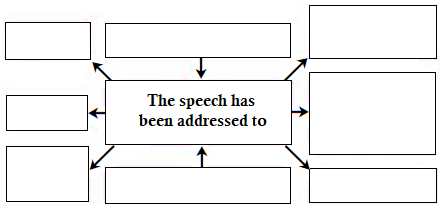
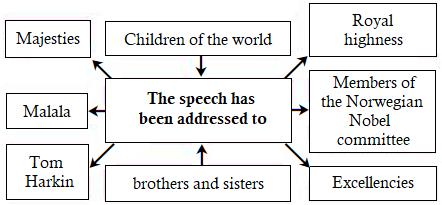
   My dear children of the world ... Your Majesties,Your Royal Highnesses, Excellencies, distinguished members of the Norwegian Nobel Committee, dear brother Tom Harkin, brothers and sisters, and my dear daughter Malala.
   From this podium of peace and humanity, I am deeply honoured to recite a mantra from the ancient texts of wisdom, Vedas. This mantra carries a prayer, an aspiration and a resolve that has the potential to liberate humanity from all man-made crises.
   Let’s walk together. In the pursuit of global progress, not a single person should be left out or left behind in any corner of the world, from East to West, from South to North.
   Let’s speak together, let our minds come together! Learning from the experiences of our ancestors, let us together create knowledge for all that benefits all.
   I bow to my late parents, to my motherland India, and to the mother earth.
   With a warm heart I recall how thousands of times, I have been liberated, each time I have freed a child from slavery. In the first smile of freedom on their beautiful faces, I see the Gods smiling.
   I give the biggest credit of this honour to my movement’s Kaalu Kumar, Dhoom Das and Adarsh Kishore from India and Iqbal Masih from Pakistan who made the supreme sacrifice for protecting the freedom and dignity of children. I humbly accept this award on behalf of all such martyrs, my fellow activists across the world and my countrymen. 

A2. Complex Factual Activity:

Complete the web-chart:
Image
A3. Activities based on Vocabulary:
(i) Choose the correct meaning of : dignity
(a) self-pride  (b) self-support  (c) self-esteem
(ii) Pick out from the passage the noun forms of the following words:
(a) dignified (b) pursue
A4. Activities based on Contextual Grammar:
Rewrite the following sentences using 'not only....but also...':
(i) This mantra carries a prayer, an aspiration and a resolve that has the potential to liberate humanity from all man-made crises.
(ii) I bow to my late parents, to my motherland India and to the mother earth.
A5. Personal Response:
(i) Write about the various problems that children are facing today.
Answer

A1. Simple Factual Activities:
(i) walk together
(ii) bow to them
(iii) speak together
(iv) liberated
A2. Complex Factual Activities:
Image
A3. Activities based on Vocabulary:
(i) (c) self-esteem
(ii) (a) dignity (b) pursuit
A4. Activities based on Contextual Grammar:
(i) This mantra carries not only a prayer, but also an aspiration and a resolve that has the potential to liberate humanity from all man-made crises.
(ii) I bow not only to my late parents, but also to my motherland India and to the mother earth.
A5. Personal Response:
(i) Children in cities face problems like severe competition, addiction to social networking and video games, etc. Children in rural areas face problems like exploitation, bonded labour, poverty, lack of opportunities, etc.

Need a full question paper?

Generate a complete, print-ready paper with questions like this in minutes — across 16+ boards, with answer keys.

Start Generating Free

Similar questions

A1. Simple Factual Activity:
Complete the diagram: (Nov. 20)

Image
   We went to a rocky beach and saw the spread of the majestic ocean and the rocks alongside, carved,sculpted and shaped by the water. Water is so gentle, rock so hard, yet, as the water flows over it every day, for years, the rock gives in. It takes the shape that the water commands. Our problems are so colossal and we
are so small, yet if we persist... 
   We saw small bits of grass peeping through the small cracks in a concrete pavement. It left us thinking: however impossible things may look, there is always
an opening...
   We saw a tree bare of all leaves in the cold winter months. We thought its chapter was over. But three months passed, spring set in and the tree was back to its green majesty once again, full of leaves, flowers, birds and life. What if we too had the conviction that, however difficult things are right now, it will not remain so for ever. Remember, this too shall pass.
   We saw an army of ants lugging a fly which was at least ten times the ant’s size. The ants organized themselves around the fly, lifted it on frail feelers and carried it to quite a distance. Their teamwork and perseverance were impressive. What if we too are
consistent, organized, focused...Spider webs are delicate,yet very strong. A rainbow colours the entire sky.Oysters take in a grain of sand they open up with a pearl. Innumerable stars shine across the infinite sky. Clouds take new shapes with every passing moment.The wind makes trees dance with unhindered passion. Water, without hint of ego, changes its form according to the dictates of the sun and the wind. When we see a caterpillar turn into a butterfly, a flower turn into a fruit, we experience the alchemy of nature... we touch it and become gold ourselves.

A2. Complex Factual Activities:
(i) Which two aspects of nature teach us to accept change and adjust according to the situation?
A3. Activities based on Vocabulary:
(i) Pick out the examples of concrete nouns from the passage.
(ii) Pick out the examples of abstract nouns from the passage.
A4. Activities based on Contextual Grammar:
Do as directed: (Nov. '20)

(i) It takes the shape of water. (Add a question tag.)
(ii) We saw small bits of grass. (Pick out the verb and state whether it is Transitive or Intransitive.)
A5. Personal Response:
(i) An oyster turns a grain of sand into a pearl. What can we learn from this example?
A1. Simple Factual Activities:
Write True or False for these statements:
(i) Steve Jobs slept in his dorm room.
(ii) Steve took his required courses as a registered student of Reed College.
(iii) During Steve's College days, one had to pay 5 cents deposit for a Coke bottle.
(iv) Steve had comfortable college experiences.

   Today I want to tell you three stories from my life. That’s it. Just three stories. The first story is about connecting the dots. I dropped out of Reed College after the first 6 months, but then stayed around as a drop-in for another 18 months before I really quit.
Looking back, it was one of the best decisions I ever made. I could stop taking the required classes that didn’t interest me, and begin dropping in on the ones that looked interesting.
   I didn’t have a dorm room, so I slept on the floor in friends’ rooms. I returned Coke bottles for the 5 cent deposits to buy food with, and I would walk seven miles across town every Sunday night to get one good meal a week at the Hare Krishna temple. I loved it. And much of what I stumbled into by following my curiosity and intuition turned out to be priceless later on. Here’s one example : Reed College offered perhaps the best calligraphy instruction in the country. Because I had to take a calligraphy class, I learned about serif and san serif typefaces, about what makes great typography great.

A2. Complex Factual Activities:
(i) What did Steve Jobs do for two years after he joined Reed College?
A3. Activities based on Vocabulary:
Use the following idioms/phrases in sentences of your own:
(i) drop in
(ii) drop out
(iii) turned out to be
(iv) stumbled into
A4. Activities based on Contextual Grammar:
Name the tense of the underlined verbs to include time and aspect:
(i) I shall be telling you three stories.
(ii) I slept on the floor.
A5. Personal Response:
(i) What impression of Steve Jobs do you get from this passage?
A1.Simple Factual Activities:
Write if the following statements are True or False:
(i) The writer thought that the lady was rean.
(ii) The writer's tip was rather inadequate. 
(iii) The lady was now like a stone. 
(iv) The writer planned to have a heavy inner.

   “You see, you’ve filled your stomach with a lot of meat,” my one miserable little chop “and you can’t eat any more. But I’ve just had a snack and I shall enjoy a peach.”
   The bill came and when I paid it I found that I had only enough for a quite inadequate tip. Her eyes rested for an instant on the three francs I left for the 
waiter and I knew that she thought me mean. But when I walked out of the restaurant I had the whole month before me and not a penny in my pocket.
   “Follow my example,” she said as we shook hands,“and never eat more than one thing for luncheon.”
   “I’ll do better than that,” I retorted, “I’ll eat nothing for dinner tonight.”
   “Humorist!” she cried gaily, jumping into a cab. “You’re quite a humorist!”
    But I have had my revenge at last. I do not believe that I am a vindictive man, but when the gods take a hand in the matter it is understandable to observe the result with satisfaction. Today, she weighs twenty- one stone.

A2. Complex Factual Activity:
Complete the reasons :
(i) The writer planned to 'eat nothing' for dinner that night because....
A3. Activity based on Vocabulary:
Fill in the blanks with one word from the passage for the following :
(i) Something that is not enough : __________
(ii) A man who is revengeful : __________
(iii) A person who fills his or her writings with humour : __________
(iv) A person who is stingy and does not like to spend money : __________
A4. Activities based on Contextual Grammar:
Pick out the verbs from the following sentences and write their tense:
(i) Tve just had a snack and 1 shall enjoy a peach.
(ii) The bill came and when I paid it 1 found that I had only enough for a quite inadequate tip.
A5. Personal Response:
(i) Do you think that the lady never 'ate more than one thing for luncheon' on a regular basis?
A1.Simple Simple l Factual Activities:
Name the following from the passage:
(i) Those considered by Kailash Satyarthi as his daughters : 
(ii) The biggest challenge knocking on the doors of humankind : 

   We have made progress in the last couple of decades. We have reduced the number of out-ofschool children by half. We have reduced the number of child labourers by a third. We have reduced child mortality and malnutrition, and we have prevented millions of child deaths.
   But, let us make no mistake, great challenges still remain.
   Friends! The biggest challenge or biggest crisis knocking on the doors of humankind is fear and intolerance.
   We have utterly failed our children in imparting an education. An education that gives the meaning and objective of life. An education that gives a sense of global citizenship among the youth.
   I am afraid that the day is not very far away when the cumulative result of this failure, will culminate in an unprecedented violence, and that will be suicidal for humankind.
    Rights, security, hope can only be restored through education. Young people like Malala ... I’ve started calling her my daughter Malala not just Malala ... So my
daughter Malala and other daughters including Kayanat.. in fact.. two Kayanats, and Shazia, and the daughters from Africa, and from all over the world. They are rising up and choosing peace over violence, tolerance over extremism, and courage over
fear.
    The solutions are emerging. But these solutions cannot be found in the deliberations in conferences alone, and cannot be found in prescriptions from a
distance.They lie in small groups and local organisations and individuals, who are confronting with the problem every day. Even if they remain unacknowledged, unrecognised and unknown to the world the solutions are with them.

A2. Complex Factual Activity:

(i) Make a list of the things that Kailash Satyarthi is not ready to accept:
A3. Activities based on Vocabulary:
Choose the correct option which conveys the exact meanings of:

(i) culminate:
(a) destroy  (b) succeed  (c) rise to a peak
(ii) mortality:
(a) death  (b) virtues  (c) starvation                            
A4. Activities based on Contextual Grammar:
Complete the following sentences with the help of the given sentences:
(i) The biggest challenge knocking on the doors of humankind is fear and intolerance.
A5. Personal Response:
(i) Explain how education can help the deprived children and child labourers.
A1.Simple Factual Activities:
Complete the following :
(i) Della had saved __________.
(ii) The current family income was __________.

    One dollar and eighty-seven cents. That was all. And sixty cents of it was in pennies. Pennies saved one and two at a time by bulldozing the grocer and the vegetable man and the butcher until one’s cheeks burned with the silent imputation of parsimony that
such close dealing implied. Three times Della counted it. One dollar and eighty-seven cents. And the next day would be Christmas.
   There was clearly nothing to do but flop down on the shabby little couch and howl. So Della did it which instigates the moral reflection that life is made up of sobs, sniffles, and smiles, with sniffles predominating.
   While the mistress of the home is gradually subsiding from the first stage to the second, take a look at the home. A furnished flat at $8 per week. It did not exactly beggar description, but it certainly had that word on the look out for the mendicancy squad.
   In the vestibule below was a letter-box into which no letter would go, and an electric button from which no mortal finger could coax a ring. Also appertaining there unto was a card bearing the name “Mr. James Dillingham Young.”
  The “Dillingham” had been flung to the breeze during a former period of prosperity when its possessor was being paid $30 per week. Now, when the income was shrunk to $20, though, they were thinking seriously of contracting to a modest and unassuming D. But whenever Mr. James DillinghamYoung came home and reached his flat above he was called ‘‘Jim” and greatly hugged by Mrs. James Dillingham Young, already 
introduced to you as Della which is all very good. 

A2. Complex Factual Activity:

(i) List the signs that indicate that Della was very poor.
A3. Activity based on Vocabulary:
Pick out from the passage words that mean the following, and state if it is a Noun, Verb or Adjective :

PhraseWord From
the passage
Part of Speech
(1) Reluctance to spend money  
(2) Relating to  
(3) Urge  
(4) provokes  

A4. Activities based on Contextual Grammar:
Frame 'Wh'-questions to get the underlined parts as the answers :
(i) Life is made up of sobs, sniffles and smiles.
(ii) Many a happy hour she had spent plauning something nice for him.
A5. Personal Response:
(i) Della counted the money thrice. Explain what you think the reason for this may be.

A1.Simple Factual Activities:
(i) Mount Huangshan is situated in __________ .
(a) Japan (b) China (c) Phillipines
(ii) The famous dam situated in Egypt on the River Nile is  __________ .
(a) Buzwaa High Dam (b) Rizwa High Dam (c) Aswan High Dam
(iii) The conference based on Human Environment was held at __________ .
(a) Athens, Greece (b) Moscow, Russia (c) Stockholm. Sweden
(iv) The project of dismantling and moving the temples in the valley to higher ground cost __________ .
(a) $40 million (b) $50 million (c) $ 80 million.

   A World Heritage Site is a site determined by the United Nations Educational, Scientific and Cultural Organization (UNESCO) to have significant cultural or
natural importance to humanity. As such the sites are protected and maintained by the International World Heritage Programme which is administered by the
UNESCO World Heritage Committee. Because World Heritage Sites are places that are significant culturally and naturally, they vary in type but include forests, lakes, monuments, buildings and cities.
    World Heritage Sites can also be a combination of both cultural and natural areas. For example, Mount Huangshan in China is a site with significance to human culture because it played a role in historical Chinese art and literature. The mountain is also
significant because of its physical landscape characteristics.
    Although the idea of protecting cultural and natural heritage sites around the world began in the early twentieth century, momentum for its actual creation was not until the 1950s. In 1954, Egypt started plans to build the Aswan High Dam to collect and control water from the Nile River. The initial plan for the dam’s construction would have flooded the valley containing the Abu Simbel Temples and scores of ancient Egyptian artefacts. To protect the temples and artefacts, UNESCO launched an international campaign in 1959 that called for the dismantling and movement of the temples to higher ground. The project cost an estimated US $80 million, $40 million of which came from 50 different countries. Because of the project’s success, UNESCO and the International Council on Monuments and Sites initiated a draft convention to create an international organization responsible for protecting cultural heritage.
   Shortly thereafter in 1965, a White House Conference in the United States called for a “World Heritage Trust” to protect historic and cultural sites but to also protect
the world’s significant natural and scenic sites. Finally, in 1968, the International Union for Conservation of Nature developed similar goals and presented them at
the United Nations conference on Human Environment in Stockholm, Sweden in 1972. Following the presentation of these goals, the Convention concerning the Protection of World Cultural and Natural Heritage was adopted by UNESCO’s General Conference on November 16, 1972.

A2. Complex Factual Activity:
Give reasons :
(i) UNESCO launched an international campaign in 1959.
A3. Activity based on Vocabulary:
Choose the correct meanings :
(i) determine:
(a) think (b) decide (c) ask (d) look
(ii) monument :
(a) statue (b) pillar (c) memorial (d) fort
(iii) significant :
(a) clever (b) effective (c) systematic (d) important
(iv) convention:
(a) typical (b) agreement (c) old-fashioned (d) persuade
A4. Activities based on Contextual Grammar:
Identify whether the following sentences are Simple, Compound or Complex :
(i) They vary in type but they include forests, mountains, etc.
(ii) The mountain is significant because of its characteristics.
(iii) To protect the temples and artefacts, UNESCO launched an international campalgn.
(iv) The project cost about US $80 million and $40 million came from 50 different countries.
A5. Personal Response:
(i) What are our duties towards preservation or conservation of any historical site?
A1.Simple Simple l Factual Activities:
Fill in the blanks:
(i) Two scientists other than Stephen Hawking mentioned in this passage are ................ and ................. .
(ii) Hawking was ............. years old when he was admitted into a medical clinic.
(iii) Hawking first began to notice problems with his physical health while he was at .................. .

    The Grand Design was Hawking’s first major publication in almost a decade. Within his new work,Hawking set out to challenge Sir Isaac Newton’s belief that the universe had to have been designed by God,simply because it could not have been born from chaos. 
  “It is not necessary to invoke God to light the blue touch paper and set the universe going,” Hawking said.
   At the age of 21, Stephen Hawking was diagnosed with amyotrophic lateral sclerosis (ALS, or Lou Gehrig’s disease). In a very simple sense, the nerves that controlled his muscles were shutting down. At the time, doctors gave him two and a half years to live.
   Hawking first began to notice problems with his physical health while he was at Oxford - on occasion he would trip and fall, or slur his speech - he didn’t look into the problem until 1963, during his first year at Cambridge. For the most part, Hawking had kept these symptoms to himself. But when his father took notice of the condition, he took Hawking to see a doctor. For the next two weeks, the 21-year-old college
student made his home at a medical clinic, where he underwent a series of tests.
   “They took a muscle sample from my arm, stuck electrodes into me, and injected some radio-opaque fluid into my spine, and watched it going up and down with
X-rays, as they tilted the bed,” he once said. “After all that, they didn’t tell me what I had, except that it was not multiple sclerosis, and that I was an atypical case.”

A2. Complex Factual Activity:
Complete the following map:
Image
A3. Activity based on Vocabulary:
Complete the following:

(i) A decade is a period of ............... .
(ii) ............. refers to the formless matter supposed to have existed before the creation of the universe.
A4. Activities based on Contextual Grammar:
(i) He would trip and fall or slur his speech.(Rewrite using 'not only...but also.....)
(ii) He didn't look into the problem until 1963. (Rewrite without 'didn't'.)
A5. Personal Response:
(i) You must have suffered from some illness or sickness. Mention two or three symptoms.
A1.Simple Simple l Factual Activities:
Choose the correct alternatives from the given statements:
(i) What was most astonishing about the 102-year- old Swamiji?
(a) He was a great speaker and orator.
(b) He was a great scientist.
(c) He was a great admirer of technology.
(d) He looked as steady and alert as any other youngster.
(ii) The year 2009 is significant because of:
(a) The invitation extended to Dr Kalam.
(b) The 102nd birthday celebrations of His Holiness Dr Sri Sri Shivakumara Mahaswamiji.
(c) The establishment of the free residential education system in Dr Sri Sri Shivakumara Mahaswamiji's ashram.
(d) The discourse given by Dr Sri Sri Shivakumara Mahaswamiji.
 
   In April 2009, Dr Kalam was invited to attend  the 102nd birthday celebrations of His Holiness Dr Sri Sri Shivakumara Mahaswamiji in the Tumkur district of Karnataka. Mahaswamiji is a remarkable person, who has dedicated his life to the service of humanity. His greatest contribution is the establishment of a free residential education system for more than nine thousand children in the ashram. The most astonishing
aspect of the entire event of his birthday was that the 102 year old Swamiji stood on his feet without any support! He looked as steady and alert as any other youngster present there. This display of inner strength touched Dr Kalam deeply.
   A couple of days later, we were discussing this unusual birthday party. I said to him, ‘Sir, do you know, only four out of 1 lakh people cross the age of 100 ?’ I had googled the subject beforehand. He replied,‘But how many of these four would be able to stand
tall for half an hour, give a wise discourse, and then go on to feed thousands of children?’ Of course nobody could know the exact answer to his question but the question itself led to many other relevant queries. ‘I wonder what powers Mahaswamiji possesses that keep him so strong at such an advanced age ? Maybe it’s a balanced diet and a healthy lifestyle, or perhaps it’s genetics ?’ I asked.

A2. Complex Factual Activity:
Find evidence from the passage that indicates that Swamiji:
(i) was dedicated
(ii) has inner strength
(iii) contributed to the good of the society
(iv) was younger than the young generation
A3. Activities based on Vocabulary:
Write the opposites of the following words using prefixes (un-, in-, etc.):
(i) invited
(ii) remarkable
(iii) humanity
(iv) wise.
A4. Activities based on Contextual Grammar:
(i) This display of inner strength touched Dr Kalam deeply. (Rewrite beginning 'Dr Kalam......)
(ii) God will shine through us. (Add a question tag.)
A5. Personal Response:
(i) What measures will you take to keep yourself physically and mentally fit?
A1. Simple Factual Activities :
Complete the following:

(i) The narrator is quite successful at stealing.
(ii) The T in the story refers to the narrator, who called himself Hari Singh.
   I was still a thief when I met Anil. And though only only 15. I was an experienced and fairly successful hand.
   Anil was watching a wrestling match when I approached him. He was about 25 a tall, lean fellow - and he looked easy-going, kind and simple enough for my purpose. I hadn't had much luck of late and thought I might be able to get into the young man's confidence.
   "You look a bit of a wrestler yourself." I said. A little flattery helps in making friends.
   "So do you," he replied, which put me off for a moment because at that time I was rather thin.
   "Well," I said modestly, "I do wrestle a bit."
   "What's your name?"
   "Hari Singh," I lied. I took a new name every month. That kept me ahead of the police and my former employers.
    After this introduction, Anil talked about the well-oiled wrestlers who were grunting, lifting and throwing each other about. I didn't have much to say. Anil walked away. I followed casually.
   "Hello again," he said.
    I gave him my most appealing smile. "I want to work for you," I said.
   "But I can't pay you."
    I thought that over for a minute. Perhaps I had misjudged my man.
    I asked, "Can you feed me?"
    "Can you cook?"
    "I can cook." I lied again.
    "If you can cook, then may be I can feed you."

A2. Complex Factual Activities:
Give reasons:
(i) The narrator changed his name every month.  
A3. Activities based on Vocabulary:
Insert the appropriate word/phrase given below, in the sentences that follow:
(flattery, appealing. by fits and starts. dashed to, undetected, spirits rose)
(i) Do not stoop to _________ Just to gain something from someone.
(ii) When the baby saw its mother, it gave an _________ smile.
A4. Do as directed:
(i) I can't pay you. (Rewrite making it affirmative.)
(ii) "I want to work for you," I said. (Change into Indirect speech.)
A5. Personal Response:
(i) 'We should learn from our own mistakes.' Explain.
A1. Simple Factual Activities:
Write if the following statements are True or False: 
(i) Joan is angry when Robert tells her to get out.
(ii) Joan feels that Squire Jack is kind.
(iii) The steward's name is Bertrand de Poulengey.
(iv) Robert thinks that the girl's idea is crazy.

Robert : (Shocked) To free Orleans!
Joan : (Simply) Yes, squire. Three men will be enough for you to send with me. Polly
and Jack have promised to come with me.
Robert : You mean Monsieur de Poulengey?
Joan : Yes, Squire Jack will come willingly.He is a very kind gentleman, and gives
me money to give to the poor. I think John Godsave will come, and Dick the Archer, and their servants, John of Honecourt and Julian. There will be no trouble for you, squire. I have arranged it all. You have only to give the order.
Robert : (To the steward) Is this true about Monsieur de Poulengey ?
Steward : (Eagerly) Yes, sir, and about Monsieur de Metz too. They both want to go with her.
Robert : (Goes to the window, and shouts into the court-yard.) Send Monseiur de Poulengey to me, will you? (He turns to Joan) Get out and wait in the yard.
Joan : (Smiling brightly at him) Right, squire. (She goes out).
Robert : (To the steward) Go with her. Stay within call and keep your eye on her.
I shall have her up here again. (The steward retreats hastily. Bertrand de Poulengey, a French guard, enters, salutes and stands waiting.)
Robert : She says you, Jack and Dick have offered to go with her. What for ? Do
you take her crazy idea of going to the Dauphin seriously ?  

A2. Complex Factual Activities:
Name the persons needed by Joan to free Orleans.
(i) Explain why Joan wanted to meet Captain Squire.
A3. Activities based on Vocabulary:
(i) Pick out four adverbs of manner from the passage.
A4. Activities based on Contextual Grammar: 
Make the following sentences affirmative without changing the meaning:

(i) Polly and Jack have promised to come with me.(Rewrite using "that".)
(ii) You have only to give the order. (Rewrite using 'nothing'.) 
A5. Personal Response:
(i) 'I have arranged it all'. What does this statement tell you about Joan?