Question
A1. Simple Factual Activities:
State whether the following statements are True or False:
(1) Pitchblende is a black, very hard and cheap substance.
(2) Men could see many substances through the powerful rays of Uranium.
(3) The emperor of Austria gifted a ton of pitchblende to the Curies
(4) The Curies sacrificed all their luxuries of life to save money to buy pitchblende.

      Marie was specially interested in a substance called uranium which was obtained from pitchblende, a black, very hard and very expensive substance. Uranium was known to give off very powerful rays by which men could see through many substances. Now Marie discovered that what was left after obtaining uranium was even more powerful. Later on, Pierre and Marie found that there was not one, but two new substances giving off these rays although they had not yet been able to obtain either of them. They called one of them Polonium, in honour of her country. Poland and the other was called Radium. Radium is the most powerful of the radio-active elements. And radio-active elements can give off rays which can penetrate substances that are opaque to light. There was another French scientist called Henri Becquerel, who in 1896 had discovered that uranium possessed this property. But Polonium and Radium possessed radio-active in much higher degree.
     The Curies now began to work with greater enthusiasm, but they were poor and pitchblende itself was an extremely expensive substance, which they could not afford to buy in large quantity. They, however, sacrificed all the luxuries of life to save money to buy whatever little amount of pitchblende they could. They lived in utter penury, not buying costly food and warm clothes for the extremely cold Parisian winter. Often they could not sleep during the cold nights due to lack of warmth. Overwork seriously affected Madame Curie’s health. Often she was forced to leave the laboratory to take a much needed rest. Her husband begged her to give up the struggle, but she resolutely refused. Marie was driven by a mad determination to discover the mystery of radium. With courage she faced all the miseries of a life of poverty and carried on with her research along with her husband who loved and supported her.
      Luck, however, favoured the Curies and a windfall came to them. It was a gift of a ton of pitchblende from the emperor of Austria, who was an admirer of the Curies. It was the most precious gift the Curies had received and in their shabby laboratory they toiled along, boiled and burnt, overpowered by heat in summer and frozen with cold in winter.

A2. Complex Factual Activities:
(1) What proves Marie's strong will power?
A3. Activities based on Vocabulary:
Find out antonyms for the following from the passage:
(1) economical ×
(2) poverty × 
(3) chill × 
(4) worthless ×
A4. Activities based on Contextual Grammar:
Change the degree:
(1) Pitchblende was the most precious gift the Curies had received.
A5. Personal Response:
(1) What qualities, do you think, are important to get success in our life?
Answer

A1. Simple Factual Activities:
(1) False
(2) True
(3) True
(4) True
A2. Complex Factual Activities:
(1) When the couple could not buy pitchblende which was an expensive substance they sacrificed all the luxuries of life to save money. They lived in extreme poverty. They could not buy costly food and warm clothes for extremely cold Parisian winter.They could not sleep due to lack of warmth. Marie refused to take rest whenever her husband begged her to give up the struggle.
    All the above incidents prove that Marie had a strong will power to achieve the aim of her life.
A3. Activity based on Vocabulary:
(1) economical × expensive
(2) poverty × luxury
(3) chill × warmth
(4) worthless × precious
A4. Activity based on Contextual Grammar:
(1) (a) Positive - No other gift the Curies had received was as precious as pitchblende.
(b) Comparative - Pitchblende was more precious gift than any other gifts the Curies had received.
A5. Personal Response:
(1) There are some key components of success without which we cannot succeed in our life.
    First our mindset without a positive mindset the rest of these components won't have as much power as they should. Staying focused on goal is also important. Besides it, dedication, discipline and determination are important factors to get success in our life.

Need a full question paper?

Generate a complete, print-ready paper with questions like this in minutes — across 16+ boards, with answer keys.

Start Generating Free

Similar questions

A1. Simple Factual Activities:
Name the following:
(1) Military officer
(2) A peasant girl
(3) The oldest son of the King France
(4) The persons who Joan needed to free Orleans

    The war fought between England and France from 1337 to 1453 has come to be known as the Hundred Years War. Joan was a peasant girl born in eastern
France who led the French army to several victories during this war.
    This play begins at the time when all of northern France and some parts of the south-west were under foreign control. The English controlled some parts and the Burgundians controlled the others. The city of New Orleans, one of the few remaining French cities was held by the English. The year is 1429. Captain Robert de Baudricourt, a military officer is seated at the table. His steward stands facing him.
Robert : I told you to throw the girl out. You have fifty armed soldiers and dozens of strong servants to carry out my orders. Are they afraid of her ?
Steward : No sir, we are afraid of you, but she puts courage in us. She really doesn’t seem to be afraid of anything. Perhaps you could frighten her, sir.
Robert : (grimly) Perhaps, where is she now ?
Steward : Down in the courtyard, sir.
(Robert goes to the window and asks the soldiers to send the girl up)
(The girl enters. She is a well-built, strong country girl of 17 to 18 years. The squire’s glare neither frightens her nor stops her. She speaks confidently.)
Joan : Good morning, captain squire. You are to give me a horse and armour and some soldiers, and send me to the Dauphin.
Robert : This girl is mad. Why didn’t you tell me so, you blockhead ?
Steward : Sir, do not anger her. Give her what she wants.
Robert : I shall send you back to your father with orders to put you under lock and
key.
Joan : You think you will, squire. But it won’t happen that way. You said you would not see me. But here I am.
Robert : So, you are assuming that I’ll give
you what you want.
Joan : Yes, squire. (Continues busily) A horse will cost sixteen francs. It is a big
amount of money. But I can save it on the armour. I don’t need beautiful armour made to my measure. I can find a soldier’s armour that will fit me well enough. I shall not want many soldiers. The Dauphin will give me, all I need, to free Orleans.
Robert : (Shocked) To free Orleans !
Joan : (Simply) Yes, squire. Three men will be enough for you to send with me.
Polly and Jack have promised to come with me.
Robert : You mean Monsieur de Poulengey ?
Joan : Yes, Squire Jack will come willingly. He is a very kind gentleman, and gives me money to give to the poor. I think John Godsave will come, and Dick the Archer, and their servants, John of Honecourt and Julian. There will be no trouble for you, squire. I have arranged it all. You have only to give the order.

A2. Complex Factual Activities:
(1) Why had Joan wanted to meet the Captain Squire? 
A3. Activities based on Vocabulary:
Give one word for the following:
(1) A person of high rank
(2) A stupid person
(3) To take for granted
(4) Military unit consisting of armoured fighting vehicles
A4. Activities based on Contextual Grammar:
(1) He is a very kind gentleman. (Make it exclamatory.)
(2) She is a well-built strong country girl. (Make it exclamatory.)
A5. Personal Response:
(1) Describe any brave lady as Joan of Arc, from India who fought for her nation.
A1. Simple Factual Activities:
(1) The garland of marriage was made of _______________.
(a) roses
(b) yellow marigolds
(c) lilies
(2) Bishamber demanded _______________ to get married to Bholi.
(a) two thousand rupees
(b) three thousand rupees
(c) five thousand rupees.

     The bridegroom lifted the garland of yellow marigolds. A woman slipped back the silken veil from the bride’s face. Bishamber took a quick glance. The garland remained poised in his hands. The bride slowly pulled down the veil over her face.
     “Have you seen her ?” said Bishamber to the friend next to him. “She has pockmarks on her face.”
     “So what ? You are not young either.”
     “Maybe. But if I am to marry her, her father must give me five thousand rupees.”
     Ramlal went and placed his turban - his honour - at Bishamber’s feet. “Do not humiliate me so. Take two thousand rupees.”
     “No. Five thousand, or we go back. Keep your daughter.”
     “Be a little considerate, please. If you go back, I can never show my face in the village.”
     “Then out with five thousand.”
     Tears streaming down his face, Ramlal went in, opened the safe and counted out the notes. He placed the bundle at the bridegroom’s feet.
     On Bishamber’s greedy face appeared a triumphant smile. He had gambled and won. “Give me the garland,” he announced.
     Once again the veil was slipped back from the bride face but this time her eyes were not downcast. She was looking up, looking straight at her prospective husband, and in her eyes there was neither anger nor hate, only cold contempt.
      Bishamber raised the garland to place it round the bride’s neck but before he could do so, Bholi’s hand struck out like a streak of lightening and garland was flung into the fire. She got up and threw away the veil.
     “Pitaji” said Bholi in a clear loud voice; and her father, mother, sisters, brothers, relations and neighbours were startled to hear her speak without even the slightest stammer.
     “Pitaji”, take back your money. I am not going to marry this man.”
      Ramlal was thunderstruck. The guests began to whisper, “So shameless! So ugly and so shameless !”
     “Bholi, are you crazy ?” shouted Ramlal. “You want to disgrace your family? Have some regard for out izzat!”
     “For the sake of your izzat,” said Bholi, “I was willing to marry this lame old man. But I will not have such a mean, greedy and contemptible coward as my husband. I won’t, I won’t, I won’t.”
     What a shameless girl! We all thought she was a harmless dumb cow.”

A2. Complex Factual Activities:
Complete the following web :
Image
A3. Activities based on Vocabulary:
(1) garment that covers the head and face
(2) hurt the pride of
(3) joyful and proud especially because of success
(4) related to the future
A4. Activities based on Contextual Grammar:
Do as directed:
(1) What a shameless girl! (Make it assertive.)
(2) Bishamber raised the garland to place it round the bride's neck. (Frame a wh-question to get the underlined part as an answer)
A5. Personal Response:
(1) What did you learn from Bholi's action of not getting married to Bishamber? 
A1. Simple Factual Activity:
Say whether the following statements are True or False:
(1) At the age of 17, Dr Stephen Hawking was suffering from an extremely rare disease.
(2) Stephen's teachers liked his handwriting very much.
(3) He got his Ph.D. studying the concept of 'Black Holes'.
(4) At the dismal stage Dr Hawking enjoyed his life the most. 

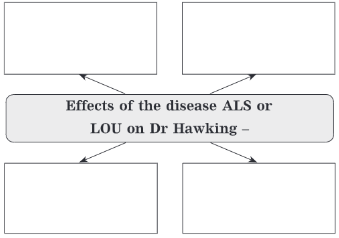
     At the age of 17, Stephen started noticing that he was becoming increasingly clumsy and even fell down a couple of times, for no reason. This perplexed him and he went to see his family doctor, who diagnosed him as suffering from an extremely rare disease - ALS or LOU Gehrig's disease that affects the nervous system and eventually weakens all the muscles of the body. Stephen says that even as a child, his muscle co-ordination was nothing to write home about. He recollects that his handwriting would send his teacher into a fit of frenzy. Nor was he inclined towards sports. Nevertheless, this disease came as a bolt from the blue.
      How much time he had left on this planet was very uncertain. The prognosis was bad and the doctors said they could not do much. Undaunted, Stephen decided to continue his research and even got engaged to a Jane Wilde. Hawking says that,
ironic as it may sound, it is at this dismal stage, began enjoying life the most. This he says was because he started living life for the moment and continued his doctoral research work with renewed vigour.
     In the meanwhile, the disease worked its way into Stephen’s body and left him disabled. He began studying the concept of “Black Holes”, to get his Ph.D. By this time, he was confined to a wheelchair and was rapidly losing control of his hands and
speech. The study of “black holes” sparked his imagination with bright ideas. He made many epochmaking statements that shook established theories.Scientists believe that the universe began with a “Big Bang”. To explain this concept better, Stephen invented what is known as “Lie Algebra”.

A2. Complex Factual Activity:
(1) Complete the following web showing the effects of the disease ALS or LOU on Dr Hawking:
Image
A3. Activities based on Vocabulary:
Match the words in Column 'A' with their meanings in Column 'B':

Column 'A'Column 'B'
 (1) confined (a) determined despite difficulties
 (2) undaunted (b) awkward
 (3) perplexed (c) restricted
 (4) clumsy (d) worried because of difficulty

A4. Activities based on Contextual Grammar:
Change the following sentences as instructed: 
(1) He made many epochmaking statements.
(Rewrite the sentence using Present Continuous Tense.)
(2) This disease came as a bolt from the blue.
(Rewrite the sentence using Past Perfect Tense.)
Ans. This disease had come as a bolt from the blue.
A5. Personal Response:
(1) What, do you think, are the miseries of a person who is confined to wheelchair?

A1. Simple Factual Activities:
Complete the sentences:
(1) A tiny bird was rushing towards _________.
(2) A heavy fire had broken out in the _________.
(3) The speaker is appealing to globalise _________.
(4) The tiny bird was going to _________.

     We can do it ...
     You may ask that - what can one person do? I would recall a story of my childhood: A heavy fire had broken out in the forest. All the animals were running away, including lion, the king of the forest. Suddenly, then he saw a tiny bird rushing towards the fire. He asked the bird, “What are you doing?” To the lion’s surprise, the bird replied “I am going to extinguish the fire.” The lion laughed and said, “How can you do it keeping just one drop of water, in your beak?” The bird was adamant, and she said, “I am doing my bit.”
     Eighteen years ago, millions of individuals marched across the globe. And demanded a new international law for the abolition of worst form of child labour, and it has happened, we did it, millions of individuals did it.
     Friends! We live in an age of rapid globalisation. We are connected through high-speed Internet. We exchange our goods and services in one single global market. Thousands of flights every day connect us from one corner to another corner of the globe. But there is one serious disconnect and there is a lack of compassion. Let us inculcate and transform these individuals’ compassion into a global compassion.
Let us globalise compassion.
     Mahatma Gandhi said, “If we are to teach real peace in this world... we shall have to begin with the children.” I humbly add, let us unite the world through the compassion for our children.
     I ask - Whose children are they who stitch footballs, yet never played with one?
     Whose children are they who harvest cocoa, yet have never tasted chocolate?
     Whose children are they who are dying of Ebola?
     Whose children are they who are kidnapped and held hostage?
     They are all our children.
     I remember an eight-year-old girl we rescued from intergenerational forced labour from stone quarries. When she was sitting in my car right after her rescue, she asked me: “Why did you not come earlier?”
     Her angry question still shakes me – and has the power to shake the whole world. Her question is for all of us. What are we doing? What are we waiting for? How many girls will we allow to go without rescue?
     Children are questioning our inaction and watching our actions. We need collective actions with a sense of urgency.
     Every single minute matters, every single child matters, every single childhood matters.
     Therefore, I challenge the passivity and pessimism surrounding our children. I challenge this culture of silence and this culture of passivity, this culture of neutrality.

A2. Complex Factual Activities:

Complete the following web:
Image

A3. Activities based on Vocabulary:
(1) Use the word 'stitch' as a Noun and a Verb in separate meaningful sentences.
A4. Activities based on Contextual Grammar:
Add a question tag:
(1) We are connected through high-speed internet.
(2) We exchange our goods and services in one single global market.
A5. Personal Response:
(1) What lesson does the story of the lion and the tiny bird teach us? 
A1. Simple Factual Activity:
(1) Dr Hawking is a very humble man, though he is considered _______________ .
(2) Dr Hawking expressed his thoughts with the help of his _______________.

    Though confined to a wheel chair with no control over his body save a finger and with
a computer to help him express his thoughts. Dr Hawking is an authority on profound subjects of science. Numerous honorary doctorates and awards have been bestowed
on him. He is a Fellow of The Royal Society and a Member of the US National Academy of Sciences.
     In spite of being considered Einstein’s equal in intelligence, Dr. Hawking is a very humble man. A simple, down to earth man, he has authored many books dealing with his awesome ideas keeping a layman in mind. His writing is full of wit and humour. His style is so lucid that non-scientists can also understand him. His book, “A Brief History of Time” is one of the best selling books of our times.
     On being asked, how he feels about having the dreadful ALS, Dr Hawking, the quintessence of optimism and hope, says, “Not very different from the rest. I try and lead as normal a life as possible, and not think about my condition or regret the things it prevents me from doing, which are not many.”
      Dr Hawking firmly believes that in the next millenium, science will discover the core secrets of the universe, its origin, its history and maybe even predict its ultimate demise.
      Like Dr Hawking, there are many people who display exemplary courage in their lives. Let us salute all those brave people, who in spite of being disabled strive to do their best.

A2. Complex Factual Activity:
(1) What does the writer say about the books authored by Dr Hawking? 
A3. Activities based on Vocabulary:
Match the words in Column 'A' with their meanings in Column 'B':

Column 'A'Column 'B'
 (1) profound (a) a person without any special skill
 (2) awesome (b) a perfect example
 (3) layman (c) showing very great (knowledge) 
 (4) quintessence (d) very impressive

A4. Activities based on Contextual Grammar:
Convert the following to Interrogative (Question) Form:
(1) The prognosis was bad.
(2) Stephen decided to continue his research.
A5. Personal Response:
(1) How do you know that Dr Hawking is a perfect example of optimism and hope?

A1. Simple Factual Activities:
Name the following:
(1) The greatest personalities from the great land-India.
(2) The American politician, attorney and author mentioned in the speech -e help beggars? 

     My dear children of the world ... Your Majesties, Your Royal Highnesses, Excellencies, distinguished members of the Norwegian Nobel Committee, dear brother Tom Harkin, brothers and sisters, and my dear daughter Malala.
      From this podium of peace and humanity, I am deeply honoured to recite a mantra from the ancient texts of wisdom, Vedas. This mantra carries a prayer, an aspiration and a resolve that has the potential to liberate humanity from all man-made crises.
      Let’s walk together. In the pursuit of global progress, not a single person should be left out or left behind in any corner of the world, from East to West, from South to North. Let’s speak together, let our minds come together! Learning from the experiences of our ancestors, let us together create knowledge for all that benefits all.
      I bow to my late parents, to my motherland India, and to the mother earth.
      With a warm heart I recall how thousands of times, I have been liberated, each time I have freed a child from slavery. In the first smile of freedom on their beautiful faces, I see the Gods smiling.
      I give the biggest credit of this honour to my movement’s Kaalu Kumar, Dhoom Das and Adarsh Kishore from India and Iqbal Masih from Pakistan who made the supreme sacrifice for protecting the freedom and dignity of children. I humbly accept this award on behalf of all such martyrs, my fellow activists across the world and my countrymen.
      My journey from the great land of Lord Buddha, Guru Nanak and Mahatma Gandhi; India to Norway is a connect between the two centres of global peace and brotherhood, ancient and modern.
      Friends, the Nobel Committee has generously invited me to present a “lecture.” Respectfully, I am unable to do that. Because, I am representing here - the sound of silence. The cry of innocence. And, the face of invisibility. I represent millions of those children who are left behind and that’s why I have kept an empty chair here as a reminder.

A2. Complex Factual Activities:
Complete the following sentences:
(1) We can create knowledge for all that benefits all by _______________.
(2) The mantras that carries a prayer has the potential to _______________.
A3. Activities based on Vocabulary:
Find out the describing words used for the following nouns and make your own sentences using any one combinations:
(1) sacrifice  (2) faces
A4. Activities based on Contextual Grammar:
Name the tense:
(1) The Nobel committee has generously invited ine to present a 'Lecture.'
(2) I am representing the millions of children.
A5. Personal Response:
(1) What do you know about Kailash Satyarthi? 
A1. Simple Factual Activities:
Make a list of the problems that we are facing and creating violence against children -

     I call upon all the governments, intergovernmental agencies, businesses, faith leaders, workers, teachers and NGOs, and each one of us, to put an end to all forms of violence against children. Slavery, trafficking, child marriages, child labour, sexual abuse, and illiteracy these things have no place in any civilised society.
     Friends, we can do this. Governments must make child - friendly policies, and invest in education and young people. Businesses must be more responsible, accountable and open to innovative partnerships.Intergovernmental agencies must work together to accelerate action. Global civil society must rise above the business-as-usual and fragmented agendas. Faith leaders and institutions, and all of us must stand with our children.
     We must be bold, we must be ambitious, and we must have the will. We must keep our promises. Over fifty years ago, on the first day of my school, I met a cobbler boy, my age sitting outside the gate of my school. I asked my teachers: “Why is he working outside? Why is he not with us in the school?” My teachers had no answer. One day, I
gathered the courage to ask the boys’ father. He said: “Sir, I have never thought about it. We are born to work.”
     His answer made me angry. It still makes me angry.

A2. Complex Factual Activities:
Image
A3. Activities based on Vocabulary:

Find out the describing words used for the following noun and make your own sentences by using any combination:
(1) _______________ agencies
(2) _______________ partnership
A4. Activities based on Contextual Grammar:
Make the sentences affirmative:
(1) My teacher had no answer.
(2) I have never thought about it.
A5. Personal Response:
(1) Why should we stop 'Child labour'?
A1. Simple Factual Activities:
Name the following: 
(1) Two discoverers of New lands.
(2) Two conquerers of the peak of Mt. Everest.

     The history of men’s progress from the darkness of ignorance to the glorious light of knowledge and enlightenment is full of chapters that tell of extraordinary men and women. These men and women worked with great courage, commitment, dedication and singleness of purpose in their effort to attain what seemed to be unattainable. These men and women were driven in their effort to uncover the truth and mystery of the universe with an indomitable spirit which characterises the human spirit. And this is the spirit that drove Columbus and Vasco de Gama to sail to the unknown seas, Robert Peary to race to the Pole, Sir Ronald Ross to fight against malaria, Hillary and Tenzing to reach the top of Everest, and Armstrong and his team to go to the moon. 
     One great woman who dedicated her life to the cause of science and to the welfare of humanity is Madame Curie, the discoverer of radium. The mere statement that Madame Curie discovered the radium will never tell the true story of the extraordinary courage, determination and singleness of purpose that this noble woman showed in the face of extreme poverty, pain and suffering that comes along with such condition.
     Born Maria Sklodowska in Warsaw, Poland on November, 7 1867, Marie Curie’s childhood dream was to study science in Paris, but her father could not afford the expense for this. So Maria took a job as a governess and saved a little money. With that little money she finally went to Sorbonne, the University of Paris, to study science. Her father could send her only a small amount and her life in the university was a disheartening experience in poverty and hunger. She lived only on bread, butter and tea, and she often fainted for lack of food. In spite of all this she pursued her studies indomitably and she topped her class with Honours in Physics and Mathematics.
     It was at the university that she met a Frenchman, Pierre Curie, a brilliant but poor scientist. Then they together began to work in a shabby laboratory. Soon, their friendship turned into love and in less than a year, in July, 1895, they were married. The couple then took a flat in Paris with scarcely any furniture in it except their books, a lamp, a white wooden table and two chairs.
      After the birth of a daughter, Irene, the next year, Marie and Pierre set up a laboratory in a wooden shed near their flat, It had a leaky skylight and an earthen floor. Here Marie, after her daily household work, settled down to study.

A2. Complex Factual Activities:
(1) What information do you get about Marie's early life? 
A3. Activities based on Vocabulary:
Find out the words from the passage which mean:
(1) unbeatable
(2) discouraging
(3) hardly
(4) illiteracy
A4. Activities based on Contextual Grammar:
(1) Her father could not afford the expenses of her education in Paris. (Make it affirmative.)
(2) Marie took a job as a governess and saved a little money. (Rewrite using 'by' + ing.)
A5. Personal Response:
(1) Describe your favourite scientist. 
A1. Simple Factual Activity:
Complete the sentences with the help of the information in the passage:
(1) For reducing weight, exercise, diet and stress- free thoughts should be _______________.
(2) Vision, wishes, intentions and dreams spark off imagination and encourage us _______________.

    Time-bound: Establish time parameters around each goal, as it will help increase focus and accountability. To reduce weight we know how to go about it. But without consistent time - bound action, it never becomes a reality. It may be exercise, diet and stress-free thoughts. All these have to be practised and implemented without hesitation, doubt or indifference, but within a deadline.
    Visions, wishes, intentions and dreams are all valuable. They spark off imagination and encourage us to define where we want to reach. In order to get there, however, we need to bring life images, down to earth and plan to execute our strategies. The quality and quantity of energy we put forth, directly impact the results. Life is something like a trumpet. If we don’t put anything in, we can’t get anything out.
     Success is a walk in the dark. Finding the right footing, precisely mastering the skills and getting to the next place, all depend on how we approach and
tackle the problem. The best way to get from where we are, to where we want to be is to find the footing of our next step. When we take the next step, it should support and hold us without a crack.

A2. Complex Factual Activity:

Complete the web: 
Image
A3. Activities based on Vocabulary:
Write antonyms for the following words :
(1) wrong ×
(2) decrease × 
(3) discourage × 
(4) light × 
A4. Activities based on Contextual Grammar:
(1) Establish time parameters around each goal. (Rewrite the sentence beginning with 'Let' and change the sentence into passive voice.)
(2) If we don't put anything in, we can't get anything out. (Rewrite the sentence using 'unless' in the beginning.)
A5. Personal Response:
(1) Write any four qualities of a successful person.
A1. Simple Factual Activities:
Choose the correct alternative and complete the following sentences:
(1) Bholi is compared with _______________.
(a) a dumb cow (b) a kind cow (c) a dead cow
(2) _______________ was not ready to get married.
(a) Bishamber (b) Bholi (c) Bholi's friend

     The bridegroom lifted the garland of yellow marigolds. A woman slipped back the silken veil from the bride’s face. Bishamber took a quick glance. The garland remained poised in his hands. The bride slowly pulled down the veil over her face.
     “Have you seen her ?” said Bishamber to the friend next to him. “She has pockmarks on her face.”
     “So what ? You are not young either.”
     “Maybe. But if I am to marry her, her father must give me five thousand rupees.”
     Ramlal went and placed his turban - his honour - at Bishamber’s feet. “Do not humiliate me so. Take two thousand rupees.”
     “No. Five thousand, or we go back. Keep your daughter.”
     “Be a little considerate, please. If you go back, I can never show my face in the village.”
     “Then out with five thousand.”
     Tears streaming down his face, Ramlal went in, opened the safe and counted out the notes. He placed the bundle at the bridegroom’s feet.
     On Bishamber’s greedy face appeared a triumphant smile. He had gambled and won. “Give me the garland,” he announced.
     Once again the veil was slipped back from the bride face but this time her eyes were not downcast. She was looking up, looking straight at her prospective husband, and in her eyes there was neither anger nor hate, only cold contempt.
      Bishamber raised the garland to place it round the bride’s neck but before he could do so, Bholi’s hand struck out like a streak of lightening and garland was flung into the fire. She got up and threw away the veil.
     “Pitaji” said Bholi in a clear loud voice; and her father, mother, sisters, brothers, relations and neighbours were startled to hear her speak without even the slightest stammer.
     “Pitaji”, take back your money. I am not going to marry this man.”
      Ramlal was thunderstruck. The guests began to whisper, “So shameless! So ugly and so shameless !”
     “Bholi, are you crazy ?” shouted Ramlal. “You want to disgrace your family? Have some regard for out izzat!”
     “For the sake of your izzat,” said Bholi, “I was willing to marry this lame old man. But I will not have such a mean, greedy and contemptible coward as my husband. I won’t, I won’t, I won’t.”
     What a shameless girl! We all thought she was a harmless dumb cow.”

A2. Complex Factual Activities:
(1) What shocked the family members?
A3. Activities based on Vocabulary:
Find out synonyms from the passage for the following words:
(1) humiliate
(2) contempt 
(3) prospective
(4) startled 
A4. Activities based on Contextual Grammar:
Rewrite the following into indirect speech:
(1) "Be a little considerate, please. If you go back, I can never show my face in the village." "Then out with five thousand."
(2) "Pitaji, take back your money. I am not going to marry this man." "Bholi, are you crazy?" shouted Ramlal.
A5. Personal Response:
(1) What did you learn from Bholi's action of not getting married to Bishamber?