Question
A1. Simple Factual Activities:
Make a list of the problems that we are facing and creating violence against children -

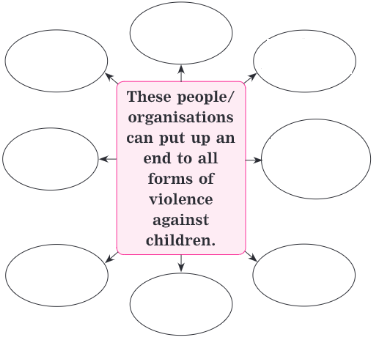
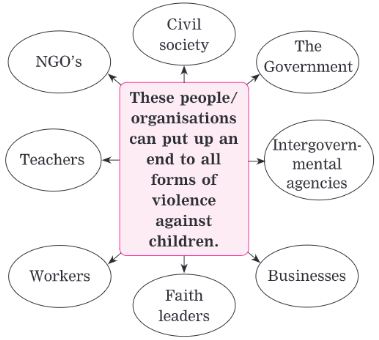
     I call upon all the governments, intergovernmental agencies, businesses, faith leaders, workers, teachers and NGOs, and each one of us, to put an end to all forms of violence against children. Slavery, trafficking, child marriages, child labour, sexual abuse, and illiteracy these things have no place in any civilised society.
     Friends, we can do this. Governments must make child - friendly policies, and invest in education and young people. Businesses must be more responsible, accountable and open to innovative partnerships.Intergovernmental agencies must work together to accelerate action. Global civil society must rise above the business-as-usual and fragmented agendas. Faith leaders and institutions, and all of us must stand with our children.
     We must be bold, we must be ambitious, and we must have the will. We must keep our promises. Over fifty years ago, on the first day of my school, I met a cobbler boy, my age sitting outside the gate of my school. I asked my teachers: “Why is he working outside? Why is he not with us in the school?” My teachers had no answer. One day, I
gathered the courage to ask the boys’ father. He said: “Sir, I have never thought about it. We are born to work.”
     His answer made me angry. It still makes me angry.

A2. Complex Factual Activities:
Image
A3. Activities based on Vocabulary:

Find out the describing words used for the following noun and make your own sentences by using any combination:
(1) _______________ agencies
(2) _______________ partnership
A4. Activities based on Contextual Grammar:
Make the sentences affirmative:
(1) My teacher had no answer.
(2) I have never thought about it.
A5. Personal Response:
(1) Why should we stop 'Child labour'?
Answer

A1. Simple Factual Activities:
(1) slavery  (2) trafficking  (3) child marriage
(4) child labour  (5) sexual abuse  (6) illiteracy
A2. Complex Factual Activities:
Image
A3. Activities based on Vocabulary:
(1) intergovernmental agencies
(2) innovative partnership
Sentence: In a developing country like India, intergovernmental agencies play important role in the process of development.
A4. Activities based on Contextual Grammar:
(1) My teacher was speechless.
(2) I have always ignored it.
A5. Personal Response:
(1) 'Child labour' is a stigma on our society. It is sure to interfere with his/her right to education. It is also harmful to their physical, mental, spiritual, moral and social development. It is harmful to the development of any country, as the child is the future citizen of every country. So we should stop child labour and child exploitation.

Need a full question paper?

Generate a complete, print-ready paper with questions like this in minutes — across 16+ boards, with answer keys.

Start Generating Free

Similar questions

A1. Simple Factual Activities:
Put ✔ or ✘ in front of the following sentences :
(1) Bholi was the beloved daughter of Ramlal.
(2) Bholi used to wear old dresses of her sisters.
(3) Bholi was happy to see so many girls of her age in the school.
(4) All the girls in the school were laughing at Bholi.

     The next day Ramlal caught Bholi by the hand and said. ‘‘Come with me. I will take you to school.’’ Bholi was frightened. She did not know what a school was like. She remembered how a few days ago their old cow. Lakshmi had been turned out of
the house and sold.
     ‘‘N-n-n-n No. no-no-no’’ she shouted in terror and pulled her hand away from her father’s grip.
     ‘‘What’s the matter with you, you fool?’’ shouted Ramlal, ‘‘I am only taking you to school.’’ Then he told his wife. ‘‘Let her wear some decent clothes today. Or else what will the teachers and the other schoolgirls think of us when they see her?’’
      New clothes had never been made for Bholi. The old dresses of her sisters were passed on to her. No one cared to mend or wash her clothes. But today she was lucky to receive a clean dress which had shrunk after many washing and no longer fitted
Champa. She was even bathed and oil was rubbed into her dry and matted hair. Only then did she begin to believe that she was being taken to a place better than her home!
      When they reached the school, the children were already in their classrooms. Ramlal handed over his daughter to the headmistress. Left alone, the poor girl looked about her with fear laden eyes. There were several rooms. And in each room girls like her squatted on mats, reading from books or writing on slates. The headmistress asked        Bholi to sit down in a corner in one of the classrooms. Bholi did not know what exactly a school was like and what happened there. But she was glad to find so many girls almost of her own age present there. She hoped that one of these girls might become her friend.
      The lady teacher who was in the class was saying something to the girls but Bholi could understand nothing. She looked at the pictures on the wall. The colours fascinated her. The horse was brown just like the horse on which the Tehsildar had come to visit their village : the goat was black like the goat of their neighbour: the parrot was green like the parrots she had seen in the mango orchard : and the cow was just like their Lakshmi. And suddenly Bholi noticed that the teacher was standing by her
side, smiling at her.
      “What’s your name. little one?’’
      ‘‘Bh-Bho-Bho.’’ She could stammer no further than that.
       Then she began to cry and tears flowed from her eyes in a helpless flood. She kept her head down as she sat in her corner, not daring to look up at the girls who, she knew were still laughing at her.

A2. Complex Factual Activities:
(1) How did Bholi's parents change her appearance? 
A3. Activities based on Vocabulary:
Find out synonyms for the following:
(1) attracted
(2) repair
A4. Activities based on Contextual Grammar:
(1) Rewrite as an exclamatory sentence:
The child was very fair and pretty.
(2) Correct the error in the following sentence. Focus on verbs and subject:
New clothes was never made for Bholi.
A5. Personal Response:
(1) "If girls go to school, who will marry them?"-Why, do you think, that Bholi's mother thought so?
A1. Simple Factual Activities:
State whether the following statements are True or False:
(1) Monsieur de Poulengey and Monsieur de Metz want to go with Joan.
(2) Chinon is one of the cities in England.
(3) Poulengey was sure that only miracle can save them.
(4) Joan's words have put fire into Robert.

Robert : (To the steward) Is this true about Monsieur de Poulengey ?
Steward : (Eagerly) Yes, sir, and about Monsieur de Metz too. They both want to go with her.
Robert : (Goes to the window, and shouts into the court-yard) Send Monseiur de Poulengey to me, will you ? (He turns to Joan) Get out and wait in the yard.
Joan : (Smiling brightly at him) Right, squire. (She goes out).
Robert : (To the steward) Go with her. Stay within call and keep your eye on her. I shall have her up here again. (The steward retreats hastily. Bertran de Poulengey, a French guard, enters, salutes and stands waiting.)
Robert : She says you, Jack and Dick have offered to go with her. What for ? Do you take her crazy idea of going to the Dauphin seriously ?
Poulengey : (Slowly) There is something about her. It may be worth trying.
Robert : Oh, come on Polly! You must be out of your mind !
Poulengey : (Unmoved) What is wrong with it ? The Dauphin is in Chinon, like a rat in a corner, except that he won’t fight. The English will take Orleans. He’ll not be able to stop them.
Robert : He beat the English the year before last at Montargis. I was with him. Poulengey : But this time, his men are cowed and now he can’t work miracles. And I tell you that nothing can save our side now but a miracle.
Robert : Miracles are all right, Polly. The only difficulty about them is that they don’t happen nowadays.
Poulengey : I used to think so. I’m not so sure now. There is something about her. I think the girl herself is a bit of a miracle. Anyhow, this is our lastchance. Let’s see what she can do.
Robert : (Wavering) You really think that ?
Poulengey : (turning) Is there anything else left for us to think? Let’s take a chance. Her words have put fire into me.
Robert : (Giving up) Whew! You’re as mad as she is.
Poulengey : (Obstinately) We want a few mad people now. See where the sane ones have landed us !
Robert : I feel like a fool. Still, if you feel sure... ?
Poulengey : I feel sure enough to take her to Chinon unless you stop me.
Robert : Do you think I ought to have another talk with her ?

A2. Complex Factual Activities:
Answer the following:
(1) Was the Dauphin fit to be a Prince and heir?
(2) What was the Squire's opinion about miracles? 
A3. Activities based on Vocabulary:
(1) Find out two adjectives and two adverbs from the passage:
A4. Activities based on Contextual Grammar:
Make it affirmative:
(1) I am not sure, now.
(2) He will not be able to stop them.
A5. Personal Response:
(1) What is your opinion about Joan? 
A1. Simple Factual Activities:
State whether the following statements are True or False:
(1) Pitchblende is a black, very hard and cheap substance.
(2) Men could see many substances through the powerful rays of Uranium.
(3) The emperor of Austria gifted a ton of pitchblende to the Curies
(4) The Curies sacrificed all their luxuries of life to save money to buy pitchblende.

      Marie was specially interested in a substance called uranium which was obtained from pitchblende, a black, very hard and very expensive substance. Uranium was known to give off very powerful rays by which men could see through many substances. Now Marie discovered that what was left after obtaining uranium was even more powerful. Later on, Pierre and Marie found that there was not one, but two new substances giving off these rays although they had not yet been able to obtain either of them. They called one of them Polonium, in honour of her country. Poland and the other was called Radium. Radium is the most powerful of the radio-active elements. And radio-active elements can give off rays which can penetrate substances that are opaque to light. There was another French scientist called Henri Becquerel, who in 1896 had discovered that uranium possessed this property. But Polonium and Radium possessed radio-active in much higher degree.
     The Curies now began to work with greater enthusiasm, but they were poor and pitchblende itself was an extremely expensive substance, which they could not afford to buy in large quantity. They, however, sacrificed all the luxuries of life to save money to buy whatever little amount of pitchblende they could. They lived in utter penury, not buying costly food and warm clothes for the extremely cold Parisian winter. Often they could not sleep during the cold nights due to lack of warmth. Overwork seriously affected Madame Curie’s health. Often she was forced to leave the laboratory to take a much needed rest. Her husband begged her to give up the struggle, but she resolutely refused. Marie was driven by a mad determination to discover the mystery of radium. With courage she faced all the miseries of a life of poverty and carried on with her research along with her husband who loved and supported her.
      Luck, however, favoured the Curies and a windfall came to them. It was a gift of a ton of pitchblende from the emperor of Austria, who was an admirer of the Curies. It was the most precious gift the Curies had received and in their shabby laboratory they toiled along, boiled and burnt, overpowered by heat in summer and frozen with cold in winter.

A2. Complex Factual Activities:
(1) What proves Marie's strong will power?
A3. Activities based on Vocabulary:
Find out antonyms for the following from the passage:
(1) economical ×
(2) poverty × 
(3) chill × 
(4) worthless ×
A4. Activities based on Contextual Grammar:
Change the degree:
(1) Pitchblende was the most precious gift the Curies had received.
A5. Personal Response:
(1) What qualities, do you think, are important to get success in our life?
A1. Simple Factual Activity:
Complete the sentences with the help of the information in the passage:
(1) The quality and quantity of energy we put forth, _______________.
(2) _______________ is a walk in the dark.

    Time-bound: Establish time parameters around each goal, as it will help increase focus and accountability. To reduce weight we know how to go about it. But without consistent time - bound action, it never becomes a reality. It may be exercise, diet and stress-free thoughts. All these have to be practised and implemented without hesitation, doubt or indifference, but within a deadline.
    Visions, wishes, intentions and dreams are all valuable. They spark off imagination and encourage us to define where we want to reach. In order to get there, however, we need to bring life images, down to earth and plan to execute our strategies. The quality and quantity of energy we put forth, directly impact the results. Life is something like a trumpet. If we don’t put anything in, we can’t get anything out.
     Success is a walk in the dark. Finding the right footing, precisely mastering the skills and getting to the next place, all depend on how we approach and
tackle the problem. The best way to get from where we are, to where we want to be is to find the footing of our next step. When we take the next step, it should support and hold us without a crack.

A2. Complex Factual Activity:

Pick out examples from the passage that support each of the following facts:
(a) Good results depend upon the quality and quantity of work put in.
(b) A time-limit should be set to achieve goals.
A3. Activities based on Vocabulary:
Classify the following words in their respective columns: 
ah, of, if, and, oh, from, we, but, it, hurrah

PronounPrepositionConjunctionInter- jection
    

A4. Activities based on Contextual Grammar:
(1) We need to bring life images. (Underline the infinitive.) 
(2) The next step should support and hold us without a crack.
(Choose the correct question tag.)
(a) should it? (b) don't it? (c) shouldn't it?
A5. Personal Response:
(1) 'If we don't put anything in, we can't get anything out.' Explain.

A1. Simple Factual Activities:
Who said to whom?

 Sentence Who saidTo whom
 (1) "Let's chat."  
 (2) "We won't get a taxi in this rain."  

    ‘Then stay with me tonight,’ she said. ‘Let’s chat. Do you know that, old friends and memories are precious and rare ?’
     I couldn’t believe it. Was this really Meena ? I pinched myself hard to be sure it wasn’t a dream. But Meena was really standing there, right in front of me, squeezing my hand, smiling, and yes, she did look happy. In the three years she had been in Bangalore, I had never once seen her smiling like that. A few strands of grey in her hair reminded me that years had passed. There were a few wrinkles in her face, but the truth was that she looked more attractive than ever before.
     Finally, I managed to say, ‘No Meena, I can’t stay with you tonight. I have to attend a dinner. Give me your card and I’ll keep in touch with you, I promise.’
     For a moment, Meena looked disappointed, ‘Let’s go and have tea at least’, she insisted.
     ‘But Meena, it’s pouring.’
     ‘So what ? We’ll buy an umbrella and then go to the Grand Hotel,’ she said.
     ‘We won’t get a taxi in this rain’, I grumbled.
     ‘So what ? We’ll walk’.
      I was very surprised. This wasn’t the same Meena I had known. Today, she seemed ready to make any number of adjustments.
      We reached the Grand Hotel drenched. By then the only thought in my mind was to find out who or what had brought about such a change in the pessimistic Meena I had known. I was quite curious.
      ‘Tell me Meena, is there a Prince Charming who has managed to change you so ?’
       Meena was surprised by my question. ‘No, there isn’t anyone like that’, she said.
       ‘Then what’s the secret of your energy?’ I asked, like Tendulkar does in the  advertisement.
       She smiled, ‘A beggar changed my life.’ I was absolutely dumbfounded and she could see it.

A2. Complex Factual Activities:
Complete the following sentences:
(1) Old friends and memories are precious and rare.
(2) A few strands of grey in her hair had reminded the writer that years had passed.
A3. Activities based on Vocabulary:
Find out synonyms for the following from the passage:
(1) inquisitive -  _____________
(2) displeased -  _____________
(3) attractive -  _____________
(4) valued -  _____________.
A4. Activities based on Contextual Grammar:
Complete the following table:

 Present Tense Past Tense Past Participle
 (1) see _______ _______
 (2) pour _______ _______
 (3) _______ brought _______
 (4) _______ _______ known

A5. Personal Response:
(1) What, according to you, is the difference between an optimistic person and a pessimistic person?

A1. Simple Factual Activities:
Complete the following web: 
Image

To see a world in a grain of sand
     And a heaven in a wild flower,
Hold infinity in the palm of your hand
      And eternity in an hour
    We instinctively turn to outdoor activities and nature as a way of relaxing and enhancing our wellbeing. Nature soothes and nurtures. Nature fulfils and motivates. Nature whispers and commands.
    Are you listening?
    When I do, it leaves me in complete awe.
    We have a hibiscus plant in our garden. Every fortnight a flower blooms on it big, bright and tender. Through the day it smiles with the sun and dances with the wind, but as evening approaches, it starts wilting. The morning after, it withers completely and by evening it falls and becomes one with the earth again. The flower comes to life only for a day, yet it does so in full splendour. What if we too lived our life, however short, to its fullest?
    We went to a rocky beach and saw the spread of the majestic ocean and the rocks alongside, carved, sculpted and shaped by the water. Water is so gentle, rock so hard, yet, as the water flows over it every day, for years, the rock gives in. It takes the shape that the water commands. Our problems are so colossal and we are so small, yet if we persist.... 

A2. Complex Factual Activities:
The writer explains the contrast features of 'water' and 'rock' in the text. Write all the features of both water and rock in the given table: 
A3. Activities based on Vocabulary:
Match the pairs of antonyms.

 Words Antonyms
 (1) gentle (a) small
 (2) colossal (b) long
 (3) short (c) quit
 (4) persist (d) hard

A4. Activities based on Contextual Grammar:
Frame Wh-questions to get the underlined parts as answers:
(1) The flower comes to life only for a day.
(2) We saw the spread of the majestic ocean.
A5. Personal Response:
(1) Explain the line Nature whispers and commands.'

A1. Simple Factual Activity:
Complete the sentences using the information from the passage:
(1) Mr Srivastava was talking to Kamal Kishore the owner of the photography shop.
(2) Sitaram was glad that he had been of service to both a customer and his friend.

      And Sitaram, glad that he had been of service to both a customer and his friend, hoisted his bag on his shoulders and went his way.
      Mrs. Srivastava had to do some shopping. She gave instructions to the ayah about looking after the baby, and told the cook not to be late with the midday meal. Then she set out for the Pipalnagar market place, to make her customary tour of the cloth shops.
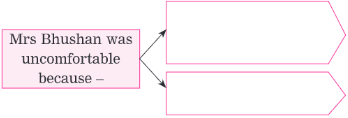
      A large shady tamarind tree grew at one end of the bazaar, and it was here that Mrs. Srivastava found her friend Mrs. Bhushan sheltering from the heat. Mrs. Bhushan was fanning herself with a large handkerchief. She complained of the summer, which she affirmed, was definitely the hottest in the history of Pipalnagar. She then showed Mrs. Srivastava a sample of the cloth she was going to buy, and for five minutes they discussed its shade, texture and design. Having exhausted this topic, Mrs. Srivastava
said, ‘Do you know, my dear, that Seth Govind Ram’s bank can’t even pay its employees? Only this morning I heard a complaint from their sweeper, who hasn’t received his wages for over a month!’
     ‘Shocking!’ remarked Mrs. Bhushan. ‘If they can’t pay the sweeper they must be in a bad way. None of the others could be getting paid either.’
     She left Mrs. Srivastava at the tamarind tree and went in search of her husband, who was sitting in front of Kamal Kishore’s photography shop, talking with the owner.
    ‘So there you are!’ cried Mrs. Bhushan. ‘I’ve been looking for you for almost an hour. Where did you disappear ?’
    ‘Nowhere,’ replied Mr. Bhushan. ‘Had you remained stationary in one shop, I might have found you. But you go from one shop to another, like a bee in a flower garden.’
    ‘Don’t start grumbling. The heat is trying enough.I don’t know what’s happening to Pipalnagar. Even the bank’s about to go bankrupt.’   

A2. Complex Factual Activity:
Complete the following web:
Image
A3. Activities based on Vocabulary:
Find describing words for the following from the passage:
(1) shop (2) meal (3) tour (4) tamarind tree
A4. Activities based on Contextual Grammar:
(1) Mrs Bhushan went in search of her husband. He was sitting in front of Kamal Kishore's photography shop.
(Rewrite the sentence joining it with 'who'.)
(2) That summer was the hottest in the history of Pipalnagar.
(Change the sentence into Positive Degree.)
A5. Personal Response:
(1) Do you think, Mr Bhushan was right to compare his wife with a bee in a flower garden? Give your reason.
A1. Simple Factual Activity:
(1) Dr Hawking is a very humble man, though he is considered _______________ .
(2) Dr Hawking expressed his thoughts with the help of his _______________.

    Though confined to a wheel chair with no control over his body save a finger and with
a computer to help him express his thoughts. Dr Hawking is an authority on profound subjects of science. Numerous honorary doctorates and awards have been bestowed
on him. He is a Fellow of The Royal Society and a Member of the US National Academy of Sciences.
     In spite of being considered Einstein’s equal in intelligence, Dr. Hawking is a very humble man. A simple, down to earth man, he has authored many books dealing with his awesome ideas keeping a layman in mind. His writing is full of wit and humour. His style is so lucid that non-scientists can also understand him. His book, “A Brief History of Time” is one of the best selling books of our times.
     On being asked, how he feels about having the dreadful ALS, Dr Hawking, the quintessence of optimism and hope, says, “Not very different from the rest. I try and lead as normal a life as possible, and not think about my condition or regret the things it prevents me from doing, which are not many.”
      Dr Hawking firmly believes that in the next millenium, science will discover the core secrets of the universe, its origin, its history and maybe even predict its ultimate demise.
      Like Dr Hawking, there are many people who display exemplary courage in their lives. Let us salute all those brave people, who in spite of being disabled strive to do their best.

A2. Complex Factual Activity:
(1) What does the writer say about the books authored by Dr Hawking? 
A3. Activities based on Vocabulary:
Match the words in Column 'A' with their meanings in Column 'B':

Column 'A'Column 'B'
 (1) profound (a) a person without any special skill
 (2) awesome (b) a perfect example
 (3) layman (c) showing very great (knowledge) 
 (4) quintessence (d) very impressive

A4. Activities based on Contextual Grammar:
Convert the following to Interrogative (Question) Form:
(1) The prognosis was bad.
(2) Stephen decided to continue his research.
A5. Personal Response:
(1) How do you know that Dr Hawking is a perfect example of optimism and hope?

A1. Simple Factual Activity:
Name the following:
(1) The country where Mount Huangshan is situated in
(2) The famous dam in Egypt on River Nile

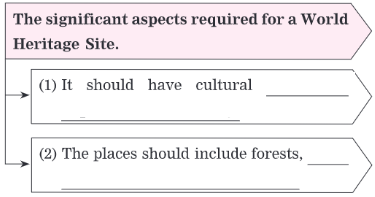
     A World Heritage Site is a site determined by the United Nations Educational, Scientific and Cultural Organization (UNESCO) to have significant cultural or natural importance to humanity. As such the sites are protected and maintained by the
International World Heritage Programme which is administered by the UNESCO World Heritage Committee. Because World Heritage Sites are places that are significant culturally and naturally, they vary in type and include forests, lakes, monuments, buildings and cities.
    World Heritage Sites can also be a combination of both cultural and natural areas. For example, Mount Huangshan in China is a site with significance to human culture because it played a role in historical Chinese art and literature. The mountain is also
significant because of its physical landscape characteristics.
     Although the idea of protecting cultural and natural heritage sites around the world began in the early twentieth century, momentum for its actual creation was not until the 1950s. In 1954, Egypt started plans to build the Aswan High Dam to collect and control water from the Nile River. The initial plan for the dam’s construction would have flooded the valley containing the Abu Simbel Temples and scores of ancient Egyptian artefacts. To protect the temples and artifacts, UNESCO launched an international campaign in 1959 that called for the dismantling and movement of the temples to higher ground. The project cost an estimated US $80 million, $40 million of which came from 50 different countries. Because of the project’s success, UNESCO and the
International Council on Monuments and Sites initiated a draft convention to create an international organization responsible for protecting cultural heritage
 
A2. Complex Factual Activity:
Complete the web:
Image
A3. Activities based on Vocabulary:
Look at the words and their meanings.Underline the correct alternatives:
(i) determine: (a) think over (b) decide (c) ask for (d) look over
(ii) monument: (a) statue (b) pillar (c) memorial building (d) fort
A4. Activities based on Contextual Grammar:
This does not mean that the book is filled with heavy Grammar.Rewrite the following sentences using 'not only ... but also' and 'as well as in two separate sentences:
(1) World Heritage Sites can be a combination of both cultural and natural areas.
A5. Personal Response:
(1) What are our duties towards preservation of any historical site?
A1. Simple Factual Activities:
State whether you agree or disagree with the following statements:

 Group 'A' Group 'B'
 (1) A small, skinny child labourer (a) to care for our children
 (2) A Sudanese child- soldier (b) children's frightened and exhausted eyes
 (3) Satyarthi had looked into  (c) was forced to kill his friends and family
 (4) The great religions teach us (d) The world forced me to take a gun or a tool

    I have come here only to share the voices and dreams of our children - because they are all our children - [gesture to everyone in the audience]. I have looked into their frightened and exhausted eyes. I have held their injured bodies and felt their broken spirits.
    Twenty years ago, in the foothills of the Himalayas, I met a small, skinny child labourer. He asked me: “Is the world so poor that it cannot give me a toy and a book, instead of forcing me to take a gun or a tool?”
    I met with a Sudanese child-soldier. He was kidnapped by an extremist militia. As his first training lesson, he was forced to kill his friends and family. He asked me: “What is my fault?”
    Friends, all the great religions teach us to care for our children. Jesus said: “Let the children come to me; do not hinder them, for the kingdom of God belongs to them.” The Holy Quran says: “Kill not your children because of poverty.”
    Friends! There is no greater violence than to deny the dreams of our children. Therefore ... I refuse to accept that all the temples and mosques and churches and prayer houses have no place for the dreams of our children.
    I refuse to accept that the world is so poor, when just one week of global military expenditure can bring all the children to classrooms. I refuse to accept that all the laws and constitutions, police and judges are unable to protect our children.
    I refuse to accept that the shackles of slavery can ever be stronger than the quest for freedom. I REFUSE TO ACCEPT here.
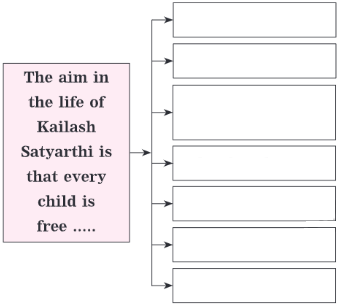
    My only aim in life is that every child is free to be a child,
- free to grow and develop,
- free to eat, sleep, and see daylight,
- free to laugh and cry,
- free to play and learn,
- free to go to school, and above all,
- free to dream.
    I have the privilege of working with many courageous people who have the same aim. We have never given up against any threat or attack and we never will.

A2. Complex Factual Activities:

Complete the following diagram/chart :
Image
A3. Activities based on Vocabulary:
Choose the correct option and write in front of the given word :
(1) extremist: _______________
(A) militant (B) robber (C) spy
(2) courageous: _______________
(A) cowards (B) brave (C) friendly
A4. Activities based on Contextual Grammar:

Rewrite the following into indirect speech:
(1) A skinny child labourer asked Satyarthi, "Is the world so poor that it cannot give me a toy and a book, instead of forcing me to take a gun or a tool?" 
A5. Personal Response:
What will you do in the following situations?
(1) If you find a child working on a brickwork site.
(2) If you come across a beggar child.