Question
A1. Simple Factual Activities:
Write whether the following statements are True or False:
(1) At birth the child was very fair and pretty.
(2) Only the eyes of the child were saved.
(3) Ramlal's three elder daughters were bad looking, unhealthy girls.
(4) But Ramlal was worried about Bholi.

     Her name was Sulekha but since her childhood everyone had been calling her Bholi the simpleton.
    She was the fourth daughter of Numberdar Ramlal. When she was ten months old, she had fallen off the cot on her head and perhaps it had damaged some part of her brain. That was why she remained a backward child and came to be known
as Bholi, the simpleton.
     At birth the child was very fair and pretty. But when she was two years old, she had an attack of small pox. Only the eyes were saved. But the entire body was permanently disfigured by deep black pockmarks. Little Sulekha could not speak till she was five and when at last she learnt to speak, she stammered. The other children often made fun of
her and mimicked her. As a result, she talked very little.
     Ramlal had seven children, three sons and four daughters and the youngest of them was Bholi. It was a prosperous farmer’s household and there was plenty to eat and drink. All the children except Bholi were healthy and strong. The sons had been sent to
the city to study in schools and later in colleges. Of the daughters Radha, the eldest had already been married. The second daughter Mangla’s marriage had also been settled Ramlal would think of third Champa. They were good looking, healthy girls. And
it was not difficult to find bridegrooms for them.
     But Ramlal was worried about Bholi. She had neither good looks nor intelligence.
     Bholi was seven years old when Mangla was married. The same year a primary school for girls was opened in their village. The Tehsildar sahib came to perform its opening ceremony. He said to Ramlal, ‘‘As a revenue official you are the representative of the government in the village and so you must set an example to the villagers. You
must send your daughter to school.’’
      That night when Ramlal consulted his wife. She cried, ‘‘Are you crazy? If girls go to school, who will marry them?’’
      But Ramlal had not the courage to disobey the Tehsildar. At last his wife said, ‘‘I will tell you what to do. Send Bholi to school. As it is there is little chance of her getting married, with her ugly face and lack of sense. Let the teachers at school worry about her.’’

A2. Complex Factual Activities:
(1) Describe the appearance of Bholi. 
A3. Activities based on Vocabulary:
Find out from the passage opposites for the following words:
(1) first
(2) unsaved
(3) temporarily
(4) figured
A4. Activities based on Contextual Grammar:
Name the Tenses:
(1) I will tell you what to do.
(2) Ramlal consulted his wife.
A5. Personal Response:
(1) What do you think about your school?
Answer

A1. Simple Factual Activities:
(1) True
(2) True
(3) False
(4) True
A2. Complex Factual Activities:
(1) Bholi was the youngest daughter of Ramlal. Some part of her brain was damaged, so she was a backward child. Her entire body was permanently disfigured by deep black pockmarks when she had an attack of smallpox. She was very weak. She had neither good looks nor intelligence.
A3. Activities based on Vocabulary:
(1) first × last
(2) unsaved × saved 
(3) temporarily × permanently 
(4) figured × disfigured 
A4. Activities based on Contextual Grammar:
(1) Simple Future Tense
(2) Simple Past Tense
A5. Personal Response:
(1) My school is the second home for me. I meet my friends and share my sorrows and joys with them. I can take proper guidance and advice from my teachers. It is the place which I love from the bottom of my heart.

Need a full question paper?

Generate a complete, print-ready paper with questions like this in minutes — across 16+ boards, with answer keys.

Start Generating Free

Similar questions

A1. Simple Factual Activities:
Choose the correct alternative for each of the following questions:
(1) What does the word 'Bholi' mean?
(a) angry (b) foolish (c) simpleton (d) sad.
(2) At what age Bholi had an attack of smallpox?
(a) six (b) two (c) ten (d) nine.

     Her name was Sulekha but since her childhood everyone had been calling her Bholi the simpleton.
    She was the fourth daughter of Numberdar Ramlal. When she was ten months old, she had fallen off the cot on her head and perhaps it had damaged some part of her brain. That was why she remained a backward child and came to be known
as Bholi, the simpleton.
     At birth the child was very fair and pretty. But when she was two years old, she had an attack of small pox. Only the eyes were saved. But the entire body was permanently disfigured by deep black pockmarks. Little Sulekha could not speak till she was five and when at last she learnt to speak, she stammered. The other children often made fun of
her and mimicked her. As a result, she talked very little.
     Ramlal had seven children, three sons and four daughters and the youngest of them was Bholi. It was a prosperous farmer’s household and there was plenty to eat and drink. All the children except Bholi were healthy and strong. The sons had been sent to
the city to study in schools and later in colleges. Of the daughters Radha, the eldest had already been married. The second daughter Mangla’s marriage had also been settled Ramlal would think of third Champa. They were good looking, healthy girls. And
it was not difficult to find bridegrooms for them.
     But Ramlal was worried about Bholi. She had neither good looks nor intelligence.
     Bholi was seven years old when Mangla was married. The same year a primary school for girls was opened in their village. The Tehsildar sahib came to perform its opening ceremony. He said to Ramlal, ‘‘As a revenue official you are the representative of the government in the village and so you must set an example to the villagers. You
must send your daughter to school.’’
      That night when Ramlal consulted his wife. She cried, ‘‘Are you crazy? If girls go to school, who will marry them?’’
      But Ramlal had not the courage to disobey the Tehsildar. At last his wife said, ‘‘I will tell you what to do. Send Bholi to school. As it is there is little chance of her getting married, with her ugly face and lack of sense. Let the teachers at school worry about her.’’

A2. Complex Factual Activities:
(i) Complete the reasons:
Ramlal decided to send Bholi to school because -
A3. Activities based on Vocabulary:
Use the following phrases in the following sentences by making certain changes:
(to shout in terror, to pass on, to look up at.)
(1) Ruta _______________ when she saw a cobra in front of her.
(2) The world _______________ Dr Kalam as a great visionary.
A4. Activities based on Contextual Grammar:
Correct the errors in the following sentences. Focus on verbs and subject:
(1) All children, except Bholi, was healthy and strong.
(2) Since childhood, everyone will have calling her Bholi.
A5. Personal Response:
(1) Explain the following statement: 
A1. Simple Factual Activities:
Answer in one word: 
(1) The motherland of Kailash Satyarthi
(2) The country which Iqbal Masih represents
(3) The place where Nobel Prize distribution programme was held
(4) The ancient texts of wisdom

     My dear children of the world ... Your Majesties, Your Royal Highnesses, Excellencies, distinguished members of the Norwegian Nobel Committee, dear brother Tom Harkin, brothers and sisters, and my dear daughter Malala.
      From this podium of peace and humanity, I am deeply honoured to recite a mantra from the ancient texts of wisdom, Vedas. This mantra carries a prayer, an aspiration and a resolve that has the potential to liberate humanity from all man-made crises.
      Let’s walk together. In the pursuit of global progress, not a single person should be left out or left behind in any corner of the world, from East to West, from South to North. Let’s speak together, let our minds come together! Learning from the experiences of our ancestors, let us together create knowledge for all that benefits all.
      I bow to my late parents, to my motherland India, and to the mother earth.
      With a warm heart I recall how thousands of times, I have been liberated, each time I have freed a child from slavery. In the first smile of freedom on their beautiful faces, I see the Gods smiling.
      I give the biggest credit of this honour to my movement’s Kaalu Kumar, Dhoom Das and Adarsh Kishore from India and Iqbal Masih from Pakistan who made the supreme sacrifice for protecting the freedom and dignity of children. I humbly accept this award on behalf of all such martyrs, my fellow activists across the world and my countrymen.
      My journey from the great land of Lord Buddha, Guru Nanak and Mahatma Gandhi; India to Norway is a connect between the two centres of global peace and brotherhood, ancient and modern.
      Friends, the Nobel Committee has generously invited me to present a “lecture.” Respectfully, I am unable to do that. Because, I am representing here - the sound of silence. The cry of innocence. And, the face of invisibility. I represent millions of those children who are left behind and that’s why I have kept an empty chair here as a reminder.

A2. Complex Factual Activities:
Complete the following sentences:
(1) The writer humbly accepts this award on behalf of all  _______________.
(2) The journey of the writer, that is India to Norway is a _______________.
A3. Activities based on Vocabulary:
Write the describing words for the following nouns from the passage:
(1) credit
(2) sacrifices
(3) chair
(4) pence
A4. Activities based on Contextual Grammar:
Make adjectives of:
(1) honour
(2) create
(3) silence
(4) peace
A5. Personal Response:
(1) Suggest any four ways to establish peace in the world.
A1. Simple Factual Activity:
Complete the sentences using the information from the passage:
(1) Sitaram was looking out for any job _______________ .
(2) The lady of the house was _______________.

    Nathu grumbled to himself as he swept the steps of the Pipalnagar Bank, owned by Seth Govind Ram. He used the small broom hurriedly and carelessly, and the dust, after rising in a cloud above his head settled down again on the steps. As Nathu was
banging his pan against a dustbin, Sitaram, the washerman’s son, passed by.
    Sitaram was on his delivery round. He had a bundle of freshly pressed clothes balanced on his head.
    ‘Don’t raise such dust!’ he called out to Nathu. ‘Are you annoyed because they are still refusing to pay you an extra two rupees a month?’
    ‘I don’t wish to talk about it,’ complained the sweeper-boy. ‘I haven’t even received my regular pay. And this is the twentieth of the month. Who would think a bank would hold up a poor man’s salary? As soon as I get my money, I’m off! Not another week I work in this place.’ And Nathu banged the pan against the dustbin several times, just
to emphasize his point and giving himself confidence.
    ‘Well, I wish you luck,’ said Sitaram. ‘I’ll keep a lookout for any jobs that might suit you.’ And he plodded barefoot along the road, the big bundle ofclothes hiding most of his head and shoulders.
     At the fourth home he visited, Sitaram heard the lady of the house mention that she was in need of a sweeper. Tying his bundle together, he said; ‘I know of a sweeper boy who’s looking for work. He can start from next month. He’s with the bank just now but they aren’t giving him his pay, and he wants to leave.’
    ‘Is that so?’ said Mrs. Srivastava. ‘Well, tell him to come and see me tomorrow.’ 

A2. Complex Factual Activity:
Write in your own words a few sentences about the following:
(i) Nathu
A3. Activities based on Vocabulary:

Do as directed:
(1) He called out to Nathu. (Rewrite the sentence in Past Continuous Tense.)
(2) Mrs Srivastava said, "Tell him to come and see me tomorrow." (Change into indirect speech.)
A4. Activities based on Contextual Grammar:

Column 'A'Column 'B'
 (1) small (a) man
 (2) pressed (b) pay
 (3) regular (c) clothes
 (4) poor (d) broom

A5. Personal Response:
(1) What makes you angry? What do you do then?

A1. Simple Factual Activity:
Who said to whom?
(1) "The bird has flown!"
(2) "The Pipalnagar Bank is about to collapse."

     ‘What’s that?’ said Kamal Kishore, sitting up suddenly. ‘Which bank?’
     ‘Why the Pipalnagar bank of course. I hear they have stopped paying employees. Don’t tell me you have an account there, Mr. Kishore?’
     ‘No, but my neighbour has!’ he exclaimed; and he called out over the low partition to the keeper of the barber shop next door. ‘Deep Chand, have you heard the latest? The Pipalnagar Bank is about to collapse. You’d better get your money out as soon as you can!’
     Deep Chand who was cutting the hair of an elderly gentleman, was so startled that his hand shook and he nicked his customer’s right ear. The customer yelped with pain and distress: pain, because of the cut and distress because of the awful news he
had just heard. With one side of his neck still unshaven, he sped across the road to the general merchant’s store where there was a telephone. He dialled Seth Govind Ram’s number. The Seth was not at home. Where was he, then? The Seth was holidaying in Kashmir. Oh, was that so? The elderly gentleman did not believe it. He hurried back to the barber’s shop and told Deep Chand: ‘The bird has flown! Seth Govind Ram has left town. Definitely, it means a collapse.’ And then he dashed out of the shop, making a beeline for his office and chequebook.
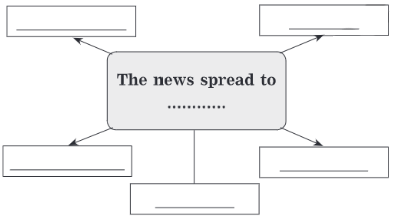
    The news spread through the bazaar with the rapidity of forest fire. From the general merchant’s it travelled to the shop, circulated amongst the customers, and then spread with them in various directions, to the betel-seller, the tailor, the free vendor, the jeweller, the beggar sitting on the pavement.   

A2. Complex Factual Activity:
Complete the web :
Image
A3. Activities based on Vocabulary:
Match the column with their meanings:

WordsMeanings
 (1) beeline (a) state of being upset
 (2) pavement (b) the direct route
 (3) nicked (c) the road for the people to walk
 (4) distress (d) cut slightly

A4. Activities based on Contextual Grammar:
Do as directed:
(1) Mr Kishore said, "Deep Chand, have you heard the latest?" (Change into indirect speech.)
(2) The bird has flown. (Rewrite the sentence using Past Perfect Tense)
A5. Personal Response:
(1) Do you think that rumour spreads faster than fire? Support your answer in two to three lines.

A1. Simple Factual Activity:
Complete the following sentences:
(1) The inventory of the State Party is called _______________.
(2) Tentative List is included on the _______________ File.

     BECOMING A WORLD HERITAGE SITE
     There are five steps in becoming a World Heritage Site, the first of which is for a country or State Party to take an inventory of its significant cultural and natural sites. This is called the Tentative List and it is important because nominations to the World Heritage List will not be considered unless the nominated site was first included on the Tentative List. Next, countries are then able to select sites from their Tentative Lists to be included on a Nomination File. The third step is a review of the Nomination File by two Advisory Bodies consisting of the International Council on Monuments and Sites and the World Conservation Union, who then make recommendations to the World Heritage Committee. The World Heritage Committee meets once a year to review these recommendations and decide which sites will be added to the World Heritage List. The final step in becoming a World Heritage Site is determining whether or not a nominated site meets at least one of ten selection criteria. If the site meets these criteria, it can then be inscribed on the World Heritage List. Once a site goes through this process and is chosen, it remains the property of the country on whose territory it sits, but it also becomes considered within the international community.
 
A2. Complex Factual Activity:
Complete the following flow-chart by choosing from the options given below to show how any site of any country can become a World Heritage Site: 
(1) Inclusion of the name of a site from the tentative list to the nomination file.
(2) Name of the site is inscribed on the World Heritage list after meeting the criteria.
(3) Inclusion of the name of site for the nomination in a tentative list after an inventory in the country or the state.
(4) Decision of the World Heritage Committee after the review of the nominated file.
(5) A review of the file included by the advisory bodies.
A3. Activities based on Vocabulary:
Match the words in Column 'A' with their meanings in Column 'B':

 Column 'A' Column 'B'
 (1) inventory (a) fixed basis to judge
 (2) territory (b) suggestions
 (3) criteria (c) region
 (4) recommendations (d) a written list of material

A4. Activities based on Contextual Grammar:
Add a tailtag :
(1) There are five steps in becoming a World. Heritage Site, _______________?
(2) It remains the property of the country, ______________
A5. Personal Response:
(1) Why, do you think, should we preserve the World Heritage Sites?

A1. Simple Factual Activities:
Complete the following sentences:
(1) Meena was a _______________.
(2) The writer was caught in the rain at _______________.

     Meena is a good friend of mine. She is an LIC officer earning a good salary. But there was always something strange about her. She was forever unhappy. Whenever I met her, I would start to feel depressed. It was as though her gloom and cynicism had a way of spreading to others. She never had anything positive to say on any subject or about any person.      
     For instance, I might say to her, ‘Meena, did you know Rakesh has come first in his school ?’     
     Meena’s immediate response would be to belittle the achievement. ‘Naturally, his father is a school teacher’, she would say.      
     If I said, ‘Meena, Shwetha is a very beautiful girl, isn’t she ?’ Meena would be pessimistic. ‘When a pony is young, he looks handsome. It is age that matters. Wait for some time. Shwetha will be uglier than anyone you know.’      
     ‘Meena, it’s a beautiful day. Let’s go for a walk’. 
     ‘No, the sun is too hot and I get tired if I walk too much. Besides, who says walking is good for health ? There’s no proof.’
     That was Meena. She stayed alone in an apartment as her parents lived in Delhi. She was an only child and had the habit of complaining about anything and everything. Naturally, she wasn’t a very pleasant company and nobody wanted to visit her. Then one day, Meena was transferred to Bombay and soon we all forgot about her.
     Many years later, I found myself caught in the rain at Bombay’s Flora Fountain. It was pouring and I didn’t have an umbrella. I was standing near Akbarallys, a popular department store, waiting for the rain to subside. Suddenly, I spotted Meena. My first reaction was to run, even in that pouring rain. I was anxious to avoid being seen by her, having to listen to her never-ending complaints. However, I couldn’t escape. She had already seen me and caught hold of my hand warmly. What’s more, she was very cheerful.
     ‘Hey ! I am really excited. It’s nice to meet old friends. What are you doing here ?’
     I explained that I was in Bombay on an official work.

A2. Complex Factual Activities:
(1) Why would Meena be sad initially? Give reasons. Pick out sentences from the passage which prove that Meena was a pessimist.
A3. Activities based on Vocabulary:
Find antonyms of the following words from the passage:
(1) optimistic × 
(2) new × 
(3) drizzle × 
(4) ugly ×
A4. Activities based on Contextual Grammar:
Change the following sentences into indirect speech:
(1) "Meena, it's a beautiful day." I said.
(2) "Hey! I am really excited. It's nice to meet old friends. What are you doing here?" Meena said to the writer.
A5. Personal Response:
(1) If you have a friend like Meena, what would be your attitude towards her? 
A1. Simple Factual Activity:
(1) He was bestowed with numerous honorary doctorates and awards.
(2) Dr Hawking's 'A Brief History of Time' is one of the best selling books of our time.

    Though confined to a wheel chair with no control over his body save a finger and with
a computer to help him express his thoughts. Dr Hawking is an authority on profound subjects of science. Numerous honorary doctorates and awards have been bestowed
on him. He is a Fellow of The Royal Society and a Member of the US National Academy of Sciences.
     In spite of being considered Einstein’s equal in intelligence, Dr Hawking is a very humble man. A simple, down to earth man, he has authored many books dealing with his awesome ideas keeping a layman in mind. His writing is full of wit and humour. His style is so lucid that non-scientists can also understand him. His book, “A Brief History of Time” is one of the best selling books of our times.
     On being asked, how he feels about having the dreadful ALS, Dr Hawking, the quintessence of optimism and hope, says, “Not very different from the rest. I try and lead as normal a life as possible, and not think about my condition or regret the things it prevents me from doing, which are not many.”
      Dr Hawking firmly believes that in the next millenium, science will discover the core secrets of the universe, its origin, its history and maybe even predict its ultimate demise.
      Like Dr Hawking, there are many people who display exemplary courage in their lives. Let us salute all those brave people, who in spite of being disabled strive to do their best.

A2. Complex Factual Activity:
(1) Which of Dr Hawking's achievements are mentioned in this passage? 
A3. Activities based on Vocabulary:
Write the adjectives for the following nouns from the passage:
(1) ideas
(2) style
(3) courage
(4) secrets.
A4. Activities based on Contextual Grammar:
Do as directed:
(1) His writing is full of wit and humour.
(Rewrite the sentence using Past Perfect Tense.)
(2) He is a fellow of the Royal Society and a member of the US National Academy of Science.(Use not only but also.)
A5. Personal Response:
(1) How do you know that Dr Hawking is a perfect example of optimism and hope?  
A1. Simple Factual Activities:
Choose the correct alternative and complete the following sentences:
(1) Bholi is compared with _______________.
(a) a dumb cow (b) a kind cow (c) a dead cow
(2) _______________ was not ready to get married.
(a) Bishamber (b) Bholi (c) Bholi's friend

     The bridegroom lifted the garland of yellow marigolds. A woman slipped back the silken veil from the bride’s face. Bishamber took a quick glance. The garland remained poised in his hands. The bride slowly pulled down the veil over her face.
     “Have you seen her ?” said Bishamber to the friend next to him. “She has pockmarks on her face.”
     “So what ? You are not young either.”
     “Maybe. But if I am to marry her, her father must give me five thousand rupees.”
     Ramlal went and placed his turban - his honour - at Bishamber’s feet. “Do not humiliate me so. Take two thousand rupees.”
     “No. Five thousand, or we go back. Keep your daughter.”
     “Be a little considerate, please. If you go back, I can never show my face in the village.”
     “Then out with five thousand.”
     Tears streaming down his face, Ramlal went in, opened the safe and counted out the notes. He placed the bundle at the bridegroom’s feet.
     On Bishamber’s greedy face appeared a triumphant smile. He had gambled and won. “Give me the garland,” he announced.
     Once again the veil was slipped back from the bride face but this time her eyes were not downcast. She was looking up, looking straight at her prospective husband, and in her eyes there was neither anger nor hate, only cold contempt.
      Bishamber raised the garland to place it round the bride’s neck but before he could do so, Bholi’s hand struck out like a streak of lightening and garland was flung into the fire. She got up and threw away the veil.
     “Pitaji” said Bholi in a clear loud voice; and her father, mother, sisters, brothers, relations and neighbours were startled to hear her speak without even the slightest stammer.
     “Pitaji”, take back your money. I am not going to marry this man.”
      Ramlal was thunderstruck. The guests began to whisper, “So shameless! So ugly and so shameless !”
     “Bholi, are you crazy ?” shouted Ramlal. “You want to disgrace your family? Have some regard for out izzat!”
     “For the sake of your izzat,” said Bholi, “I was willing to marry this lame old man. But I will not have such a mean, greedy and contemptible coward as my husband. I won’t, I won’t, I won’t.”
     What a shameless girl! We all thought she was a harmless dumb cow.”

A2. Complex Factual Activities:
(1) What shocked the family members?
A3. Activities based on Vocabulary:
Find out synonyms from the passage for the following words:
(1) humiliate
(2) contempt 
(3) prospective
(4) startled 
A4. Activities based on Contextual Grammar:
Rewrite the following into indirect speech:
(1) "Be a little considerate, please. If you go back, I can never show my face in the village." "Then out with five thousand."
(2) "Pitaji, take back your money. I am not going to marry this man." "Bholi, are you crazy?" shouted Ramlal.
A5. Personal Response:
(1) What did you learn from Bholi's action of not getting married to Bishamber? 
A1. Simple Factual Activity:
Fill in the blanks and complete the sentences:
(1) The number of World Heritage Sites in 2009 were _______________.
(2) _______________ of the World Heritage Sites are considered mixed.

    TYPES OF WORLD HERITAGE SITES
    As of 2009, there are 890 World Heritage Sites that are located in 148 countries (map). 689 of these sites are cultural and include places like the Sydney Opera House in Australia and the Historic Center of Vienna in Austria. 176 are natural and feature such locations as the U.S.'s Yellowstone and Grand Canyon National Parks. 25 of the World Heritage Sites are considered mixed i.e. natural and cultural Peru's Machu Picchu is one of these. Italy has the highest number of World Heritage Sites with 44.
     India has 36 (28 cultural, 7 natural and 1 mixed) World Heritage Sites. The World Heritage Committee has divided the world’s countries into five geographic zones which include (1) Africa, (2) Arab States, (3) Asia Pacific (including Australia and Oceania), (4)
Europe and North America and (5) Latin America and the Caribbean.
     WORLD HERITAGE SITES IN DANGER
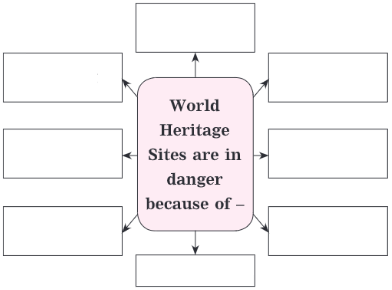
     Like many natural and historic cultural sites around the world, many World Heritage Sites are in danger of being destroyed or lost due to war, poaching, natural disasters like earthquakes, uncontrolled urbanization, heavy tourist traffic and environmental factors like air pollution and acid rain. World Heritage Sites that are in danger are inscribed on a separate List of World Heritage Sites in Danger which allows the World Heritage Committee to allocate resources from the World Heritage Fund to that site. In addition, different plans are put into place to protect and/or restore the site. If however, a site loses the characteristics which allowed for it to be originally included on the World Heritage List, the World Heritage Committee can choose to delete the site from the list. To learn more about World Heritage Sites, visit the World Heritage Centre’s website at whc.unesco.org.

A2. Complex Factual Activity:
Complete the following Web by giving reasons why World Heritage sites are in danger :
Image
A3. Activities based on Vocabulary:
Find from the passage the nouns of the following:
(1) locate 
(2) urbanize
(3) pollute
(4) add
A4. Activities based on Contextual Grammar:
Write the following sentences using 'not only... but also' and 'as well as' in two separate sentences:
(1) Opera House in Australia and the Historic Center of Vienna in Austria are cultural sites of the World Heritage.
A5. Personal Response:
(1) What is the role of the 'World Heritage Sites' in promoting tourism in any country?
A1. Simple Factual Activities:
Complete the following sentences:
(1) Even though we have made progress in the last couple of decades, we are facing _______________ .
(2) _______________ gives a sense of global citizenship among the youth.

     We have made progress in the last couple of decades. We have reduced the number of out-ofschool children by half. We have reduced the number of child labourers by a third. We have reduced child mortality and malnutrition, and we have prevented millions of child deaths.
     But, let us make no mistake, great challenges still remain.
     Friends! The biggest challenge or biggest crisis knocking on the doors of humankind is fear and intolerance.
     We have utterly failed our children in imparting an education. An education that gives the meaning and objective of life. An education that gives a sense of global citizenship among the youth.
     I am afraid that the day is not very far away when the cumulative result of this failure, will culminate in an unprecedented violence, and that will be suicidal for humankind.
     Rights, security, hope can only be restored through education.
     Young people like Malala ... I’ve started calling her my daughter Malala not just Malala ... So my daughter Malala and other daughters including Kayanat.. in fact.. two Kayanats, and Shazia, and the daughters from Africa, and from all over the world. They are rising up and choosing peace over violence, tolerance over extremism, and courage over fear.
     The solutions are emerging. But these solutions cannot be found in the deliberations in conferences alone, and cannot be found in prescriptions from a distance.
     They lie in small groups and local organisations and individuals, who are confronting with the problem every day. Even if they remain unacknowledged, unrecognised and unknown to the world the solution are with them.

A2. Complex Factual Activities:

(1) What are the children's issues highlighted by Kailash Satyarthi in this passage? 
A3. Activities based on Vocabulary:
Choose the correct option and write in front of the given word:
(1) culminate : _______________
(A) destroy (B) succeed (C) rise to a peak
(2) crisis:  _______________
(A) unstable situation(B) problems (C) difficulty
A4. Activities based on Contextual Grammar:

Complete the following sentences with the help of the sentence given below:
The biggest challenge knocking on the doors of humankind is fear and intolerance.
(1) No other challenge knocking _______________ is as big as _______________.
(2) Fear and intolerance are bigger than  ______________________________.
A5. Personal Response:
(1) What efforts will you take to enrol the out-of-school out-of children?