Question
A1. Simple Factual Activities:
Complete the following sentences:
(1) Even though we have made progress in the last couple of decades, we are facing _______________ .
(2) _______________ gives a sense of global citizenship among the youth.

     We have made progress in the last couple of decades. We have reduced the number of out-ofschool children by half. We have reduced the number of child labourers by a third. We have reduced child mortality and malnutrition, and we have prevented millions of child deaths.
     But, let us make no mistake, great challenges still remain.
     Friends! The biggest challenge or biggest crisis knocking on the doors of humankind is fear and intolerance.
     We have utterly failed our children in imparting an education. An education that gives the meaning and objective of life. An education that gives a sense of global citizenship among the youth.
     I am afraid that the day is not very far away when the cumulative result of this failure, will culminate in an unprecedented violence, and that will be suicidal for humankind.
     Rights, security, hope can only be restored through education.
     Young people like Malala ... I’ve started calling her my daughter Malala not just Malala ... So my daughter Malala and other daughters including Kayanat.. in fact.. two Kayanats, and Shazia, and the daughters from Africa, and from all over the world. They are rising up and choosing peace over violence, tolerance over extremism, and courage over fear.
     The solutions are emerging. But these solutions cannot be found in the deliberations in conferences alone, and cannot be found in prescriptions from a distance.
     They lie in small groups and local organisations and individuals, who are confronting with the problem every day. Even if they remain unacknowledged, unrecognised and unknown to the world the solution are with them.

A2. Complex Factual Activities:

(1) What are the children's issues highlighted by Kailash Satyarthi in this passage? 
A3. Activities based on Vocabulary:
Choose the correct option and write in front of the given word:
(1) culminate : _______________
(A) destroy (B) succeed (C) rise to a peak
(2) crisis:  _______________
(A) unstable situation(B) problems (C) difficulty
A4. Activities based on Contextual Grammar:

Complete the following sentences with the help of the sentence given below:
The biggest challenge knocking on the doors of humankind is fear and intolerance.
(1) No other challenge knocking _______________ is as big as _______________.
(2) Fear and intolerance are bigger than  ______________________________.
A5. Personal Response:
(1) What efforts will you take to enrol the out-of-school out-of children? 
Answer

A1. Simple Factual Activities:
(1) Even though we have made progress in the last couple of decades, we are facing great challenges.
(2) An education gives a sense of global citizenship among the youth.
A2. Complex Factual Activities:
(1) The children's issues highlighted by Kailash Satyarthi in this passage are-
- The burning problem in India-child labour.
- The Right of children to free and compulsory education.
- Mortality and malnutrition.
- Child labour as a human rights issue as well as a welfare matter and charitable cause.
A3. Activities based on Vocabulary:
(1) (C) rise to a peak
(2) (A) unstable situation 
A4. Activities based on Contextual Grammar:
(1) No other challenge knocking on the doors of humankind is as big as fear and intolerance.
(2) Fear and intolerance are bigger than any other challenge knocking on the doors of humankind.
A5. Personal Response:
(1) If I see any children out of school, I will tell them the importance of education in their life. I will also tell them about the Right of Children to Free and Compulsory Education. By convincing them I will help them to take admission in schools nearby so that they can stand and face the life independently and get success in their life. Also, I shall try to convince their parents to send their children to school

Need a full question paper?

Generate a complete, print-ready paper with questions like this in minutes — across 16+ boards, with answer keys.

Start Generating Free

Similar questions

A1. Simple Factual Activities:
Complete the following sentences:
(1) Bholi's parents. were eager to accept Bishamber's proposal for marriage because they felt that _______________.
(2) _______________ were envious of her luck.

         Thus the years passed.
    The village became a small town. The little primary school became high school. There were now a cinema under a tin shed and a cotton ginning mill. The mail train began to stop at their railway station.
     One night, after dinner, Ramlal said to his wife, “Then, shall I accept Bishamber’s proposal?”
    “Yes, certainly” his wife said. “Bholi will be lucky to get such a well to do bridegroom. A big shop, a house of his own and I hear several thousands in the bank. Moreover, he is not asking for any dowry”.
    “That’s right, but he is not so young, you know -almost the same age as I am- and he also limps. Moreover, the children from his first wife are quite grown up”.
    “So what does it matter ?” his wife replied. “Forty five or fifty-it is no great age for a man. We are lucky that he is from another village and does not know about her pockmarks and her lack of sense. If we don’t accept this proposal, she may remain
unmarried all her life.”
    “Yes, but I wonder what Bholi will say”.
    “What will that witless one say ? She is like a dumb cow.”
    “May be you are right”, muttered Ramlal. In the other corner of the courtyard, Bholi lay awake on her cot, and listened to her parents’ whispered conversation.
     Bishamber Nath was a well - to - do grocer. He came with a big party of friends and relations with him for the wedding. A brass band playing a popular tune from an Indian film headed the procession, with the bridegroom riding a decorated horse. Ramlal was
overjoyed to see such pomp and splendour. He had never dreamt that his fourth daughter would have such a grand wedding. Bholi’s elder sisters who had come for the occasion were envious of her luck.
     When the auspicious moment came the priest said, “Bring the bride”. Bholi, clad in a red silken bridal dress, was led to bride’s place near the sacred fire.
    “Garland the bride,” one of his friends prompted Bishamber Nath.

A2. Complex Factual Activities:
(1) What were the drawbacks of Bishamber as a bridegroom? 
A3. Activities based on Vocabulary:
Find out synonyms from the passage for the following words: 
(1) fortunate
(2) surely
(3) senseless 
(4) jealous 
A4. Activities based on Contextual Grammar:
Change the following sentences in indirect speech:
(1) "What will that witless one say? She is like a dumb cow". "May be you are right," muttered Ramlal.
(2) "Yes, certainly," his wife said, "Bholi will be lucky to get such a well-to-do bridegroom."
A5. Personal Response:
(1) What is your opinion about Bholi's bridegroom? Should she get married to him?
A1. Simple Factual Activities:
Write one sentence each, why the following years were landmarks in the lives of Pierre and Marie Curie: 
(1) 1902 -
(2) 1903 -

    The Curies continued their work for four more years. Wearing an acid stained, dust covered mask, Marie toiled along stirring large pots of pitchblende ensuring that the fires beneath were active throughout the day and the night. Then in 1902, success finally came. On a September night the Curies, after a day’s tiresome work, went home. Then just as they were about to go to bed they went to the laboratory to have another look at the hundreds of small bowls into which they had poured filtered pitchblende. In the dark laboratory as they moved cautiously forward there were all around them rays of soft, bluish purple light coming from the small, glass covered bowls. Radium had been discovered ! Marie said to her husband, ‘Do you remember the day when you told me that you wanted radium to have a beautiful colour? Look …. look!’’
     Actually, what they had produced was just a tiny pinch of white powder that looked like salt. But it was to become one of the wonders of the world. With its rays people would be able to see through the hardest of substances except lead.
     The benefits of radium in the world of medicine are incalculable. It has been used with great effect in the treatment of cancer. The bacteria of such diseases as typhus, cholera and anthrax can also be killed by radium.
     In 1903 the Curies along with Henry Becquesel, were awarded the Nobel Prize for physics for the discovery of Radium and Polonium. They wished, they could have patented their discovery and become rich, but this noble woman refused to do so and gave it free to the world to be used properly.
     In 1906, Pierre was knocked down and killed by a horse-drawn wagon. Marie clung to his lifeless body and remained disconsolate.
      In 1911, Marie was awarded the Nobel prize for the second time and this was for Chemistry. Madame Curie remained comparatively poor and when asked why she did not make money by her discoveries, she replied, ‘‘I am working for science. Radium belongs to the people, not to me.’’
      In 1934, the health of Marie Curie failed and in the July of that year this great scientist, who had given her life for the cause of science and humanity, died. In every great man and woman there is a compulsive desire to discover the truth. Madame Curie, who pursued her life’s goal with great courage, endurance, dedication and strength of character, is a living example of this statement.
      There are also men and women who show extreme courage when they are face to face with great danger. But greater is the courage of men and women who display a strength of mind that is not defeated by extremely hostile and unfavourable conditions of life. Madame Curie certainly belongs to this latter group.

A2. Complex Factual Activities:
(1) How is radium used in the medical field? 
A3. Activities based on Vocabulary:
Write down the describing words used for the following nouns :
(1) _______________ work
(2) _______________ pitchblende
(3) _______________ colour
(4) _______________ desire.
A4. Activities based on Contextual Grammar:
Change the voice:
(1) In 1906, Pierre was knocked down by a horse- drawn wagon.
(Begin the sentence with 'A horse-drawn wagon'.)'
(2) In 1911, Marie was awarded the Nobel Prize.
(Begin the sentence with 'They'.)
A5. Personal Response:
(1) Why are awards and prizes given to the people in different fields?
A1. Simple Factual Activity:
Complete the following sentences with the information given in the passage:
(1) The man with crooked leg was _______________.
(2) Someone said that the Seth had hanged himself _______________.

    Old Ganpat the beggar, had a crooked leg. He had been squatting on the pavement for years, calling for alms. In the evening someone would come with a barrow and take him away. He had never been known to walk. But now, on learning that the bank was about to collapse, Ganpat astonished everyone, leaping to his feet and actually running at top speed in the direction of the bank. It soon became known that he had a thousand rupees in savings!
     Men stood in groups at street corners discussing the situation. Pipalnagar seldom had a crisis, seldom or never had floods, earthquakes or drought; and the imminent crash of the Pipalnagar Bank set everyone talking and speculating and rushing about in a frenzy. Some boasted of their farsightedness, congratulating themselves on having already taken out their money, or on never having put any in; others speculated on the reasons for the crash, putting it all down to excesses indulged in by Seth Govind Ram. The Seth had fled the State, said one. He had fled the country, said another. He was hiding in Pipalnagar, said a third. He had hanged himself from the tamarind tree, said a fourth, and had been found that morning by the sweeper-boy.
     By noon the small bank had gone through all; its ready cash, and the harassed manager was in a dilemma. Emergency funds could only be obtained from another bank some thirty miles distant, and he wasn’t sure he could persuade the crowd to wait
until then. And there was no way of contacting Seth Govind Ram on his houseboat in Kashmir. 

A2. Complex Factual Activity:
Complete the following sentences that tell you about Ganpat, the beggar:
(1) Ganpat was an old beggar who had a _______________.
(2) He had been _______________ for years.
A3. Activities based on Vocabulary:
Find the describing words for the following from the passage:
(1) fund (2) leg (3) manager (4) speed
A4. Activities based on Contextual Grammar:
(1) I must know the reason. You are late.
(Join the sentence with the word 'why'.)
(2) He was hiding in Pipalnagar.
(Rewrite the sentence using Simple Present Tense.)
A5. Personal Response:
(1) Have you ever heard a rumour that harmed people? Elaborate it.
A1. Simple Factual Activities:
Match the comparisons as given in the passage:

'A' 'B'
 (1) The Dauphin is (a) she is
 (2) Joan of Arc (b) like a rat in a corner
  (c) a bit of miracle

Robert : (To the steward) Is this true about Monsieur de Poulengey ?
Steward : (Eagerly) Yes, sir, and about Monsieur de Metz too. They both want to go with her.
Robert : (Goes to the window, and shouts into the court-yard) Send Monseiur de Poulengey to me, will you ? (He turns to Joan) Get out and wait in the yard.
Joan : (Smiling brightly at him) Right, squire. (She goes out).
Robert : (To the steward) Go with her. Stay within call and keep your eye on her. I shall have her up here again. (The steward retreats hastily. Bertran de Poulengey, a French guard, enters, salutes and stands waiting.)
Robert : She says you, Jack and Dick have offered to go with her. What for ? Do you take her crazy idea of going to the Dauphin seriously ?
Poulengey : (Slowly) There is something about her. It may be worth trying.
Robert : Oh, come on Polly! You must be out of your mind !
Poulengey : (Unmoved) What is wrong with it ? The Dauphin is in Chinon, like a rat in a corner, except that he won’t fight. The English will take Orleans. He’ll not be able to stop them.
Robert : He beat the English the year before last at Montargis. I was with him. Poulengey : But this time, his men are cowed and now he can’t work miracles. And I tell you that nothing can save our side now but a miracle.
Robert : Miracles are all right, Polly. The only difficulty about them is that they don’t happen nowadays.
Poulengey : I used to think so. I’m not so sure now. There is something about her. I think the girl herself is a bit of a miracle. Anyhow, this is our lastchance. Let’s see what she can do.
Robert : (Wavering) You really think that ?
Poulengey : (turning) Is there anything else left for us to think? Let’s take a chance. Her words have put fire into me.
Robert : (Giving up) Whew! You’re as mad as she is.
Poulengey : (Obstinately) We want a few mad people now. See where the sane ones have landed us !
Robert : I feel like a fool. Still, if you feel sure... ?
Poulengey : I feel sure enough to take her to Chinon unless you stop me.
Robert : Do you think I ought to have another talk with her ?

A2. Complex Factual Activities:
Answer the following:
(1) What did Robert tell the Steward? 
(2) What did Robert accuse Poulengey of?
A3. Activities based on Vocabulary:
(1) Find out two adjectives and two adverbs from the passage:
A4. Activities based on Contextual Grammar:
Choose the correct question tag:
(1) The Steward retreats hastily, _______________
(2) You are as mad as she is, _______________
(3) I am not so sure now, _______________
(4) Jack and Dick have offered to go with her, _______________
A5. Personal Response:
(1) What is your opinion about Joan?

A1. Simple Factual Activities:
State whether the following statements are True or False:
(1) On the rocky beach the writer found rocks curved and sculpted by the water
(2) When we listen to the Nature, it leaves us in complete awe.
(3) We should not live our life to its fullest.
(4) The water was shaped by the rocks.

To see a world in a grain of sand
     And a heaven in a wild flower,
Hold infinity in the palm of your hand
      And eternity in an hour
    We instinctively turn to outdoor activities and nature as a way of relaxing and enhancing our wellbeing. Nature soothes and nurtures. Nature fulfils and motivates. Nature whispers and commands.
    Are you listening?
    When I do, it leaves me in complete awe.
    We have a hibiscus plant in our garden. Every fortnight a flower blooms on it big, bright and tender. Through the day it smiles with the sun and dances with the wind, but as evening approaches, it starts wilting. The morning after, it withers completely and by evening it falls and becomes one with the earth again. The flower comes to life only for a day, yet it does so in full splendour. What if we too lived our life, however short, to its fullest?
    We went to a rocky beach and saw the spread of the majestic ocean and the rocks alongside, carved, sculpted and shaped by the water. Water is so gentle, rock so hard, yet, as the water flows over it every day, for years, the rock gives in. It takes the shape that the water commands. Our problems are so colossal and we are so small, yet if we persist.... 

A2. Complex Factual Activities:
Complete the following sentences:
(1) _______________ smiles with the sun and dances with the wind.
(2) 'However short our life is _______________ is the lesson we learn from the hibiscus plant..
(3) The rock on the beach was _______________.
(4) The poet William Blake tells us to hold _______________ eternity in an hour.
A3. Activities based on Vocabulary:
Find synonyms/one word from the text for the following words/phrases.
(1) a strong feeling of fear or respect
(2) to direct authoritatively
(3) large and impressively beautiful
A4. Activities based on Contextual Grammar:
Use 'not only..... but also'.
(1) Outdoor activities enhance and relax our well- being.
(2) Nature whispers and commands.
A5. Personal Response:
(1) The rock is hard, but is it dominating? Give reason for your answer.
A1. Simple Factual Activities:
Who said to whom:
(1) "Come with me. I will take you to school."
(2) "What is your name, little one?"

     The next day Ramlal caught Bholi by the hand and said. ‘‘Come with me. I will take you to school.’’ Bholi was frightened. She did not know what a school was like. She remembered how a few days ago their old cow. Lakshmi had been turned out of
the house and sold.
     ‘‘N-n-n-n No. no-no-no’’ she shouted in terror and pulled her hand away from her father’s grip.
     ‘‘What’s the matter with you, you fool?’’ shouted Ramlal, ‘‘I am only taking you to school.’’ Then he told his wife. ‘‘Let her wear some decent clothes today. Or else what will the teachers and the other schoolgirls think of us when they see her?’’
      New clothes had never been made for Bholi. The old dresses of her sisters were passed on to her. No one cared to mend or wash her clothes. But today she was lucky to receive a clean dress which had shrunk after many washing and no longer fitted
Champa. She was even bathed and oil was rubbed into her dry and matted hair. Only then did she begin to believe that she was being taken to a place better than her home!
      When they reached the school, the children were already in their classrooms. Ramlal handed over his daughter to the headmistress. Left alone, the poor girl looked about her with fear laden eyes. There were several rooms. And in each room girls like her squatted on mats, reading from books or writing on slates. The headmistress asked        Bholi to sit down in a corner in one of the classrooms. Bholi did not know what exactly a school was like and what happened there. But she was glad to find so many girls almost of her own age present there. She hoped that one of these girls might become her friend.
      The lady teacher who was in the class was saying something to the girls but Bholi could understand nothing. She looked at the pictures on the wall. The colours fascinated her. The horse was brown just like the horse on which the Tehsildar had come to visit their village : the goat was black like the goat of their neighbour: the parrot was green like the parrots she had seen in the mango orchard : and the cow was just like their Lakshmi. And suddenly Bholi noticed that the teacher was standing by her
side, smiling at her.
      “What’s your name. little one?’’
      ‘‘Bh-Bho-Bho.’’ She could stammer no further than that.
       Then she began to cry and tears flowed from her eyes in a helpless flood. She kept her head down as she sat in her corner, not daring to look up at the girls who, she knew were still laughing at her.

A2. Complex Factual Activities:
(1) What shows that Bholi was unwilling to go to school? 
A3. Activities based on Vocabulary:
Complete the following sentences using words given in the brackets:
(disfigured, matted, fascinated)
(1) After the accident Juhi's face was _______________.
(2) It took a long time to straighten the _______________ bundle of wool.
A4. Activities based on Contextual Grammar:
(1) Change into indirect speech:
Ramlal's wife said to him, "I will tell you what to do."
(2) Rewrite as an exclamatory sentence:
The child was very fair and pretty.
A5. Personal Response:
(1) "If girls go to school, who will marry them?"-Why, do you think, that Bholi's mother thought so? 
A1. Simple Factual Activities:
Name the following: 
(1) Original name of Madame Curie.
(2) Her place of birth.

     The history of men’s progress from the darkness of ignorance to the glorious light of knowledge and enlightenment is full of chapters that tell of extraordinary men and women. These men and women worked with great courage, commitment, dedication and singleness of purpose in their effort to attain what seemed to be unattainable. These men and women were driven in their effort to uncover the truth and mystery of the universe with an indomitable spirit which characterises the human spirit. And this is the spirit that drove Columbus and Vasco de Gama to sail to the unknown seas, Robert Peary to race to the Pole, Sir Ronald Ross to fight against malaria, Hillary and Tenzing to reach the top of Everest, and Armstrong and his team to go to the moon. 
     One great woman who dedicated her life to the cause of science and to the welfare of humanity is Madame Curie, the discoverer of radium. The mere statement that Madame Curie discovered the radium will never tell the true story of the extraordinary courage, determination and singleness of purpose that this noble woman showed in the face of extreme poverty, pain and suffering that comes along with such condition.
     Born Maria Sklodowska in Warsaw, Poland on November, 7 1867, Marie Curie’s childhood dream was to study science in Paris, but her father could not afford the expense for this. So Maria took a job as a governess and saved a little money. With that little money she finally went to Sorbonne, the University of Paris, to study science. Her father could send her only a small amount and her life in the university was a disheartening experience in poverty and hunger. She lived only on bread, butter and tea, and she often fainted for lack of food. In spite of all this she pursued her studies indomitably and she topped her class with Honours in Physics and Mathematics.
     It was at the university that she met a Frenchman, Pierre Curie, a brilliant but poor scientist. Then they together began to work in a shabby laboratory. Soon, their friendship turned into love and in less than a year, in July, 1895, they were married. The couple then took a flat in Paris with scarcely any furniture in it except their books, a lamp, a white wooden table and two chairs.
      After the birth of a daughter, Irene, the next year, Marie and Pierre set up a laboratory in a wooden shed near their flat, It had a leaky skylight and an earthen floor. Here Marie, after her daily household work, settled down to study.

A2. Complex Factual Activities:
Complete the following sentences: 
(1) Madame Curie dedicated her life to the cause _______________ and to the _______________.
(2) The qualities that great achievers possess are _______________ and _______________.
A3. Activities based on Vocabulary:
Find out the words from the passage which mean:
(1) unbeatable
(2) discouraging
(3) hardly
(4) illiteracy
A4. Activities based on Contextual Grammar:
(1) took a job as a governess and saved a little money. (Rewrite using 'by' + ing.)
(2) Marie Curie's childhood dream was to study science in Paris, but her father could not afford the expense for this. (Rewrite using "Though')
A5. Personal Response:
(1) Describe your favourite scientist.
A1. Simple Factual Activities:
(1) The garland of marriage was made of _______________.
(a) roses
(b) yellow marigolds
(c) lilies
(2) Bishamber demanded _______________ to get married to Bholi.
(a) two thousand rupees
(b) three thousand rupees
(c) five thousand rupees.

     The bridegroom lifted the garland of yellow marigolds. A woman slipped back the silken veil from the bride’s face. Bishamber took a quick glance. The garland remained poised in his hands. The bride slowly pulled down the veil over her face.
     “Have you seen her ?” said Bishamber to the friend next to him. “She has pockmarks on her face.”
     “So what ? You are not young either.”
     “Maybe. But if I am to marry her, her father must give me five thousand rupees.”
     Ramlal went and placed his turban - his honour - at Bishamber’s feet. “Do not humiliate me so. Take two thousand rupees.”
     “No. Five thousand, or we go back. Keep your daughter.”
     “Be a little considerate, please. If you go back, I can never show my face in the village.”
     “Then out with five thousand.”
     Tears streaming down his face, Ramlal went in, opened the safe and counted out the notes. He placed the bundle at the bridegroom’s feet.
     On Bishamber’s greedy face appeared a triumphant smile. He had gambled and won. “Give me the garland,” he announced.
     Once again the veil was slipped back from the bride face but this time her eyes were not downcast. She was looking up, looking straight at her prospective husband, and in her eyes there was neither anger nor hate, only cold contempt.
      Bishamber raised the garland to place it round the bride’s neck but before he could do so, Bholi’s hand struck out like a streak of lightening and garland was flung into the fire. She got up and threw away the veil.
     “Pitaji” said Bholi in a clear loud voice; and her father, mother, sisters, brothers, relations and neighbours were startled to hear her speak without even the slightest stammer.
     “Pitaji”, take back your money. I am not going to marry this man.”
      Ramlal was thunderstruck. The guests began to whisper, “So shameless! So ugly and so shameless !”
     “Bholi, are you crazy ?” shouted Ramlal. “You want to disgrace your family? Have some regard for out izzat!”
     “For the sake of your izzat,” said Bholi, “I was willing to marry this lame old man. But I will not have such a mean, greedy and contemptible coward as my husband. I won’t, I won’t, I won’t.”
     What a shameless girl! We all thought she was a harmless dumb cow.”

A2. Complex Factual Activities:
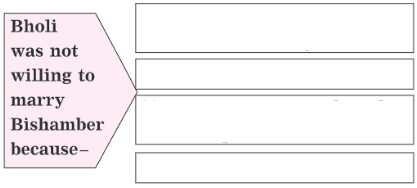
Complete the following web :
Image
A3. Activities based on Vocabulary:
(1) garment that covers the head and face
(2) hurt the pride of
(3) joyful and proud especially because of success
(4) related to the future
A4. Activities based on Contextual Grammar:
Do as directed:
(1) What a shameless girl! (Make it assertive.)
(2) Bishamber raised the garland to place it round the bride's neck. (Frame a wh-question to get the underlined part as an answer)
A5. Personal Response:
(1) What did you learn from Bholi's action of not getting married to Bishamber? 
A1. Simple Factual Activities:
Put ✔ or ✘ in front of the following sentences :
(1) Bholi was the beloved daughter of Ramlal.
(2) Bholi used to wear old dresses of her sisters.
(3) Bholi was happy to see so many girls of her age in the school.
(4) All the girls in the school were laughing at Bholi.

     The next day Ramlal caught Bholi by the hand and said. ‘‘Come with me. I will take you to school.’’ Bholi was frightened. She did not know what a school was like. She remembered how a few days ago their old cow. Lakshmi had been turned out of
the house and sold.
     ‘‘N-n-n-n No. no-no-no’’ she shouted in terror and pulled her hand away from her father’s grip.
     ‘‘What’s the matter with you, you fool?’’ shouted Ramlal, ‘‘I am only taking you to school.’’ Then he told his wife. ‘‘Let her wear some decent clothes today. Or else what will the teachers and the other schoolgirls think of us when they see her?’’
      New clothes had never been made for Bholi. The old dresses of her sisters were passed on to her. No one cared to mend or wash her clothes. But today she was lucky to receive a clean dress which had shrunk after many washing and no longer fitted
Champa. She was even bathed and oil was rubbed into her dry and matted hair. Only then did she begin to believe that she was being taken to a place better than her home!
      When they reached the school, the children were already in their classrooms. Ramlal handed over his daughter to the headmistress. Left alone, the poor girl looked about her with fear laden eyes. There were several rooms. And in each room girls like her squatted on mats, reading from books or writing on slates. The headmistress asked        Bholi to sit down in a corner in one of the classrooms. Bholi did not know what exactly a school was like and what happened there. But she was glad to find so many girls almost of her own age present there. She hoped that one of these girls might become her friend.
      The lady teacher who was in the class was saying something to the girls but Bholi could understand nothing. She looked at the pictures on the wall. The colours fascinated her. The horse was brown just like the horse on which the Tehsildar had come to visit their village : the goat was black like the goat of their neighbour: the parrot was green like the parrots she had seen in the mango orchard : and the cow was just like their Lakshmi. And suddenly Bholi noticed that the teacher was standing by her
side, smiling at her.
      “What’s your name. little one?’’
      ‘‘Bh-Bho-Bho.’’ She could stammer no further than that.
       Then she began to cry and tears flowed from her eyes in a helpless flood. She kept her head down as she sat in her corner, not daring to look up at the girls who, she knew were still laughing at her.

A2. Complex Factual Activities:
(1) How did Bholi's parents change her appearance? 
A3. Activities based on Vocabulary:
Find out synonyms for the following:
(1) attracted
(2) repair
A4. Activities based on Contextual Grammar:
(1) Rewrite as an exclamatory sentence:
The child was very fair and pretty.
(2) Correct the error in the following sentence. Focus on verbs and subject:
New clothes was never made for Bholi.
A5. Personal Response:
(1) "If girls go to school, who will marry them?"-Why, do you think, that Bholi's mother thought so?
A1. Simple Factual Activities:
Name the following:
(1) The greatest personalities from the great land-India.
(2) The American politician, attorney and author mentioned in the speech -e help beggars? 

     My dear children of the world ... Your Majesties, Your Royal Highnesses, Excellencies, distinguished members of the Norwegian Nobel Committee, dear brother Tom Harkin, brothers and sisters, and my dear daughter Malala.
      From this podium of peace and humanity, I am deeply honoured to recite a mantra from the ancient texts of wisdom, Vedas. This mantra carries a prayer, an aspiration and a resolve that has the potential to liberate humanity from all man-made crises.
      Let’s walk together. In the pursuit of global progress, not a single person should be left out or left behind in any corner of the world, from East to West, from South to North. Let’s speak together, let our minds come together! Learning from the experiences of our ancestors, let us together create knowledge for all that benefits all.
      I bow to my late parents, to my motherland India, and to the mother earth.
      With a warm heart I recall how thousands of times, I have been liberated, each time I have freed a child from slavery. In the first smile of freedom on their beautiful faces, I see the Gods smiling.
      I give the biggest credit of this honour to my movement’s Kaalu Kumar, Dhoom Das and Adarsh Kishore from India and Iqbal Masih from Pakistan who made the supreme sacrifice for protecting the freedom and dignity of children. I humbly accept this award on behalf of all such martyrs, my fellow activists across the world and my countrymen.
      My journey from the great land of Lord Buddha, Guru Nanak and Mahatma Gandhi; India to Norway is a connect between the two centres of global peace and brotherhood, ancient and modern.
      Friends, the Nobel Committee has generously invited me to present a “lecture.” Respectfully, I am unable to do that. Because, I am representing here - the sound of silence. The cry of innocence. And, the face of invisibility. I represent millions of those children who are left behind and that’s why I have kept an empty chair here as a reminder.

A2. Complex Factual Activities:
Complete the following sentences:
(1) We can create knowledge for all that benefits all by _______________.
(2) The mantras that carries a prayer has the potential to _______________.
A3. Activities based on Vocabulary:
Find out the describing words used for the following nouns and make your own sentences using any one combinations:
(1) sacrifice  (2) faces
A4. Activities based on Contextual Grammar:
Name the tense:
(1) The Nobel committee has generously invited ine to present a 'Lecture.'
(2) I am representing the millions of children.
A5. Personal Response:
(1) What do you know about Kailash Satyarthi?