Question
A1. Simple Factual Activities:
Write whether the following statements are True or False:
(1) The first Indian tea was sent to England for public sale in 1823.
(2) Tea became a fashionable and popular drink in Europe.
(3) Our body produces chemicals called free radicals.
(4) The word 'chai' is now sometimes used in English to refer to China tea.
Thus the habit of drinking tea spread to Japan, Europe and England, where it became a fashionable and popular drink among the people.
How did this magical beverage get its name? The Chinese character t’u was first used in early inscriptions to describe tea. But later, a new character, ch’a, was developed to refer specifically to tea. The word ch’a is now sometimes used in English to refer to China tea. And, as we all know, it is very close to the Hindi word chai, which is used all over India to refer to tea.
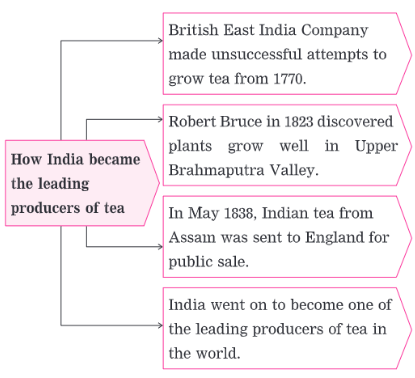
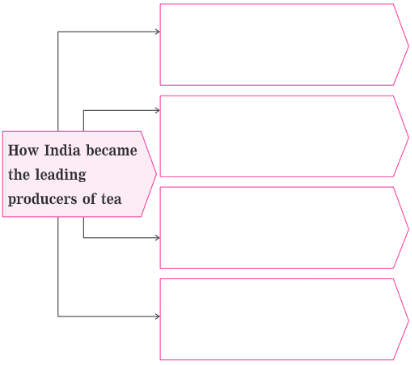
How did tea first come to India? Historians think that tea had been known in India as a medicinal plant since ancient times, but tea was not drunk for pleasure until the British began to establish plantations in the 19th century. In the 1770s, the British East India Company made several unsuccessful attempts to grow tea in Bhutan and Assam, with seeds from China. Although these attempts failed, the botanist Robert Bruce in 1823 discovered tea plants growing wild in the Upper Brahmaputra valley. In May 1838, the first Indian tea from Assam was sent to England for public sale. Since then India has gone on to become one of the leading producers of tea in the world.
Tea lovers claim that tea may be able to reduce the risk of cancer, control blood pressure, fight viruses in our body and actually help us live longer!
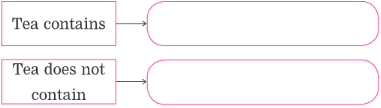
Our body produces chemicals called free radicals. They can damage our body and our health. Tea contains antioxidants called flavonoids. Scientists believe these help to protect our system against free radicals.
A2. Complex Factual Activities:
Complete the web :
A3. Activities based on Vocabulary:
Match the verbs in 'A' with the related phrases/words in 'B' from the passage:
Write whether the following statements are True or False:
(1) The first Indian tea was sent to England for public sale in 1823.
(2) Tea became a fashionable and popular drink in Europe.
(3) Our body produces chemicals called free radicals.
(4) The word 'chai' is now sometimes used in English to refer to China tea.
Thus the habit of drinking tea spread to Japan, Europe and England, where it became a fashionable and popular drink among the people.
How did this magical beverage get its name? The Chinese character t’u was first used in early inscriptions to describe tea. But later, a new character, ch’a, was developed to refer specifically to tea. The word ch’a is now sometimes used in English to refer to China tea. And, as we all know, it is very close to the Hindi word chai, which is used all over India to refer to tea.
How did tea first come to India? Historians think that tea had been known in India as a medicinal plant since ancient times, but tea was not drunk for pleasure until the British began to establish plantations in the 19th century. In the 1770s, the British East India Company made several unsuccessful attempts to grow tea in Bhutan and Assam, with seeds from China. Although these attempts failed, the botanist Robert Bruce in 1823 discovered tea plants growing wild in the Upper Brahmaputra valley. In May 1838, the first Indian tea from Assam was sent to England for public sale. Since then India has gone on to become one of the leading producers of tea in the world.
Tea lovers claim that tea may be able to reduce the risk of cancer, control blood pressure, fight viruses in our body and actually help us live longer!
Our body produces chemicals called free radicals. They can damage our body and our health. Tea contains antioxidants called flavonoids. Scientists believe these help to protect our system against free radicals.
A2. Complex Factual Activities:
Complete the web :
A3. Activities based on Vocabulary:
Match the verbs in 'A' with the related phrases/words in 'B' from the passage:
| 'A' | 'B' |
| (1) reduce | (a) viruses in our body |
| (2) control | (b) us live longer |
| (3) fight | (c) the risk of cancer |
| (4) help | (d) blood pressure |
A4. Activities based on Contextual Grammar:
Underline the infinitives in the following sentences:
(1) The word ch'a' is used in English to refer to China tea.
(2) Tea may be able to reduce the risk of cancer
A5. Personal Response:
What is the difference between 'claim' and 'fact'?