Question
A1. Simple Factual Activities:
Complete the following sentences using the information given in the passage:
(1) Most people agree that tea is a ______________.
(2) Emperor Shennong was called the father of ______________.
(3) Bodhidharma found that chewing tea leaves acted as ______________.
(4) Tea got its distinctive flavour by its theanine as well as ______________.
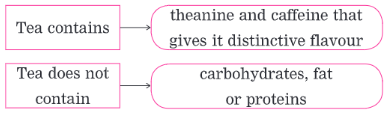
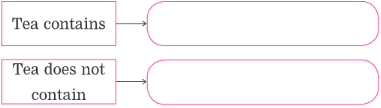
Most people agree that tea is a refreshing drink. It contains no carbohydrates, fat, or proteins. What gives tea its special and distinctive flavour is theanine as well as caffeine, which give the drink its stimulating quality.
How and when did people first begin to drink tea? An amusing story has come down to us from Chinese legends. It is said that Emperor Shennong, the father of Chinese agriculture and medicine, was on his travels, when a servant was boiling some water for the emperor to drink. Just then, a few leaves from a nearby tree blew into the boiling water. The water immediately changed colour. On drinking the water, the emperor was amazed by the rich flavour and the refreshing quality of the resulting infusion. Excited by the unknown plant and its amazing flavour, he carried out further investigations, and discovered that tea had many healing and restorative properties and could also be used as an antidote to certain poisons.
Yet another legend tells us that it was a Buddhist monk named Bodhidharma who was the first to use tea as a drink. He was keen to find a herb or a medicinal plant which would help him stay awake and alert for long periods of time in prayer and meditation. After considerable search and trial, he found that chewing leaves from the tea shrub acted as a stimulant, helping him stay awake. It was he who introduced tea among his disciples in China. It is said that Japanese priests studying under Buddhist teachers in China carried tea seeds and leaves back home with them. Turkish traders also began to bargain for tea on the border of Mongolia. In fact, the story goes that the Chinese Emperor Hui Tsung was so taken up with tea that he set up a research into the best tea- whisking methods and also hosted tea-making and tea-tasting tournaments in the court. So ‘tea minded’ was he, that he failed to notice that Mongolia had actually taken over his empire!
A2. Complex Factual Activities:
A3. Activities based on Vocabulary:
Match the words in Column 'A' with their meaning in Column 'B':
Complete the following sentences using the information given in the passage:
(1) Most people agree that tea is a ______________.
(2) Emperor Shennong was called the father of ______________.
(3) Bodhidharma found that chewing tea leaves acted as ______________.
(4) Tea got its distinctive flavour by its theanine as well as ______________.
Most people agree that tea is a refreshing drink. It contains no carbohydrates, fat, or proteins. What gives tea its special and distinctive flavour is theanine as well as caffeine, which give the drink its stimulating quality.
How and when did people first begin to drink tea? An amusing story has come down to us from Chinese legends. It is said that Emperor Shennong, the father of Chinese agriculture and medicine, was on his travels, when a servant was boiling some water for the emperor to drink. Just then, a few leaves from a nearby tree blew into the boiling water. The water immediately changed colour. On drinking the water, the emperor was amazed by the rich flavour and the refreshing quality of the resulting infusion. Excited by the unknown plant and its amazing flavour, he carried out further investigations, and discovered that tea had many healing and restorative properties and could also be used as an antidote to certain poisons.
Yet another legend tells us that it was a Buddhist monk named Bodhidharma who was the first to use tea as a drink. He was keen to find a herb or a medicinal plant which would help him stay awake and alert for long periods of time in prayer and meditation. After considerable search and trial, he found that chewing leaves from the tea shrub acted as a stimulant, helping him stay awake. It was he who introduced tea among his disciples in China. It is said that Japanese priests studying under Buddhist teachers in China carried tea seeds and leaves back home with them. Turkish traders also began to bargain for tea on the border of Mongolia. In fact, the story goes that the Chinese Emperor Hui Tsung was so taken up with tea that he set up a research into the best tea- whisking methods and also hosted tea-making and tea-tasting tournaments in the court. So ‘tea minded’ was he, that he failed to notice that Mongolia had actually taken over his empire!
A2. Complex Factual Activities:
A3. Activities based on Vocabulary:
Match the words in Column 'A' with their meaning in Column 'B':
| Column 'A' | Column 'B' |
| (1) investigation | (a) a substance (tea) that helps you to stay awake. |
| (2) stimulant | (b) a drink made by leaving shrubs (leaves), etc. in boiling water. |
| (3) infusion | (c) making you strong and healthy again. |
| (4) restorative | (d) a scientific examination for finding the truth. |
A4. Activities based on Contextual Grammar:
Underline the infinitives in the following sentence:
(1) It was funny to read words that stood still.
(2) Do I have to read the book?
(3) Turkish traders began to bargain for tea..
(4) A servant was boiling some water for the king to drink.
A5. Personal Response:
What is the difference between legends or stories and history?