Question
A1. Simple Factual Activity:
Pick out the statements that are false and write Them correctly:
(i) On the beach, the author found rocks carved and sculpted by the wind.
(ii) The hibiscus flower smiles with the sun and Hances with the wind.
(iii) Rocks take the shape that the water commands.
(iv) Our problems are big and so are we.

To see a world in a grain of sand
And a heaven in a wild flower,
Hold infinity in the palm of your hand
And eternity in an hour

   Something, as tiny as a grain of sand, can spark off an idea or imagination of a huge
significance to the world. One can witness and experience the beauty of Heaven in something as small as wild flower and derive joy forever. Only one should have the eyes and time to see it.
   Infinity is endless space; but your small palm can hold the destiny of earth through your efforts.Eternity is endless time; but just an hour in your life can make a difference to the world forever.
(Great deeds can surpass the limits of time and space. They never die.)
   We instinctively turn to outdoor activities and nature as a way of relaxing and enhancing our well being. Nature soothes and nurtures. Nature fulfils and
motivates. Nature whispers and commands.
    Are you listening?
   When I do, it leaves me in complete awe.
   We have a hibiscus plant in our garden. Every fortnight a flower blooms on it-big, bright and tender. Through the day it smiles with the sun and dances with the wind, but as evening approaches, it starts wilting. The morning after, it withers completely and by evening it falls and becomes one with the earth again. The flower comes to life only for a day, yet it does so in full splendour. What if we too lived our life, however short, to its fullest ?
   We went to a rocky beach and saw the spread of the majestic ocean and the rocks alongside, carved, sculpted and shaped by the water. Water is so gentle, rock so hard, yet, as the water flows over it every day, for years, the rock gives in. It takes the shape that the water commands. Our problems are so colossal and we are so small, yet if we persist...
A2. Complex Factual Activities:
Read the following questions from the passage. What do they imply?
(i) Are you listening?
(ii) What if we too had lived our lives, however short, to the fullest?
A3. Activities based on Vocabulary:
(i) Pick out the examples of concrete nouns from the passage.
Concrete nouns nouns that we can touch or see.
(ii) Pick out the examples of abstract nouns from the passage.
Abstract nouns nouns that we can't touch or see.
A4. Activities based on Contextual Grammar:
Underline the verbs in the sentences below, and say whether they are Transitive (T) or Intransitive (I):
(i) One can witness and experience the beauty of Heaven. 
(ii) It leaves me in complete awe. 
(iii) Nature soothes and nurtures,
(iv) It withers completely. 
A5. Personal Response:
(i) Why does the writer begin by quoting the lines from William Blake's poem 'Auguries of Innocence"?
Answer

A1. Simple Factual Activities:
Statements (i) and (iv) are false. The orrected statements are:
(i) On the beach, the author found rocks carved and sculpted by the water.
(iv) Our problems are very big, and we are very mall
A2. Complex Factual Activities:
(i) It implies that one must listen.
(ii) It implies that we too should live our lives to the fullest, however short they may be.
A3. Activities based on Vocabulary:
(i) sand, flower, ocean, rock, water.
(ii) infinity, imagination, joy, significance,experience, difference, awe. 
A4. Activities based on Contextual Grammar:
(i) One can witness and experience the beauty of Heaven.(T)
(ii) It leaves me in complete awe.(T)
(iii) Nature soothes and nurtures. (I)
(iv) It withers completely.(I)
A5. Personal Response:
(i) These lines show that if we pause to reflect, there is much beauty in nature and plenty that we can learn from it. The write-up expands on the same idea, thus reflecting the philosophy of the quoted lines from William Blake.

Need a full question paper?

Generate a complete, print-ready paper with questions like this in minutes — across 16+ boards, with answer keys.

Start Generating Free

Similar questions

A1.Simple Factual Activities:
Write who said to whom :

StatementWhoTo Whom
 (i) You'll wake him up.  
 (ii) "We mustn't miss the chance."  

   One morning in a small apartment in Bombay a girl of about sixteen looked up from the newspaper and said excitedly, ‘Pandit Ravi Shankar is playing tomorrow at the Shanmukhananda auditorium.’
  ‘Sh-sh,’ said her mother pointing to the figure sleeping on the bed. ‘You’ll wake him up. You know he needs all the sleep and rest he can get.’
   But the boy on the bed was not asleep. ‘Pandit Ravi Shankar!’ he said. ‘Pandit Ravi Shankar, the sitar maestro? He raised himself up on his elbows for one second, then fell back. But his eyes were shining. ‘We mustn’t miss the chance,’ he said. ‘I’ve - ‘I’ve –
always wanted to hear him and see him…’
   ‘Lie down son, lie down.’ His mother sprang to his side. ‘He actually raised himself up without help,’ she murmured with a catch in her throat and her eyes turned to the idols on a corner shelf. The prayer, which she uttered endlessly, came unbidden to her lips.
  ‘I must hear him and see him,’ the boy repeated. ‘It’s the chance of a lifetime.’ Then he began to cough and gasp for breath and had to be given oxygen from the cylinder that stood under the bed. But his large eyes were fixed on his sister.
   Smita bit her lip in self-reproach. She had been so excited at seeing the announcement, that she had not remembered that her brother was very ill. She had
seen how the doctors had shaken their heads gravely and spoken words that neither she nor even her parents could understand. But somewhere deep inside Smita had known the frightening truth – that Anant was going to die. The word cancer had hung in the air – her brother 

A2. Complex Factual Activity:
(i) Why was Smita excited?
(ii) What was the chance of a lifetime for Anant?
A3. Activity based on Vocabulary:
Write from the passage antonyms for the following words :
(i) bored (ii) forgot (iii) worse (iv) worst
A4. Activities based on Contextual Grammar:
Add question tags :
(i) You know he needs all the sleep and rest be can get.
(ii) You'll wake him up.
(iii) His eyes were shining.
(iv) We mustn't miss the chance.
A5. Personal Response:
(i) How would you feel and react if you came to know that someone closely known to you was suffering from cancer?

A1.Simple Simple l Factual Activities:
Name the following from the passage:
(i) Those considered by Kailash Satyarthi as his daughters : 
(ii) The biggest challenge knocking on the doors of humankind : 

   We have made progress in the last couple of decades. We have reduced the number of out-ofschool children by half. We have reduced the number of child labourers by a third. We have reduced child mortality and malnutrition, and we have prevented millions of child deaths.
   But, let us make no mistake, great challenges still remain.
   Friends! The biggest challenge or biggest crisis knocking on the doors of humankind is fear and intolerance.
   We have utterly failed our children in imparting an education. An education that gives the meaning and objective of life. An education that gives a sense of global citizenship among the youth.
   I am afraid that the day is not very far away when the cumulative result of this failure, will culminate in an unprecedented violence, and that will be suicidal for humankind.
    Rights, security, hope can only be restored through education. Young people like Malala ... I’ve started calling her my daughter Malala not just Malala ... So my
daughter Malala and other daughters including Kayanat.. in fact.. two Kayanats, and Shazia, and the daughters from Africa, and from all over the world. They are rising up and choosing peace over violence, tolerance over extremism, and courage over
fear.
    The solutions are emerging. But these solutions cannot be found in the deliberations in conferences alone, and cannot be found in prescriptions from a
distance.They lie in small groups and local organisations and individuals, who are confronting with the problem every day. Even if they remain unacknowledged, unrecognised and unknown to the world the solutions are with them.

A2. Complex Factual Activity:

(i) Make a list of the things that Kailash Satyarthi is not ready to accept:
A3. Activities based on Vocabulary:
Choose the correct option which conveys the exact meanings of:

(i) culminate:
(a) destroy  (b) succeed  (c) rise to a peak
(ii) mortality:
(a) death  (b) virtues  (c) starvation                            
A4. Activities based on Contextual Grammar:
Complete the following sentences with the help of the given sentences:
(i) The biggest challenge knocking on the doors of humankind is fear and intolerance.
A5. Personal Response:
(i) Explain how education can help the deprived children and child labourers.
A1.Simple Simple l Factual Activities:
The following incidents in Stephen Hawking's life are given in jumbled order. Arrange the incidents in proper sequence as per their order of occurrence in Hawking's life:"
(i) Hawking authored 'A Briefer History of Time' that contained the newest developments.
(ii) Hawking's book 'A Brief History of Time' spent more than four years atop the London Sunday Times'.
(iii) Hawking's book The Universe in a Nutshell' offered an illustrated guide to cosmology's big theories.
(iv) Hawking published the book 'A Brief History of Time that offered an overview of space and time

   Stephen Hawking (born January 8, 1942) is a British scientist, professor and author who has done groundbreaking work in physics and cosmology, and whose books have helped to make science accessible to everyone. At the age of 21, while studying cosmology at the University of Cambridge, he was diagnosed with amyotrophic lateral sclerosis (ALS). Part of his life story was depicted in the 2014 film ‘The Theory of
Everything.’
  Over the years, Stephen Hawking has written or co-written a total of 15 books. A few of the most noteworthy include: The Grand Design, The Universe in a Nutshell, The Theory of Everything.
   In 1988 Hawking catapulted to international prominence with the publication of A Brief History of Time. The short, informative book became an account of cosmology for the masses and offered an overview of space and time, the existence of God and the future.The work was an instant success, spending more than four years atop the ‘London Sunday Times’ bestseller list. Since its publication, it has sold millions of
copies worldwide and been translated into more than 40 languages.
   ‘A Brief History of Time’ also wasn’t as easy to understand as some had hoped. So in 2001, Hawking followed up his book with ‘The Universe in a Nutshell,’ which offered a more illustrated guide to cosmology’s big theories.
   In 2005, Hawking authored the even more accessible ‘A Briefer History of Time,’ which further simplified the original work’s core concepts and touched upon the newest developments in the field like String theory.  

A2. Complex Factual Activity:
Complete the table with relevant information about Hawking:

BooksFilms


A3. Activity based on Vocabulary:
Find out the antonyms from the passage for the following:

(i) worst 
(ii) exclude 
(iii) duplicate 
(iv) oldest
A4. Activities based on Contextual Grammar:
(i) He was diagnosed with amyotrophic lateral sclerosis. (Rewrite using the present perfect tense of the underlined part.)
(ii) It has sold millions of copies worldwide and been translated into more than 40 languages.(Change into a simple sentence)
A5. Personal Response:
(i) Stephen Hawking was a versatile personality. Justify.

A1. Simple Factual Activities :
Choose the correct alternatives from the given options and rewrite the sentences:
(appealing, casually, flattery, well-otled)
(i) I followed __________.
(ii) Anil talked about the __________ wrestlers.
(iii) I gave him my most __________ smile.
(iv) A little __________ helps in making friends.

   I was still a thief when I met Anil. And though only only 15. I was an experienced and fairly successful hand.
   Anil was watching a wrestling match when I approached him. He was about 25 a tall, lean fellow - and he looked easy-going, kind and simple enough for my purpose. I hadn't had much luck of late and thought I might be able to get into the young man's confidence.
   "You look a bit of a wrestler yourself." I said. A little flattery helps in making friends.
   "So do you," he replied, which put me off for a moment because at that time I was rather thin.
   "Well," I said modestly, "I do wrestle a bit."
   "What's your name?"
   "Hari Singh," I lied. I took a new name every month. That kept me ahead of the police and my former employers.
    After this introduction, Anil talked about the well-oiled wrestlers who were grunting, lifting and throwing each other about. I didn't have much to say. Anil walked away. I followed casually.
   "Hello again," he said.
    I gave him my most appealing smile. "I want to work for you," I said.
   "But I can't pay you."
    I thought that over for a minute. Perhaps I had misjudged my man.
    I asked, "Can you feed me?"
    "Can you cook?"
    "I can cook." I lied again.
    "If you can cook, then may be I can feed you."

A2. Complex Factual Activities:
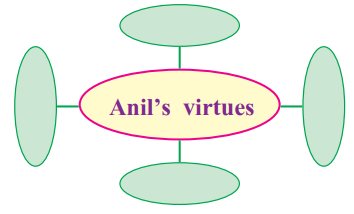
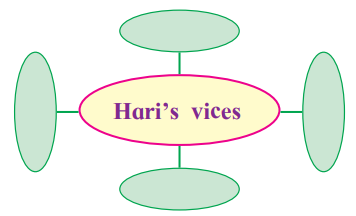
Complete the web diagrams:
(i) 

Image
(ii)
Image

A3. Activities based on Vocabulary:
Find similar meanings from the passage for the following:
(i) endearing
(ii) miscalculated
(iii) humbly
(iv) awful
A4. Do as directed:
(i) I can't pay you. (Rewrite making it affirmative.)
(ii) "I want to work for you," I said. (Change into Indirect speech.)
A5. Personal Response:
(i) Why did Anil employ Hari as a cook, even though he could not afford to pay him?

A1.Simple Factual Activities:
The following incidents in Stephen Hawking's life are given in jumbled order. Arrange the incidents in proper sequence as per their order of occurrence in Hawking's life:

(i) Hawking was rushed to hospital.
(ii) Hawking was unable to attend a conference in Arizona.
(iii) Hawking's predicament caught the attention of a California computer programmer.
(iv) Hawking announced that he was retiring.

   The predicament caught the attention of a California computer programmer, who had developed a speaking program that could be directed by head or eye movement. The invention allowed Hawking to select words on a computer screen that were then passed through a speech synthesizer. At the time of its introduction, Hawking, who still had use of his fingers,selected his words with a handheld clicker. Today, with virtually all control of his body gone, Hawking directs the program through a cheek muscle attached to a
sensor.
   Through the program, and the help of assistants, Stephen Hawking has continued to write at a prolific rate. His work has included numerous scientific papers,of course, but  also information for the non-scientific community.
   Hawking’s health, of course, remains a constant concern - a worry that was heightened in 2009 when he failed to appear at a conference in Arizona because of a chest infection. In April, Hawking, who had already announced he was retiring after 30 years from the post of Lucasian Professor of Mathematics at Cambridge, was rushed to the hospital for being what university officials described as “gravely ill.” It was later announced that he was expected to make a full recovery.

A2. Complex Factual Activity:
(i) Find evidences of Stephen Stephen Hawking's Hawking's special life.
A3. Activity based on Vocabulary:
(i) Write the adjective forms of:(a) infection (b) office.
(ii) Write from the last paragraph phrases that give an indication of Stephen Hawking's health situation.
A4. Activities based on Contextual Grammar:
Pick out the verbs and state the tense.

(i) Stephen Hawking has continued to write at a prolific rate.
(ii) He had already announced he was retiring.
A5. Personal Response:
Do you agree or disagree with the following statement? Justify your stand/answer by quoting a line from the passage.

(i) Though Hawking lost control over his body, he writes at a prolific rate with the help of assistants.

A1.Simple Factual Activities:
Put the following statements in the correct order of occurrence :
(i) "If you'll unwrap that package you may see why you had me going a while at first."
(ii) "It's Christmas Eve, boy."
(iii) "Don't you like me just as well, anyhow?"
(iv) "It's sold, I tell you,"

   “You’ve cut off your hair?” asked Jim, laboriously, as if he had not arrived at that patent fact yet even after the hardest mental labour.
   “Cut it off and sold it,” said Della. “Don’t you like me just as well, anyhow? I’m me without my hair, ain’t I?”
  Jim looked about the room curiously.
  “You say your hair is gone?” he said, with an air almost of idiocy.
  “You needn’t look for it,” said Della. “It’s sold, I tell you—sold and gone, too. It’s Christmas Eve, boy. Be good to me, for it went for you. Maybe the hairs of my head were numbered,” she went on with sudden serious sweetness, “but nobody could ever count my love for you. Shall I put the chops on, Jim?”
   Out of his trance Jim seemed quickly to wake. For ten seconds let us regard with discreet scrutiny some inconsequential object in the other direction. Eight dollars a week or a million a year—what is the difference? A mathematician or a wit would give you the wrong answer. The magi brought valuable gifts, but that was not among them. This dark assertion will be illuminated later on.
  Jim drew a package from his overcoat pocket and threw it upon the table.
  “Don’t make any mistake, Dell,” he said, “about me. I don’t think there’s anything in the way of a haircut or a shave or a shampoo that could make me like my girl any less. But if you’ll unwrap that package you may see why you had me going a while at first.”
 
A2. Complex Factual Activity:
(i) Describe Jim's behaviour when he saw Della's short hair.
A3. Activity based on Vocabulary:
Complete the following table :

NounAdjectiveAdverb
 (i) ________________laboriously
 (ii) Idiocy________ ________
 (iii) ________discreet________
 (iv) ________________curiously

A4. Activities based on Contextual Grammar:
Do as Directed :
(i) Jim drew a package from his overcoat pocket and threw it upon the table.
(Rewrite beginning 'Drawing....'.)
(ii) The magi brought valuable gifts, but that was not among them.
(Rewrite beginning 'Though......)
A5. Personal Response:
(i) When did the narrator try to divert the reader's attention, for ten seconds, at least?

A1. Simple Factual Activity:
Complete the following sentences with the help of the given passage:
(i) The narrator was thinking of catching .......................... .
(ii) When Anil was sleeping peacefully, his face was .......................... .
(iii) The narrator slid his hands under the mattress to .......................... .
(iv) The narrator thought that if he didn't take the money. Anil would only waste .......................... .

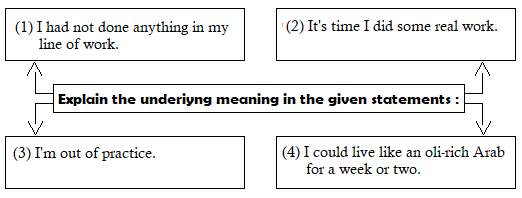
   I had been working for Anil for almost a month and, apart from cheating on the shopping, had not done anything in my line of work. I had every opportunity for doing so. Anil had given me a key to the door, and I could come and go as I pleased. He was the most trusting person I had ever met.
    And that is why it was so difficult to rob him. It’s easy to rob a greedy man, because he can afford to be robbed; but it’s difficult to rob a careless man sometimes he doesn’t even notice he’s been robbed and that takes all the pleasure out of the work.
   Well, it’s time I did some real work, I told myself; I’m out of practice. And if I don’t take the money, he’ll only waste it on his friends. After all, he doesn’t even pay me.
   Anil was asleep. A beam of moonlight stepped over the balcony and fell on the bed. I sat up on the floor, considering the situation. If I took the money, I could catch the 10.30 Express to Lucknow. Slipping out of the blanket, I crept up to the bed. Anil was sleeping peacefully. His face was clear and unlined; even I had more marks on my face, though mine were mostly scars.
   My hand slid under the mattress, searching for the notes. When I found them, I drew them out without a sound. Anil sighed in his sleep and turned on his side, towards me. I was startled and quickly crawled out of the room.
   When I was on the road, I began to run. I had the notes at my waist, held there by the string of my pyjamas. I slowed down to a walk and counted the notes: 600 rupees in fifties! I could live like an oil-rich Arab for a week or two.

A2. Complex Factual Activities:
Complete the web:
Image
A3. Activities based on Vocabulary:
Write the adjective forms of the following words:
(i) opportunity
(ii) pleasure 
(iii) sleep 
(iv) situation
A4. Activities based on Contextual Grammar:
Frame a Wh-question to get the underlined answer: 
(i)  Anil was the most trusting person I had ever met. (Rewrite using 'never'.)
(ii) I had not done anything in my line of work. (Rewrite without 'not')
A5. Personal Response:
(i) What could have caused the scars on Hari's face?
A1. Simple Factual Activity:
Pick out the statements that are false and write Them correctly:
(i) On the beach, the author found rocks carved and sculpted by the wind.
(ii) The hibiscus flower smiles with the sun and Hances with the wind.
(iii) Rocks take the shape that the water commands.
(iv) Our problems are big and so are we.

To see a world in a grain of sand
And a heaven in a wild flower,
Hold infinity in the palm of your hand
And eternity in an hour

   Something, as tiny as a grain of sand, can spark off an idea or imagination of a huge
significance to the world. One can witness and experience the beauty of Heaven in something as small as wild flower and derive joy forever. Only one should have the eyes and time to see it.
   Infinity is endless space; but your small palm can hold the destiny of earth through your efforts.Eternity is endless time; but just an hour in your life can make a difference to the world forever.
(Great deeds can surpass the limits of time and space. They never die.)
   We instinctively turn to outdoor activities and nature as a way of relaxing and enhancing our well being. Nature soothes and nurtures. Nature fulfils and
motivates. Nature whispers and commands.
    Are you listening?
   When I do, it leaves me in complete awe.
   We have a hibiscus plant in our garden. Every fortnight a flower blooms on it-big, bright and tender. Through the day it smiles with the sun and dances with the wind, but as evening approaches, it starts wilting. The morning after, it withers completely and by evening it falls and becomes one with the earth again. The flower comes to life only for a day, yet it does so in full splendour. What if we too lived our life, however short, to its fullest ?
   We went to a rocky beach and saw the spread of the majestic ocean and the rocks alongside, carved, sculpted and shaped by the water. Water is so gentle, rock so hard, yet, as the water flows over it every day, for years, the rock gives in. It takes the shape that the water commands. Our problems are so colossal and we are so small, yet if we persist...

A2. Complex Factual Activities:
(i) The writer explains the contrasting features of 'water' and 'rock' in the lesson. Write all the features of both water and rock in the given table.
A3. Activities based on Vocabulary:
(i) Pick out the examples of concrete nouns from the passage.
Concrete nouns nouns that we can touch or see.
(ii) Pick out the examples of abstract nouns from the passage.
Abstract nouns nouns that we can't touch or see.
A4. Activities based on Contextual Grammar:
(i) Choose the correct 'not only ... but also..." form of the sentence:
Natures soothes and nurtures.
(a) Not only nature soothes but nurtures also.
(b) Nature soothes not only but also nurtures.
(c) Nature soothes but also nurtures not only.
(d) Nature not only soothes but also nurtures.
(ii) By evening it falls and becomes one with the earth again. (Rewrite using the -ing form of the underlined word.)"
A5. Personal Response:
(i) How do you deal with difficulties and problems?

A1.Simple Factual Activities:
Write whether the following statements are True or False:
(i) Smita dreamt that she was at the concert.
(ii) Anant had said, "The chance of a lifetime the previous evening.
(iii) At the end of the concert, the artistes stood and clapped for the audience.
(iv) A man with a long moustache was one of the artistes.

   The next day as Smita and her father were leaving for the concert, her brother smiled and said, ‘Enjoy yourself,’ though the words came out in painful gasps. ‘Lucky you!’
   Sitting besides her father in the gallery, Smita heard as in a dream the thundering welcome the audience gave the great master. Then the first notes came over the air and Smita felt as if the gates of a land of enchantment and wonder were opening. Spellbound, she listened to the unfolding ragas, the slow plaintive notes, the fast twinkling ones, but all the while the plan she had decided on the evening before remained firmly in her mind. ‘The chance of a lifetime.’ She heard Anant’s voice in every beat of the tabla.
  The concert came to an end, the audience gave the artistes a standing ovation.
  A large moustachioed man having a long moustache, made a long boring speech. Then came the presentation of bouquets. Then more applause and the curtain came
down. The people began to move towards the exits.

A2. Complex Factual Activity:
Arrange the following sentences chronologically according to their occurrence in the passage:
(i) The first notes came over the air.
(ii) The audience gave the artistes a standing ovation.
(iii) The audience gave the great master a thundering welcome.
(iv) The ragas unfolded.
A3. Activity based on Vocabulary: 
Pick the odd man out from the following based on the passage and give reasons :
(i) sitting, thundering, unfolding, twinkling
(ii) slow, boring, plaintive, twinkling
A4. Activities based on Contextual Grammar:
Underline the adverbs :
(i) The curtain came down.
(ii) The plan she had decided on the evening before remained firmly in her mind.
A5. Personal Response:
(i) Have you ever attended any concert? How was your experience there?
A1. Simple Factual Activities:
Name the following:
(i) The world's most successful animation studio.
(ii) The company that Steve Jobs took ve years to establish.
(iii) The company that bought Next.
(iv) Steve Jobs' wife.

   My second story is about love and loss. I found what I loved to do early in life. Woz (Steve Wozniak) and I started Apple when I was 20. In 10 years Apple had grown from just the two of us in a garage into a $2 billion company. And then I got fired. It was
devastating.
    But something slowly began to dawn on me - I still loved what I did. And so I decided to start over.
   The heaviness of being successful was replaced by the lightness of being a beginner again. It freed me to enter one of the most creative periods of my life.
    During the next five years, I started a company Next, another company named Pixar, and fell in love with an amazing woman who would become my wife. Pixar is now the world’s most successful animation studio, Apple bought Next. I returned to Apple and
the technology we developed at Next is at the heart of Apple’s current renaissance. And Laurene and I have a wonderful family together.
   Sometimes life hits you in the head with a brick. Don’t lose faith. The only way to do great work is to love what you do. If you haven’t found it yet, keep looking. Don’t settle.

A2. Complex Factual Activities:
Say how:
(i) What setback did Jobs suffer when he was thirty?
A3. Activities based on Vocabulary:
(i) When the father learned about his son's misdeeds, it .................. .
(ii) Even if you don't succeed at first, don't .................. in yourself.
(iii) It is corruption in high places that lies ................. of the non-development of this locality.
(iv) On reading exactly the same essays in both answer sheets, it ................ the examiner that the students had cheated during the exams.
A4. Activities based on Contextual Grammar:
(i) You haven't found it. (Name the tense of the verbs underlined to include Time and Aspect.)
(ii) I got fired.(Rewrite changing to the future perfect tense.)
A5. Personal Response:
(i) Which quality of Steve Jobs impresses you the most? How would you apply it in your life?