Question
A1. Simple Factual Activity:
Pick out the statements that are false and write Them correctly:
(i) On the beach, the author found rocks carved and sculpted by the wind.
(ii) The hibiscus flower smiles with the sun and Hances with the wind.
(iii) Rocks take the shape that the water commands.
(iv) Our problems are big and so are we.

To see a world in a grain of sand
And a heaven in a wild flower,
Hold infinity in the palm of your hand
And eternity in an hour

   Something, as tiny as a grain of sand, can spark off an idea or imagination of a huge
significance to the world. One can witness and experience the beauty of Heaven in something as small as wild flower and derive joy forever. Only one should have the eyes and time to see it.
   Infinity is endless space; but your small palm can hold the destiny of earth through your efforts.Eternity is endless time; but just an hour in your life can make a difference to the world forever.
(Great deeds can surpass the limits of time and space. They never die.)
   We instinctively turn to outdoor activities and nature as a way of relaxing and enhancing our well being. Nature soothes and nurtures. Nature fulfils and
motivates. Nature whispers and commands.
    Are you listening?
   When I do, it leaves me in complete awe.
   We have a hibiscus plant in our garden. Every fortnight a flower blooms on it-big, bright and tender. Through the day it smiles with the sun and dances with the wind, but as evening approaches, it starts wilting. The morning after, it withers completely and by evening it falls and becomes one with the earth again. The flower comes to life only for a day, yet it does so in full splendour. What if we too lived our life, however short, to its fullest ?
   We went to a rocky beach and saw the spread of the majestic ocean and the rocks alongside, carved, sculpted and shaped by the water. Water is so gentle, rock so hard, yet, as the water flows over it every day, for years, the rock gives in. It takes the shape that the water commands. Our problems are so colossal and we are so small, yet if we persist...

A2. Complex Factual Activities:
(i) The writer explains the contrasting features of 'water' and 'rock' in the lesson. Write all the features of both water and rock in the given table.
A3. Activities based on Vocabulary:
(i) Pick out the examples of concrete nouns from the passage.
Concrete nouns nouns that we can touch or see.
(ii) Pick out the examples of abstract nouns from the passage.
Abstract nouns nouns that we can't touch or see.
A4. Activities based on Contextual Grammar:
(i) Choose the correct 'not only ... but also..." form of the sentence:
Natures soothes and nurtures.
(a) Not only nature soothes but nurtures also.
(b) Nature soothes not only but also nurtures.
(c) Nature soothes but also nurtures not only.
(d) Nature not only soothes but also nurtures.
(ii) By evening it falls and becomes one with the earth again. (Rewrite using the -ing form of the underlined word.)"
A5. Personal Response:
(i) How do you deal with difficulties and problems?
Answer

A1. Simple Factual Activities:
Statements (i) and (iv) are false. The orrected statements are:
(i) On the beach, the author found rocks carved and sculpted by the water.
(iv) Our problems are very big, and we are very mall
A2. Complex Factual Activities:

WaterRock
1. gentle1. hard
2. persistent2. humble
3. persevering3. yielding
4. determined4. adaptable

A3. Activities based on Vocabulary:
(i) sand, flower, ocean, rock, water.
(ii) infinity, imagination, joy, significance,experience, difference, awe. 
A4. Activities based on Contextual Grammar:
(i) (d) Nature not only soothes but also
(ii) By evening it falls, becoming one with the earth again.
A5. Personal Response:
(i) When I come across problems in life. I turn towards nature for inspiration. I try to understand how the different elements in nature deal with their difficulties and try to solve my own problems in the same way.

Need a full question paper?

Generate a complete, print-ready paper with questions like this in minutes — across 16+ boards, with answer keys.

Start Generating Free

Similar questions

A1.Simple Factual Activities:
Complete the following :
(i) Della had saved __________.
(ii) The current family income was __________.

    One dollar and eighty-seven cents. That was all. And sixty cents of it was in pennies. Pennies saved one and two at a time by bulldozing the grocer and the vegetable man and the butcher until one’s cheeks burned with the silent imputation of parsimony that
such close dealing implied. Three times Della counted it. One dollar and eighty-seven cents. And the next day would be Christmas.
   There was clearly nothing to do but flop down on the shabby little couch and howl. So Della did it which instigates the moral reflection that life is made up of sobs, sniffles, and smiles, with sniffles predominating.
   While the mistress of the home is gradually subsiding from the first stage to the second, take a look at the home. A furnished flat at $8 per week. It did not exactly beggar description, but it certainly had that word on the look out for the mendicancy squad.
   In the vestibule below was a letter-box into which no letter would go, and an electric button from which no mortal finger could coax a ring. Also appertaining there unto was a card bearing the name “Mr. James Dillingham Young.”
  The “Dillingham” had been flung to the breeze during a former period of prosperity when its possessor was being paid $30 per week. Now, when the income was shrunk to $20, though, they were thinking seriously of contracting to a modest and unassuming D. But whenever Mr. James DillinghamYoung came home and reached his flat above he was called ‘‘Jim” and greatly hugged by Mrs. James Dillingham Young, already 
introduced to you as Della which is all very good. 

A2. Complex Factual Activity:

(i) List the signs that indicate that Della was very poor.
A3. Activity based on Vocabulary:
Pick out from the passage words that mean the following, and state if it is a Noun, Verb or Adjective :

PhraseWord From
the passage
Part of Speech
(1) Reluctance to spend money  
(2) Relating to  
(3) Urge  
(4) provokes  

A4. Activities based on Contextual Grammar:
Frame 'Wh'-questions to get the underlined parts as the answers :
(i) Life is made up of sobs, sniffles and smiles.
(ii) Many a happy hour she had spent plauning something nice for him.
A5. Personal Response:
(i) Della counted the money thrice. Explain what you think the reason for this may be.

A1. Simple Factual Activities:
Say whether the following statements are True or False:
(i) The person the king saved and helped was his enemy.
(ii) The hermit helped the king.
(iii) When he awoke, the king immediately realized where he was.
(iv) The king had gone out for a walk.

    Meanwhile the sun had set and it had become cool. So the king, with the hermit’s help, carried the wounded man into the hut. The man lay there quietly with his eyes closed. By now, the king was so tired after his walk and the work he had done, that he lay down himself and also fell asleep. When he awoke in the morning, it took him some time to remember where he was and who was the strange bearded man lying by his side and gazing intently at him. “Forgive me !” said the bearded man in a weak voice, when he saw that the king was awake and was looking at him.‘‘I do not know you, and I’ve nothing to forgive you for,” said the king. “
   You do not know me, but I know you. I am that enemy of yours who swore to revenge himself on you because you executed his brother and seized his property. I knew you had gone alone to see the hermit, and I resolved to kill you on your way back. But the day passed and you did not return. So I came out of my ambush to find you. Your bodyguards recognised me and wounded me. I escaped from them but would have bled to death had you not dressed my wound. I wished to kill you but you have saved my life. Now if I live, and if you wish it, I’ll serve you all my life.”

A2. Complex Factual Activities:
(i) Summarize the climax in 4 to 5 lines in your own words.
A3. Activities based on Vocabulary:
Match the words with their opposites:

WordsOpposites
 (a) familiar (i) weak
 (b) forget (ii) strange
 (c) firm (iii) nothing
 (d) everything (iv) remember

A4. Activities based on Contextual Grammar:
(i) 'Forgive me,' said the bearded man. (Rewrite in indirect speech.)
(ii) Pick out the finite and non-finite verbs in the sentences:
*Forgive me.
A5. Personal Response:
(i) Whom do you consider your guide when you are in difficulty? Why? (March '20)

A1. Simple Factual Activity:
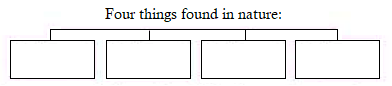
Complete the diagram: (Nov. 20)

Image
   We went to a rocky beach and saw the spread of the majestic ocean and the rocks alongside, carved,sculpted and shaped by the water. Water is so gentle, rock so hard, yet, as the water flows over it every day, for years, the rock gives in. It takes the shape that the water commands. Our problems are so colossal and we
are so small, yet if we persist... 
   We saw small bits of grass peeping through the small cracks in a concrete pavement. It left us thinking: however impossible things may look, there is always
an opening...
   We saw a tree bare of all leaves in the cold winter months. We thought its chapter was over. But three months passed, spring set in and the tree was back to its green majesty once again, full of leaves, flowers, birds and life. What if we too had the conviction that, however difficult things are right now, it will not remain so for ever. Remember, this too shall pass.
   We saw an army of ants lugging a fly which was at least ten times the ant’s size. The ants organized themselves around the fly, lifted it on frail feelers and carried it to quite a distance. Their teamwork and perseverance were impressive. What if we too are
consistent, organized, focused...Spider webs are delicate,yet very strong. A rainbow colours the entire sky.Oysters take in a grain of sand they open up with a pearl. Innumerable stars shine across the infinite sky. Clouds take new shapes with every passing moment.The wind makes trees dance with unhindered passion. Water, without hint of ego, changes its form according to the dictates of the sun and the wind. When we see a caterpillar turn into a butterfly, a flower turn into a fruit, we experience the alchemy of nature... we touch it and become gold ourselves.

A2. Complex Factual Activities:
(i) Which two aspects of nature teach us to accept change and adjust according to the situation?
A3. Activities based on Vocabulary:
(i) Pick out the examples of concrete nouns from the passage.
(ii) Pick out the examples of abstract nouns from the passage.
A4. Activities based on Contextual Grammar:
Do as directed: (Nov. '20)

(i) It takes the shape of water. (Add a question tag.)
(ii) We saw small bits of grass. (Pick out the verb and state whether it is Transitive or Intransitive.)
A5. Personal Response:
(i) An oyster turns a grain of sand into a pearl. What can we learn from this example?
A1.Simple Simple l Factual Activities:
Choose the correct alternative from the given statements:
(i) Dr. Kalam's father was an imam.
(a) a teacher (b) a scientist (c) a farmer (d) an imam
(ii) Dr. Kalam's friends discussed on science and spirituality.
(a) science and technology   (b) discoveries and inventions
(c) science and spirituality    (d) community's problems and solutions

   Dr Kalam’s own life was nourished by multiple faiths.
   His father, a boatman, also served as an imam at their local mosque, and his two best friends were from two different religions-one was a Hindu and the other was a Christian. Pakshi Lakshmana Shastrigal was the head priest of the famous Rameswara temple and a Vedic scholar, and the Reverend Father Bodal had built the first church on Rameswara Island. Dr Kalam recalled how ‘All three of them, in the unique attire of their religion, used to sit and discuss the community’s problems and find solutions. Throughout the nation and the world, the need to have a frank dialogue among cultures, religions and civilizations is felt now more than ever.’
   When asked where he got his humility from Dr Kalam would always attribute it to his father. In him, he saw how simplicity and divinity could go together. Even though his father was a boatman and Dr Kalam went on to become the President of India, they shared the same values in life. Both believed that if one leads a spiritual life then that spirituality can lift them out of any kind of confusion misery or failure.

A2. Complex Factual Activity:
(i) How were different virtues inculcated in Dr Kalam?
A3. Activities based on Vocabulary:
(i) Write from the passage four words that are connected with or related to religions.
A4. Activities based on Contextual Grammar:
Pick out the auxiliaries and state the function:
(i) All three of them used to sit and discuss the community's problems.
(ii) Simplicity and divinity could go together.
A5. Personal Response:
(i) What makes Dr Kalam a humble personality?
A1.Simple Simple l Factual Activities:
Name the following from the passage:
(i) The great personalities from India:
(ii) The two centres of global peace and brotherhood:

   My journey from the great land of Lord Buddha, Guru Nanak and Mahatma Gandhi; India to Norway is a connect between the two centres of global peace and brotherhood, ancient and modern.
   Friends, the Nobel Committee has generously invited me to present a “lecture.” Respectfully, I am unable to do that. Because, I am representing here the sound of silence. The cry of innocence. And, the face of invisibility. I represent millions of those
children who are left behind and that’s why I have kept an empty chair here as a reminder.
   I have come here only to share the voices and dreams of our children - because they are all our children - (gesture to everyone in the audience). I have looked into their frightened and exhausted eyes.I have held their injured bodies and felt their broken spirits.
   Twenty years ago, in the foothills of the Himalayas, I met a small, skinny child labourer. He asked me: “Is the world so poor that it cannot give me a toy and a book, instead of forcing me to take a gun or a tool?”
   I met with a Sudanese child-soldier. He was kidnapped by an extremist militia. As his first training lesson, he was forced to kill his friends and family. He asked me: “What is my fault?” 

A2. Complex Factual Activity:

(i) Make a list of the things that Kailash Satyarthi is not ready to accept:
A3. Activities based on Vocabulary:
(i) Pick out from the passage the verb form of - hindrance                                    
(ii) Make a meaningful sentence using the phrase 'give up':
A4. Activities based on Contextual Grammar:
Do as directed:
(i) I have the privilege of working with many courageous people who have the same aim. (Rewrite using the noun form of the underlined word.)
(ii) All the great religions teach us to care for our children. (Frame a Wh-question to get the underlined words as the answer.)
A5. Personal Response:
(i) "Besides the political freedom that our nation enjoys, what other freedom should it strive for? Say why.
A1. Simple Factual Activity:
Choose the correct alternatives from the given options:
(i) The Lucknow Express had picked up/not picked up speed.
(ii) Hari wanted to/did not want to stay at a hotel.
(iii) On discovering the theft, Anil would feel sad for the loss of his money/the loss of trust.
(iv) Hari had never bought/always bought a ticket in his life.

   When I reached the station I did not stop at the ticket office (I had never bought a ticket in my life.) but dashed straight to the platform. The Lucknow Express was just moving out. The train had still to pick up speed and I should have been able to jump into one of the carriages, but I hesitated — for some reason I can’t explain — and I lost the chance to get away.
   When the train had gone, I found myself standing alone on the deserted platform. I had no idea where to spend the night. I had no friends, believing that friends were more trouble than help. And I did not want to make anyone curious by staying at one of the small hotels near the station. The only person I knew really well was the man I had robbed. Leaving the station, I walked slowly through the bazaar.
    In my short career as a thief, I had made a study of men’s faces when they had lost their goods. The greedy man showed fear; the rich man showed anger; the poor man showed acceptance. But I knew that Anil’s face, when he discovered the theft, would show only a touch of sadness. Not for the loss of money, but for the loss of trust.
    I found myself in the maidan and sat down on a bench. The night was chilly — it was early November — and a light drizzle added to my discomfort. Soon it was raining quite heavily. My shirt and pyjamas stuck to my skin, and a cold wind blew the rain across my
face.
    I went back to the bazaar and sat down in the shelter of the clock tower. The clock showed midnight. I felt for the notes. They were damp from the rain.

A2. Complex Factual Activities:
Give reasons:

(i) Hari hesitated to board the train.
A3. Activities based on Vocabulary:
(1) Find from the passage the collocations for the following:
(i) ticket ...........  (ii) ............ slowly 
(2) Pick out 2 examples of code-mixing from the passage:
A4. Activities based on Contextual Grammar:
Frame Wh-questions to get the underlined answers: 
(i) I had made a study of men's faces.
(ii) The poor man showed acceptance.
A5. Personal Response:

(i) What is face-reading? Can you read faces?
A1. Simple Factual Activities:
Arrange the following incidents from Steve Jobs' life in proper sequence based on this passage:
(i) Jobs married Laurene.
(ii) Jobs returned to Apple Inc.
(iii) Jobs started Next.
(iv) Jobs got fired.

   My second story is about love and loss. I found what I loved to do early in life. Woz (Steve Wozniak) and I started Apple when I was 20. In 10 years Apple had grown from just the two of us in a garage into a $2 billion company. And then I got fired. It was
devastating.
    But something slowly began to dawn on me - I still loved what I did. And so I decided to start over.
   The heaviness of being successful was replaced by the lightness of being a beginner again. It freed me to enter one of the most creative periods of my life.
    During the next five years, I started a company Next, another company named Pixar, and fell in love with an amazing woman who would become my wife. Pixar is now the world’s most successful animation studio, Apple bought Next. I returned to Apple and
the technology we developed at Next is at the heart of Apple’s current renaissance. And Laurene and I have a wonderful family together.
   Sometimes life hits you in the head with a brick. Don’t lose faith. The only way to do great work is to love what you do. If you haven’t found it yet, keep looking. Don’t settle.

A2. Complex Factual Activities:
Say how:
(i) Jobs reacted later on, after the shock of being fired from Apple.
A3. Activities based on Vocabulary:
Match the words/phrases in column A with their meanings in column B:

(A)(B)
 (i) renaissance (a) causing great destruction
 (ii) to start over (b) lost one's job
 (iii) fired (c) revival
 (iv) devastating (d) to begin again

A4. Activities based on Contextual Grammar:
(i) I started a company. (Rewrite changing to the present continuous tense.)
(ii) Life hits you in the head. (Rewrite in the present perfect continuous tense.)
A5. Personal Response:
(i) What does this second story of Jobs convey to you?

A1.Simple Factual Activities:
Write who said to whom :

StatementWhoTo Whom
 (i) You'll wake him up.  
 (ii) "We mustn't miss the chance."  

   One morning in a small apartment in Bombay a girl of about sixteen looked up from the newspaper and said excitedly, ‘Pandit Ravi Shankar is playing tomorrow at the Shanmukhananda auditorium.’
  ‘Sh-sh,’ said her mother pointing to the figure sleeping on the bed. ‘You’ll wake him up. You know he needs all the sleep and rest he can get.’
   But the boy on the bed was not asleep. ‘Pandit Ravi Shankar!’ he said. ‘Pandit Ravi Shankar, the sitar maestro? He raised himself up on his elbows for one second, then fell back. But his eyes were shining. ‘We mustn’t miss the chance,’ he said. ‘I’ve - ‘I’ve –
always wanted to hear him and see him…’
   ‘Lie down son, lie down.’ His mother sprang to his side. ‘He actually raised himself up without help,’ she murmured with a catch in her throat and her eyes turned to the idols on a corner shelf. The prayer, which she uttered endlessly, came unbidden to her lips.
  ‘I must hear him and see him,’ the boy repeated. ‘It’s the chance of a lifetime.’ Then he began to cough and gasp for breath and had to be given oxygen from the cylinder that stood under the bed. But his large eyes were fixed on his sister.
   Smita bit her lip in self-reproach. She had been so excited at seeing the announcement, that she had not remembered that her brother was very ill. She had
seen how the doctors had shaken their heads gravely and spoken words that neither she nor even her parents could understand. But somewhere deep inside Smita had known the frightening truth – that Anant was going to die. The word cancer had hung in the air – her brother 

A2. Complex Factual Activity:
(i) Why was Smita excited?
(ii) What was the chance of a lifetime for Anant?
A3. Activity based on Vocabulary:
Write from the passage antonyms for the following words :
(i) bored (ii) forgot (iii) worse (iv) worst
A4. Activities based on Contextual Grammar:
Add question tags :
(i) You know he needs all the sleep and rest be can get.
(ii) You'll wake him up.
(iii) His eyes were shining.
(iv) We mustn't miss the chance.
A5. Personal Response:
(i) How would you feel and react if you came to know that someone closely known to you was suffering from cancer?

A1.Simple Simple l Factual Activities:
Fill in the blanks:
(i) Hawking claimed that he could think in ................ dimensions.
(ii) ................ is the study of the big. ................... is the study of the small.
(iii) .................. is a single unifying theory that can combine cosmology with quantum mechanics.

   Together these three books, along with Hawking’s own research and papers, articulate the physicist’s personal search for science’s Holy Grail: a single unifying theory that can combine cosmology (the study of the big) with quantum mechanics (the study of the small) to explain how the universe began. It’s this kind of ambitious thinking that has allowed Hawking, who claims he can think in 11 dimensions, to lay out some
big possibilities for humankind. He’s convinced that time travel is possible, and that humans may indeed colonize other planets in the future.
   In September 2010, Hawking spoke against the idea that God could have created the universe in his book The Grand Design. Hawking previously argued that belief in a creator could be compatible with modern scientific theories. His new work, however, concluded that the Big Bang was the inevitable consequence of the laws of physics and nothing more. “Because there is a law such as gravity, the universe can and will create itself from nothing,” Hawking said. “Spontaneous creation is the reason there is something rather than nothing, why the universe exists, why we exist.”  

A2. Complex Factual Activity:

Name of Hawking's bookCentral IdeaConclusion
   

A3. Activity based on Vocabulary:
Write sentences using the given phrases:

(i) lay out
(ii) be the consequence of
A4. Activities based on Contextual Grammar:
Add question tags:
(i) There is something rather than nothing, Isn't there?
(ii) There is something rather than nothing.
A5. Personal Response:
Do you agree or disagree with the following statements? Justify your stand/answer by quoting a line from the passage:
(i) Do you agree or disagree with the following statements? Justify your stand/answer by quoting a line from the passage:

A1. Simple Factual Activities:
Say whether the following statements are True or False:
(i) The king wanted to know the answers to three questions.
(ii) The king never failed in any undertaking.
(iii) The people convinced the king to make a proclamation.
(iv) The king announced a reward for the right answers.

   Once a certain king had an idea. If he always knew the right time to begin everything, if he knew who were the right people to listen to and who to avoid the most important thing to do, he would never fail in anything that he would undertake and above all, if he
always knew what was the most undertake. Since he was convinced that he was right in thinking this way, he had a proclamation made in his kingdom. He would give a great reward to anyone who would teach him what the right time was for every action, who the most necessary people were, and how he might know the most important thing to do.
    Many learned people came to the court but they all gave different answers. In reply to the first question,some said that to know the right time for every action,one must draw up in advance a table of days, months and years, and must live strictly according to it. Others declared that it was impossible to decide beforehand the right time for every action; but that, not letting oneself be absorbed in idle pastimes, one should always attend to all that was going on, and then do that which was most essential. Yet others said that it was impossible for one man to decide correctly the right time for every action and that the king should, instead, have a council of wise people, who would help him to fix the proper time for everything.

A2. Complex Factual Activities:
(i) What final suggestion did the last group of learned men offer regarding the best time?
A3. Activities based on Vocabulary:
The following compound words from the passage are spelt in jumbled order. Rearrange the letters to make them meaningful:

(i) a r e e t u k d n
(ii) y o n n a c
(iii) s t a p s i e m
(iv) h e e d a r f o n b
A4. Activities based on Contextual Grammar:
Pick out the finite and non-finite verbs from the sentences:
(i) He always knew the right time to begin everything.
(ii) He was right in thinking this way.
A5. Personal Response:
(i) What is the right time, according to you?