Question
A1.Simple Factual Activities:
Choose the correct alternative and complete the given sentences:
(i) The tenure of the World Heritage Committee is __________ years.
(a) four (b) five (c) six
(ii) The World Heritage Committee consists of representatives from _____  State Parties. 
(a) 6 (b) 20 (c) 21
(iii) The World Heritage Committee meets __________ .
(a) once a year (b) twice a year (c) three times a year
(iv) A nominated site has to be first included in a  __________ .
(a) World Heritane List (b) Nomination File (c) Tentative List

    Today, the World Heritage Committee is the main group responsible for establishing which sites will be listed as a UNESCO World Heritage Site. The Committee meets once a year and consists of representatives from 21 State Parties that are elected for six year terms by the World Heritage Center’s General Assembly. The State Parties are then responsible for identifying and nominating new sites within their territory to be considered for inclusion on the World Heritage list.
   There are five steps in becoming a World Heritage Site, the first of which is for a country or State Party to take an inventory of its significant cultural and  natural sites. This is called the Tentative List and it is important because nominations to the World Heritage List will not be considered unless the nominated sitewas first included on the Tentative List. Next, countries are then able to select sites from their Tentative Lists to be included on a Nomination File. The third step is a review of the Nomination File by two Advisory Bodies consisting of the International Council on Monuments and Sites and the World Conservation Union, who then make recommendations to the World Heritage Committee. The World Heritage Committee
meets once a year to review these recommendations and decide which sites will be added to the World Heritage List. The final step in becoming a World Heritage Site is determining whether or not a nominated site meets at least one of the ten selection criteria. If the site meets these criteria, it can then be inscribed on the World Heritage List. Once a site goes through this process and is chosen, it remains the property of the country on whose territory it sits, but it also becomes considered within the international community.

A2. Complex Factual Activity:
(i) Explain what the World Heritage Committee is responsible for.
(ii) Who makes recommendations to the World Heritage Committee?
A3. Activity based on Vocabulary:
Choose the correct noun forms from those given in the brackets :
(i) inscribed      (inscription/inscribtion) 
(ii) responsible (responsive/responsibility) 
(iii) nominated  (nominative/nomination) 
(iv) included     (inclusion/inclution)
A4. Activities based on Contextual Grammar:
(i) Use 'not only...but also' in the following sentence :
The State Parties are responsible for identifying and nominating new sites.
(ii) Identify whether the following sentence is Simple, Compound or Complex :
If the site meets with these criteria,
it can be inscribed on the World Heritage List.
A5. Personal Response:
(i) What is the role of World Heritage Sites in developing tourism in any country?
Answer

A1.Simple Factual Activities:
(i) (c) six
(ii) (c) 21
(iiii) (a) once a year
(iv) (c) Tentative List
A2. Complex Factual Activity:
(i) The World Heritage Committee is the main group responsible for establishing which sites will be listed as UNESCO World Heritage Sites.
(ii) The recommendations to the World Heritage Committee are made by two Advisory Bodies: the International Council on Monuments and Sites and the World Conservation Union.
A3. Activity based on Vocabulary:
(i) inscription
(ii) responsibility
(iii) nomination
(iv) inclusion.
A4. Activities based on Contextual Grammar:
(i) The State Parties are responsible for not only identifying but also nominating new sites.
(ii) Complex
A5. Personal Response:
(i) World Heritage Sites are those that are significant culturally and naturally. People are interested in seeing such sites and learning the history behind them; hence they are a major tourist attraction, and they draw tourists to a country, boosting the country's revenue.

Need a full question paper?

Generate a complete, print-ready paper with questions like this in minutes — across 16+ boards, with answer keys.

Start Generating Free

Similar questions

A1.Simple Factual Activities:
(i) The gift Jim had brought for Della was __________ .
(ii) The beautiful present flashed with __________ .

   White fingers and nimble tore at the string and paper. And then an ecstatic scream of joy; and then, alas! a quick feminine change to hysterical tears and wails, necessitating the immediate employment of all the comforting powers of the lord of the flat.
   For there lay The Combs—the set of combs, side and back, that Della had worshipped long in a Broadway window. Beautiful combs, pure tortoise shell, with jeweled rims—just the shade to wear in the beautiful vanished hair. They were expensive combs, she knew, and her heart had simply craved and yearned over them without the least hope of possession. And now, they were hers, but the tresses that should have adorned the coveted adornments were gone.
   But she hugged them to her bosom, and at length she was able to look up with dim eyes and a smile and say: “My hair grows so fast, Jim!”
   And then Della leaped up like a little singed cat and cried, “Oh, oh!”
   Jim had not yet seen his beautiful present. She held it out to him eagerly upon her open palm. The dull precious metal seemed to flash with a reflection of her bright and ardent spirit.
   “Isn’t it a dandy, Jim? I hunted all over town to find it. You’ll have to look at the time a hundred times a day now. Give me your watch. I want to see how it looks on it.”
   Instead of obeying, Jim tumbled down on the couch and put his hands under the back of his head and smiled.
  “Dell,” said he, “let’s put our Christmas presents away and keep ‘em a while. They’re too nice to use just at present. I sold the watch to get the money to buy your combs. And now suppose you put the chops on.”
   The magi, as you know, were wise men— wonderfully wise men—who brought gifts to the Babe in the manger. They invented the art of giving Christmas presents. Being wise, their gifts were, no doubt, wise ones, possibly bearing the privilege of exchange in case of duplication. And here I have lamely related to you the uneventful chronicle of two foolish children in a flat who most unwisely sacrificed for each other the greatest treasures of their house. But in a last word to the wise of these days let it be said that of all who give gifts, these two were the wisest. Of all who give and receive gifts, such as they are wisest. Everywhere they are wisest. They are the magi.

A2. Complex Factual Activity:
Pick out and rewrite the exact sentences which indirectly imply the following :
(i) Della's elated mood underwent a change as she opened her gift.
(ii) Jim wanted to put the Christmas presents away and get back to daily life.
A3. Activity based on Vocabulary:
FIII in the blanks with words from the passage that are the opposites of the underlined words :
(i) Something that is not ______ is ______ .
(ii) Something that is not ______ is ______ .
(iii) Men who are not ______ are ______ .
(iv) Something that is not ______ is ______.
A4. Activities based on Contextual Grammar:
Add the appropriate Guestion Tags :
(i) Della leaped up, ....... ?
(ii) You'll have to look at the time, ........ ?
(iii) They were expensive combs, ........ ?
(iv) My hair grows so fast, ........ ?.
A5. Personal Response:
(i) Justify the title of the story, 'The Gift of the Magi'.

A1. Simple Factual Activities:
State whether the following statements are True or False:
(i) The hermit was well known.
(ii) The hermit spoke usually to everyone.
(iii) The hermit dug the ground easily
(iv) The hermit was strong.

   Equally varied were the answers to the second question. Some said, the people, the king most needed,were his councillors; others the priests; others the doctors while some said the warriors were the most necessary.
  To the third question about what was the most important occupation, some replied that the most important thing in the world was science. Others said     it was skill in warfare; and others, again, that it was religious worship. The king was convinced by none of
these answers and gave the reward to none.
   He decided, instead to go to a hermit who was widely renowned for his wisdom. The hermit lived in a small hut in a forest which he never left. He spoke only to common folk. So the king put on simple clothes and approaching the hermit’s cell, dismounted his horse and left his bodyguard behind.
   When the king arrived, the hermit was digging the ground in front of his hut. He greeted the king but went on digging. The hermit was frail and weak, and each time he struck the ground with the spade and turned over a little earth, he breathed heavily. The king went up to him and said, “I have come to you, wise hermit,to ask you to answer three questions-How can I learn to do the right thing at the right time ? Who are the
people I most need, and to whom should I, therefore,pay most attention? And what affairs are the most aimportant and need my first attention?”
    The hermit listened to the king but said nothing. He just spat on his hand and resumed digging. The king watched in silence for a while. 

A2. Complex Factual Activities:
State whether you agree/disagree with the following statements: (March 20)
(i) The hermit was strong and agile.
(ii) The king came to the hermit to ask three questions. 
A3. Activities based on Vocabulary:
(i) From the passage, find the collocations for the following:

(a) frail and .................. .  (b) simple ................. .
(ii) The following compound words from the passage are spelt in jumbled order.
Rearrange the letters to make them meaningful.

(a) d u b g y r o a d      (b) f r a w e r a
A4. Activities based on Contextual Grammar:
Do as directed: (March 20)
(i) When the king arrived the hermit was digging the ground. (Name and identify the subordinate clause.)
(ii) The hermit listened to the king but said nothing. (Rewrite the sentence beginning Though......)
A5. Personal Response:
(i) The learned people were sometimes divided in their opinions, different people giving quite different answers; at other times, none of them gave an answer. They all suggested ways to look for an answer. Can you point out one example of each?
A1.Simple Simple l Factual Activities:
Complete the following sentences:
(i) The narrator was not happy about the concert because ........................ .
(ii) When the narrator turned to look at his neighbour ......................... .

 When I was a very young man, I was invited to dine at the house of a philanthropist. After a wonderful dinner, our hostess took us to a large drawing room. Chairs were being arranged. “I’m arranging the chairs for a concert”, my hostess said, “We’re going to listen to a very good pianist.”
  Though everyone else was very happy, I was not. I did not understand classical music. I thought I was tone-deaf. I sat down so that I would not be impolite and waited for the concert to begin. I did not pay attention to the music after it began.
   After a while, I heard everyone clapping, so I realised that the piece was over. Just then I heard a gentle, but firm voice saying, “You’re fond of Bach?”
   I knew as much about Bach as I did about nuclear physics. I was going to say something ordinary so that I could get out of the situation. I turned in order to look at my neighbour and I saw a very famous face.It was someone with a shock of white hair and a pipe.

A2. Complex Factual Activity:
Who said to whom?

StatementWhoTo Whom Effect on the listener
(i) "We are going to listen to       a very good pianist."   
(ii) "You're fond of Bach?"   

A3. Activities based on Vocabulary:
Rewrite the following sentences using the phrases given in the brackets:
(to pay attention to, to be fond of, to get out of. shock of hair)
(i) Sachin ............... playing cricket.
(ii) The teacher asked her students ............... their studies,
(iii) The rabbit trapped in the snare was trying to ................ it.
(iv) He moved and I saw a ............... gleaming in the sun.
A4. Activities based on Contextual Grammar:
Write what the underlined auxiliaries indicate:

(i) Chairs were being arranged.(Change to the active voice.)
(ii) I heard a gentle, but firm, voice saying, "You're fond of Bach?"(Rewrite using the indirect form of narration.)
A5. Personal Response:
(i) Point out some differences among light music, classical music and folk music.

A1.Simple Factual Activities:
Say whether the following are True or False:
(i) In Bombay, the family stayed with their aunt.
(ii) The doctors told the family directly that Anant did not have many days to live.
(iii) The family voiced their fears to Anant.
(iv) Anant was well enough to take part in the forthcoming table tennis tournament.

   Whenever they came to Bombay they stayed with Aunt Sushila. Her apartment was not big but there was always room for them.
   They had come with high hopes in the miracles of modern science. They told themselves that Anant would be cured at the hospital and he would again walk and run and even take part in the forthcoming table-tennis tournament. And, he would play the sitarperhaps be a great sitarist one day. But his condition grew worse with each passing day and the doctors at the cancer hospital said, ‘Take him home. Give him the thing he likes, indulge him,’ and they knew then that the boy had not many days to live. But they did not voice their fears. They laughed and smiled and talked and surrounded Anant with whatever made him happy. They fulfilled his every need and gave him whatever he asked for. And now he was asking to go to the concert. ‘The chance of a lifetime,’ he was saying.
   ‘When you are better,’ his mother said. ‘This is not the last time they are going to play.’
   Smita stood at the window looking at the traffic,her eyes wet with tears. Her mother whispered, ‘But you Smita, you must go. Your father will take you.’
   When she was alone with Aunt Sushila, Smita cried out in a choked voice, ‘No, how can I? We’ve always done things together, Anant and I.’
   ‘A walk in the park might make you feel better,’ said Aunt Sushila and Smita was grateful for her suggestion.
   In the park, people were walking, running, playing ball, doing yogic exercises, feeding the ducks and eating roasted gram and peanuts, Smita felt alone in their midst. She
was lost in her thoughts.
   Suddenly a daring thought came to her and as she hurried home she said to herself. ‘Why not? There’s no harm in trying it.’
   ‘It would be nice to go to the concert. I don’t know when we’ll get another opportunity to hear Pandit Ravi Shankar,’ she said to her mother later. And her father agreed to get the tickets.

A2. Complex Factual Activity:
Complete the table:

Smita's mother tries to 
Smita's aunt suggests that 

A3. Activity based on Vocabulary: 
Match the columns:

AB
 (i) choked (a) exercises
 (ii) roasted (b) thought
 (iii) yogic (c) gram
 (iv) daring (d) voice

A4. Activities based on Contextual Grammar:
Frame Yes-No questions to get the sentences as answer :
(i) There's no harm in trying it.
(ii) It would be nice to go to the concert.
A5. Personal Response:
(i) "Two contradietory pictures are depicted in the story. Deseribe them in your words.

A1. Simple Factual Activities:
Say whether the following statements are True or False:
(i) The person the king saved and helped was his enemy.
(ii) The hermit helped the king.
(iii) When he awoke, the king immediately realized where he was.
(iv) The king had gone out for a walk.

    Meanwhile the sun had set and it had become cool. So the king, with the hermit’s help, carried the wounded man into the hut. The man lay there quietly with his eyes closed. By now, the king was so tired after his walk and the work he had done, that he lay down himself and also fell asleep. When he awoke in the morning, it took him some time to remember where he was and who was the strange bearded man lying by his side and gazing intently at him. “Forgive me !” said the bearded man in a weak voice, when he saw that the king was awake and was looking at him.‘‘I do not know you, and I’ve nothing to forgive you for,” said the king. “
   You do not know me, but I know you. I am that enemy of yours who swore to revenge himself on you because you executed his brother and seized his property. I knew you had gone alone to see the hermit, and I resolved to kill you on your way back. But the day passed and you did not return. So I came out of my ambush to find you. Your bodyguards recognised me and wounded me. I escaped from them but would have bled to death had you not dressed my wound. I wished to kill you but you have saved my life. Now if I live, and if you wish it, I’ll serve you all my life.”

A2. Complex Factual Activities:
(i) Summarize the climax in 4 to 5 lines in your own words.
A3. Activities based on Vocabulary:
Match the words with their opposites:

WordsOpposites
 (a) familiar (i) weak
 (b) forget (ii) strange
 (c) firm (iii) nothing
 (d) everything (iv) remember

A4. Activities based on Contextual Grammar:
(i) 'Forgive me,' said the bearded man. (Rewrite in indirect speech.)
(ii) Pick out the finite and non-finite verbs in the sentences:
*Forgive me.
A5. Personal Response:
(i) Whom do you consider your guide when you are in difficulty? Why? (March '20)

A1.Simple Simple l Factual Activities:
Fill in the blanks:
(i) Hawking claimed that he could think in ................ dimensions.
(ii) ................ is the study of the big. ................... is the study of the small.
(iii) .................. is a single unifying theory that can combine cosmology with quantum mechanics.

   Together these three books, along with Hawking’s own research and papers, articulate the physicist’s personal search for science’s Holy Grail: a single unifying theory that can combine cosmology (the study of the big) with quantum mechanics (the study of the small) to explain how the universe began. It’s this kind of ambitious thinking that has allowed Hawking, who claims he can think in 11 dimensions, to lay out some
big possibilities for humankind. He’s convinced that time travel is possible, and that humans may indeed colonize other planets in the future.
   In September 2010, Hawking spoke against the idea that God could have created the universe in his book The Grand Design. Hawking previously argued that belief in a creator could be compatible with modern scientific theories. His new work, however, concluded that the Big Bang was the inevitable consequence of the laws of physics and nothing more. “Because there is a law such as gravity, the universe can and will create itself from nothing,” Hawking said. “Spontaneous creation is the reason there is something rather than nothing, why the universe exists, why we exist.”  

A2. Complex Factual Activity:
(i) What is Hawking convinced of?
A3. Activity based on Vocabulary:
Write words ending in '-ity' using the words given:

(i) unify 
(ii) possible 
(iii) compatible 
(iv) inevitable
A4. Activities based on Contextual Grammar:
State the function of the underlined auxiliaries:
(i) Humans may colonize other planets in the future.
(ii) The universe can create itself from nothing.
A5. Personal Response:
(i) Do you believe that there is a God? Why?
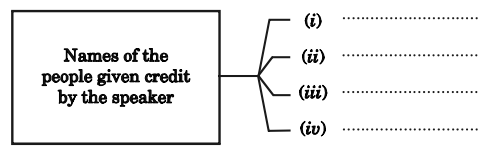
I give the biggest credit of this honour to my movement's Kaalu Kumar, Dhoom Das and Adarsh Kishore from India and Iqbal Masih from Pakistan who made the supreme sacrifice for protecting the freedom and dignity of children. I humbly accept this award on behalf of all such martyrs, my fellow activists across the world and my countrymen.
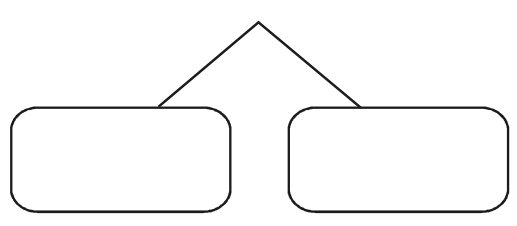
My journey from the great land of Lord Buddha, Guru Nanak and Mahatma Gandhi, India to Norway is a connect between the two centres of global peace and brotherhood, ancient and modern.
Friends, the Nobel Committee has generously invited me to present a "lecture." Respectfully, I am unable to do that. Because, I am representing here - the sound of silence. The cry of innocence. And, the face of invisibility. I represent millions of those children who are left behind and that's why I have kept an empty chair here as a reminder.
I have come here only to share the voices and dreams of our children - because they are all our children (gesture to everyone in the audience). I have looked into their frightened and exhausted eyes. I have held their injured bodies and felt their broken spirits.

B1. Complete the activity :
Image

B2. Fill up the boxes :
(i) Two centres of global peace:

Image
(ii) The speaker represents :
Image


B3. Write the antonyms of the following words by adding prefixes :
(a) honour × __________
(b) broken × __________
(ii) Give one word for the following from the passage :
(a) a person who works for social change .
(b) a person who sacrifices his/her life for the country.

B4. Do as directed :
(i) I humbly accept this award on behalf of all such martyrs.
(Pick out two determiners)
(ii) I have held their injured bodies and felt their broken spirits.
(Rewrite the sentence by using ‘not only–but also’)

B5. Would you like to be a social worker when you grow up ? Why ?
A1. Simple Factual Activities:
Complete the table:

The words....Who said...To Whom...
(i) This may all be nonsense.  
(ii) I wash my hands of it.  
(iii) How is she to get into the royal presence?  
(iv) And the dress?  

Robert : (To Poulengey) This may all be nonsense, Polly. But the troops might
just be inspired by it though nothing that we say seems to put any fire into
them. Even the Dauphin might believe it. And if she can put some fight into
him, she can put it into anybody.
Robert :
(Turning to Joan) Now you, listen to me and don’t cut in before I have time to think. Your orders are that you are to go to Chinon under the escort of this gentleman and three of his friends.
Joan :
(Radiant, clasping her hands) Oh, thank you, squire !
Poulengey :
How is she to get into the royal presence ?
Robert :
I don’t know. How did she get into my presence ? I will send her to Chinon and she can say I sent her. Then, let come what may. I can do no more.
Joan :
And the dress ? I may have a soldier’s dress, squire ?
Robert :
Take what you please. I wash my hands off it.
Joan :
(Wildly excited by her success) Come, Polly. (She dashes out.)
Robert :
(Shaking Poulengey’s hand) Goodbye, old man, I am taking a big chance. Few other men would have done it. But as you say, there is something about her.
Poulengey :
Yes, there is something about her. Goodbye.

A2. Complex Factual Activities:
Give reasons:
(i) Robert finally agreed to the plan.
A3. Activities based on Vocabulary:
Use the following words in separate sentences, with the words having different meanings:
(i) fire (ii) dress
A4. Activities based on Contextual Grammar:
Rewrite the following as Assertive sentences:  

(i) Make the following sentence Affirmative without changing the meaning:
I can do no more.
(ii) Pick out the modal auxiliary and state its function.
Even the Dauphin might believe it.
A5. Personal Response:
(i)  Do you think that Joan succeeds in her plan?

A1. Simple Factual Activity:
Rearrange the sentences in the order of occurrence:
(i) He crept to the head of the bed.
(ii) He slipped the notes under the mattress.
(iii) He opened the door quietly.
(iv) He went back to the room.

   Anil’s money. In the morning he would probably have given me two or three rupees to go to the cinema, but now I had it all. I couldn’t cook his meals, run to the bazaar or learn to write whole sentences any more.
   I had forgotten about them in the excitement of the theft. Whole sentences, I knew, could one day bring me more than a few hundred rupees. It was a simple matter to steal — and sometimes just as simple to be caught. But to be a really big man, a clever and respected man, was something else. I should go back to Anil, I told myself, if only to learn to read and write.
   I hurried back to the room feeling very nervous, for it is much easier to steal something than to return it undetected. I opened the door quietly, then stood in the
doorway, in clouded moonlight. Anil was still asleep.I crept to the head of the bed, and my hand came up with the notes. I felt his breath on my hand. I remained still for a minute. Then my hand found the edge of the mattress, and slipped under it with the notes.
    I awoke late next morning to find that Anil had already made the tea. He stretched out his hand towards me. There was a fifty-rupee note between his fingers.
My heart sank. I thought I had been discovered.
  “I made some money yesterday,” he explained. “Now you’ll be paid regularly.”
   My spirits rose. But when I took the note, I saw it was still wet from the night’s rain.
  “Today we’ll start writing sentences,” he said.
   He knew. But neither his lips nor his eyes showed anything. I smiled at Anil in my most appealing way. And the smile came by itself, without any effort.

A2. Complex Factual Activities:
(i) "Explain why Hari gave a genuine appealing smile.
A3. Insert the appropriate word/phrase given below, in the sentence that follows:

(flattery, appealing, by fits and starts, dashed to, undetected, spirits rose)
(i) The crime went ............. for 11 years.
(ii) After the death of my pet dog, my when ............ dad got me a new pup. 
A4. Activities based on Contextual Grammar:
Rewrite using the modal auxiliary 'might'.

(i) He would probably have given me two or three rupees to go to the cinema.
(ii) Whole sentences, I knew, could one day bring me more than a few hundred rupees.
A5. Personal Response:

(i) Do you feel Anil's way of handling a thief like Hari was effective? Justify your answer.
A1.Simple Simple l Factual Activities:
The following incidents in Stephen Hawking's life are given in jumbled order. Arrange the incidents in proper sequence as per their order of occurrence in Hawking's life:"
(i) Hawking authored 'A Briefer History of Time' that contained the newest developments.
(ii) Hawking's book 'A Brief History of Time' spent more than four years atop the London Sunday Times'.
(iii) Hawking's book The Universe in a Nutshell' offered an illustrated guide to cosmology's big theories.
(iv) Hawking published the book 'A Brief History of Time that offered an overview of space and time

   Stephen Hawking (born January 8, 1942) is a British scientist, professor and author who has done groundbreaking work in physics and cosmology, and whose books have helped to make science accessible to everyone. At the age of 21, while studying cosmology at the University of Cambridge, he was diagnosed with amyotrophic lateral sclerosis (ALS). Part of his life story was depicted in the 2014 film ‘The Theory of
Everything.’
  Over the years, Stephen Hawking has written or co-written a total of 15 books. A few of the most noteworthy include: The Grand Design, The Universe in a Nutshell, The Theory of Everything.
   In 1988 Hawking catapulted to international prominence with the publication of A Brief History of Time. The short, informative book became an account of cosmology for the masses and offered an overview of space and time, the existence of God and the future.The work was an instant success, spending more than four years atop the ‘London Sunday Times’ bestseller list. Since its publication, it has sold millions of
copies worldwide and been translated into more than 40 languages.
   ‘A Brief History of Time’ also wasn’t as easy to understand as some had hoped. So in 2001, Hawking followed up his book with ‘The Universe in a Nutshell,’ which offered a more illustrated guide to cosmology’s big theories.
   In 2005, Hawking authored the even more accessible ‘A Briefer History of Time,’ which further simplified the original work’s core concepts and touched upon the newest developments in the field like String theory.  

A2. Complex Factual Activity:
Complete the table with relevant information about Hawking:

BooksFilms


A3. Activity based on Vocabulary:
Find out the antonyms from the passage for the following:

(i) worst 
(ii) exclude 
(iii) duplicate 
(iv) oldest
A4. Activities based on Contextual Grammar:
(i) He was diagnosed with amyotrophic lateral sclerosis. (Rewrite using the present perfect tense of the underlined part.)
(ii) It has sold millions of copies worldwide and been translated into more than 40 languages.(Change into a simple sentence)
A5. Personal Response:
(i) Stephen Hawking was a versatile personality. Justify.