Question
A1.Simple Factual Activities:
Write whether the following statements are True or False :
(i) Della wanted to buy a Christmas present for Jim.
(ii) There was a pier glass between the windows of the room.
(iii) Jim now earned $30 per weck.
(iv) It was Christmas Eve.

    Della finished her cry and attended to her cheeks with the powder rag. She stood by the window and looked out dully at a gray cat walking a gray fence in a gray backyard.Tomorrow would be Christmas Day, and she had only $1.87 with which to buy Jim a present. She had been saving every penny she could for months, with this result.Twenty dollars a week doesn’t go far. Expenses had been greater than she had calculated. They always are. Only $1.87 to buy a present for Jim. Her Jim. Many a happy hour she had spent planning for something nice for him. Something fine and rare and sterling - something just a little bit near to being worthy of the honour of being owned by Jim.
   There was a pier-glass between the windows of the room. Perhaps you have seen a pier-glass in an $8 flat. A very thin and very agile person may, by observing his  reflection in a rapid sequence of longitudinal strips, obtain a fairly accurate conception of his looks. Della,being slender, had mastered the art.
    Suddenly she whirled from the window and stood before the glass. Her eyes were shining brilliantly, but her face had lost its colour within twenty seconds. Rapidly she pulled down her hair and let it fall to its full length.

A2. Complex Factual Activity:

(i) What troubled Della on Christmas Eve?
A3. Activity based on Vocabulary:
Write the part of speech of each of the words given below :
(i) falrly accurate conception.
(ii) very agile person."
A4. Activities based on Contextual Grammar:
(i) Rewrite the following sentence as an interrogative sentence :
Twenty dollars a week doesn't go far.
(ii) Rewrite the following sentence beginning 'Though.....' :
Her eyes were shining brilliantly, but her face had lost its colour.
A5. Personal Response:
(i) Della counted the money thrice. Explain what you think the reason for this may be.
Answer

A1.Simple Factual Activities:
(i) True
(ii) True
(iii) False
(iv) True
A2. Complex Factual Activity:
(i) The next day was Christmas Day and Della had only one dollar and eighty-seven cents with which to buy Jim a present. She had spent a lot of time thinking about a good present for him, but with the money she had saved she would not get anything worthy of him. Hence, she was feeling disturbed.
A3. Activity based on Vocabulary:
(i) fairly-adverb
   accurate-adjective
   conception-noun
(ii) very-adverb
    aglle-adjective
    person-noun
A4. Activities based on Contextual Grammar:
(i) Does twenty dollars a week go far?
(ii) Though her eyes were shining brilliantly, her face had lost its colour.
A5. Personal Response:
(i) If I ran short of money to buy a gint for one of my parents/siblings, I would borrow from someone else close to me. For example, if I wanted to buy a bag for my sister and fell short of money, I would ask my mother to lend it to me. If I wanted to buy something for Mom and did not have the money for it, I would borrow from dad.

Need a full question paper?

Generate a complete, print-ready paper with questions like this in minutes — across 16+ boards, with answer keys.

Start Generating Free

Similar questions

A1. Simple Factual Activities :
Complete the following:

(i) The narrator is quite successful at stealing.
(ii) The T in the story refers to the narrator, who called himself Hari Singh.
   I was still a thief when I met Anil. And though only only 15. I was an experienced and fairly successful hand.
   Anil was watching a wrestling match when I approached him. He was about 25 a tall, lean fellow - and he looked easy-going, kind and simple enough for my purpose. I hadn't had much luck of late and thought I might be able to get into the young man's confidence.
   "You look a bit of a wrestler yourself." I said. A little flattery helps in making friends.
   "So do you," he replied, which put me off for a moment because at that time I was rather thin.
   "Well," I said modestly, "I do wrestle a bit."
   "What's your name?"
   "Hari Singh," I lied. I took a new name every month. That kept me ahead of the police and my former employers.
    After this introduction, Anil talked about the well-oiled wrestlers who were grunting, lifting and throwing each other about. I didn't have much to say. Anil walked away. I followed casually.
   "Hello again," he said.
    I gave him my most appealing smile. "I want to work for you," I said.
   "But I can't pay you."
    I thought that over for a minute. Perhaps I had misjudged my man.
    I asked, "Can you feed me?"
    "Can you cook?"
    "I can cook." I lied again.
    "If you can cook, then may be I can feed you."

A2. Complex Factual Activities:
Give reasons:
(i) The narrator changed his name every month.  
A3. Activities based on Vocabulary:
Insert the appropriate word/phrase given below, in the sentences that follow:
(flattery, appealing. by fits and starts. dashed to, undetected, spirits rose)
(i) Do not stoop to _________ Just to gain something from someone.
(ii) When the baby saw its mother, it gave an _________ smile.
A4. Do as directed:
(i) I can't pay you. (Rewrite making it affirmative.)
(ii) "I want to work for you," I said. (Change into Indirect speech.)
A5. Personal Response:
(i) 'We should learn from our own mistakes.' Explain.
A1. Write if the following sentences are True or False:
(i) Adams was Mary Kom's friend.
(ii) Charles Atkinson was Mary Kom's coach.
(iii) The judges for Mary Kom's semi-finals at the Olympics were fait
(iv) Charles Atkinson did not go along with Mary Kom for the Olympic finals.

In an exclusive interview with Sportskeeda correspondent Taruka Srivastava, Olympic Bronze medalist Mary Kom talked about her preparation for the Olympics and her elation at winning a medal.
Interviewer : First things first- you’re the first Indian female boxer to win an Olympics medal for India. Has the feeling completely sunk in?
Mary Kom : I am really happy with my achievement and yes it is yet to sink in. I am just so exhilarated.
Interviewer : You were the only female representative from India in boxing. Did that put additional pressure on you?
Mary Kom : No, not at all. I was pretty confident about myself. I knew.
Interviewer : Your coach Charles Atkinson was not allowed to accompany you to the Olympics. How did that affect your preparations ?
Mary Kom : Well, I did miss him there but thankfully, we had already done our homework and I was well prepared.
Interviewer : During your preparations for the Olympics, you sparred with the male boxers of the Indian contingent. Who was your favourite sparring partner ?
Mary Kom : (Laughs) Well, I trained hard in Pune and the male boxers were kind enough to practise with me whenever I required them. To name a favourite
would be unfair.
Interviewer : You were quoted saying “Adams was very clever, a counter- puncher but, although she carried power, she wasn’t very tactical. I was scoring
but the judges were not pressing the buttons.” Do you think dodgy judging was part of the reason for your loss in the semi-finals?
Mary Kom : Yes, I think some of the decisions were unfortunate and did not work to my benefit.  

A2. What prime quality did Mary Kom display during her first attempt in the Olympic games? What was her bad luck?
A3. Find the antonyms of the following words from the passage:
(i) depressed (ii) diffident (iii) float (iv) gain
A4. (i) Although she carried power, she wasn't very tactical.
(Rewrite using a coordinating conjunction.)
(ii) The male boxers kindly practised with me whenever I required them to.
(Underline the subordinate clause and state its kind.)
A5. What, according to you, should a sportsperson do to be successful?
A1.Simple Factual Activities:
(i) In the mid-1970's what did the Hawking family do?

   Eventually, however, doctors did diagnose Hawking with the early stages of ALS. It was devastating news for him and his family, but a few events prevented him from becoming completely despondent. The first of these came while Hawking was still in the hospital. There, he shared a room with a boy suffering from leukemia. Relative to what his roommate was going through, Hawking later reflected, his situation seemed more tolerable. Not long after he was released from the hospital, Hawking had a dream that he was going to be executed. He said this dream made him realize that there were still things to do with his life.
   In a sense, Hawking’s disease helped him become the noted scientist he is today. Before the diagnosis, Hawking hadn’t always focused on his studies. “Before my condition was diagnosed, I had been very bored with life,” he said. “There had not seemed to be anything worth doing.” With the sudden realization that he might not even live long enough to earn his Ph.D, Hawking poured himself into his work and research. 
   As physical control over his body diminished (he’d be forced to use a wheelchair by 1969), the effects of his disease started to slow down. Over time, however, Hawking’s ever-expanding career was accompanied by an ever-worsening physical state. By the mid-1970s, the Hawking family had taken in one of Hawking’s graduate students to help manage his care and work.He could still feed himself and get out of bed, but virtually everything else required assistance. In addition, his speech had become increasingly slurred, so that only those who knew him well could understand him. In 1985 he lost his voice for good following a tracheotomy. The resulting situation required 24-hour nursing care for the acclaimed physicist.
  It also put in peril Hawking’s ability to do his work.

A2. Complex Factual Activity:
(i) Make a list of Hawking's physical inabilities after 1963.
A3. Activity based on Vocabulary:
Choose three synonyms for each of the following:

(i) acclaimed :
(a) renowned (b) famous (c) celebrated (d) socialite.
(ii) peril :
(a) unease  (b) danger (c) difficulty (d) trouble.
A4. Activities based on Contextual Grammar:
(i) Pick out the determiners:
(a) A few events prevented him from becoming completely despondent.
(b) His situation seemed more tolerable.
(ii) The resulting situation required 24-hour nursing care for the acclaimed physicist.
(Underline the words used as adjectives.)
A5. Personal Response:
Do you agree or disagree with the following statement? Justify your stand/answer by quoting a line from the passage.

(i) Stephen Hawking was diagnosed with Alzheimer's disease.
A1. Simple Factual Activities:
State whether the following statements are True or False:
(i) The king got irritated with the hermit. 
(ii) The hermit answered all the questions of the king.
(iii) It was evening when the king met the hermit.
(iv) The hermit was full of energy.

   The hermit listened to the king but said nothing. He just spat on his hand and resumed digging. The king watched in silence for a while.Then, feeling sorry for the hermit, he said, “You are tired, let me take the spade and work a while for you.” The hermit silently handed over the spade and sat down on the ground. When he had dug two beds, the king stopped and repeated his questions. The hermit again gave no answer, but rose, stretched out his hand for the spade,and said, “Now rest a while and let me work a bit”.But the king did not give him the spade and continued to dig.
   One hour passed and another. The sun began to sink behind the trees and the king at last stuck the spade into the ground and said, “I came to you, wise one, for an answer to my questions. If you can give me none, please say so, and I will go home”. “Here
comes someone running,” said the hermit, “let us see who it is.”
   The king turned round and saw a bearded man come running out of the forest. The man held his hands pressed against his stomach, and blood was flowing from under them. When he reached the king, he fainted and fell to the ground, moaning feebly. The king and the hermit unfastened the man’s clothing. There was a large wound in his stomach. The king washed it as well as he could, and bandaged it with his handkerchief
and a towel the hermit had. But the blood would not stop flowing, and the king again and again removed the bandage soaked with warm blood and washed and rebandaged the wound. When at last the blood stopped flowing, the man revived and asked for something to drink. The king brought some fresh water and gave it to him.

A2. Complex Factual Activities:
(i) How did the hermit respond to the king's questions?
A3. Activities based on Vocabulary:
Choose adverbs/adjectives that collocate with these words:

(i) moaning:
(a) profusely (b) heavily (c) feebly (d) sadly.
(ii) blood:
(a) profuse (b) warm (c) fresh (d) bandaged.
A4. Activities based on Contextual Grammar:
Pick out the finite and non-finite verbs from the sentences:
(i) The king continued to dig.
(ii) The sun began to sink.
A5. Personal Response:
(i) Though the hermit did not say anything to the king for some time, he did not ignore the king or treat him rudely in any way. Do you agree? What evidence of his politeness can you point out? What shows that he listened and responded  to the king's words?
A1.Simple Factual Activities:
Write who said to whom :

StatementWhoTo Whom
 (i) You'll wake him up.  
 (ii) "We mustn't miss the chance."  

   One morning in a small apartment in Bombay a girl of about sixteen looked up from the newspaper and said excitedly, ‘Pandit Ravi Shankar is playing tomorrow at the Shanmukhananda auditorium.’
  ‘Sh-sh,’ said her mother pointing to the figure sleeping on the bed. ‘You’ll wake him up. You know he needs all the sleep and rest he can get.’
   But the boy on the bed was not asleep. ‘Pandit Ravi Shankar!’ he said. ‘Pandit Ravi Shankar, the sitar maestro? He raised himself up on his elbows for one second, then fell back. But his eyes were shining. ‘We mustn’t miss the chance,’ he said. ‘I’ve - ‘I’ve –
always wanted to hear him and see him…’
   ‘Lie down son, lie down.’ His mother sprang to his side. ‘He actually raised himself up without help,’ she murmured with a catch in her throat and her eyes turned to the idols on a corner shelf. The prayer, which she uttered endlessly, came unbidden to her lips.
  ‘I must hear him and see him,’ the boy repeated. ‘It’s the chance of a lifetime.’ Then he began to cough and gasp for breath and had to be given oxygen from the cylinder that stood under the bed. But his large eyes were fixed on his sister.
   Smita bit her lip in self-reproach. She had been so excited at seeing the announcement, that she had not remembered that her brother was very ill. She had
seen how the doctors had shaken their heads gravely and spoken words that neither she nor even her parents could understand. But somewhere deep inside Smita had known the frightening truth – that Anant was going to die. The word cancer had hung in the air – her brother 

A2. Complex Factual Activity:
(i) Why was Smita excited?
(ii) What was the chance of a lifetime for Anant?
A3. Activity based on Vocabulary:
Write from the passage antonyms for the following words :
(i) bored (ii) forgot (iii) worse (iv) worst
A4. Activities based on Contextual Grammar:
Add question tags :
(i) You know he needs all the sleep and rest be can get.
(ii) You'll wake him up.
(iii) His eyes were shining.
(iv) We mustn't miss the chance.
A5. Personal Response:
(i) How would you feel and react if you came to know that someone closely known to you was suffering from cancer?

A1.Simple Factual Activities:
Fill in the blanks:

(i) For 30 years, Stephen Hawking held the post of ..................... .
(ii) Stephen Hawking selected his words with a ...................... .
(iii) Stephen Hawking failed to appear at the conference because of a .................. .
(iv) ................ remains a constant anxiety.

   The predicament caught the attention of a California computer programmer, who had developed a speaking program that could be directed by head or eye movement. The invention allowed Hawking to select words on a computer screen that were then passed through a speech synthesizer. At the time of its introduction, Hawking, who still had use of his fingers,selected his words with a handheld clicker. Today, with virtually all control of his body gone, Hawking directs the program through a cheek muscle attached to a
sensor.
   Through the program, and the help of assistants, Stephen Hawking has continued to write at a prolific rate. His work has included numerous scientific papers,of course, but  also information for the non-scientific community.
   Hawking’s health, of course, remains a constant concern - a worry that was heightened in 2009 when he failed to appear at a conference in Arizona because of a chest infection. In April, Hawking, who had already announced he was retiring after 30 years from the post of Lucasian Professor of Mathematics at Cambridge, was rushed to the hospital for being what university officials described as “gravely ill.” It was later announced that he was expected to make a full recovery.

A2. Complex Factual Activity:
Explain the life of Stephen Hawking with reference to the following statement:
(i) Hawking's health, of course, remains a constant concern.
A3. Activity based on Vocabulary:
Choose three synonyms for each of the following:

(i) Write the adjective forms of:
(a) infection  (b) office.
(ii) Write from the last paragraph phrases that give an indication of Stephen Hawking's health situation.
A4. Activities based on Contextual Grammar:
Underline the determiners:

Today, with virtually .............. control of ............ body gone. Hawking directs ............. program through ............. cheek muscle attached to .............. sensor.
A5. Personal Response:
Do you agree or disagree with the following statement? Justify your stand/answer by quoting a line from the passage.
(i)  Though Hawking lost control over his body, he writes at a prolific rate with the help of assistants.
A1. Simple Factual Activities:
State whether the following statements are True or False:

(i) The spider's webs are delicate as well as weak.
(ii) The teamwork and perseverance of ants were impressive.

   We went to a rocky beach and saw the spread of the majestic ocean and the rocks alongside, carved,sculpted and shaped by the water. Water is so gentle, rock so hard, yet, as the water flows over it every day, for years, the rock gives in. It takes the shape that the water commands. Our problems are so colossal and we
are so small, yet if we persist... 
   We saw small bits of grass peeping through the small cracks in a concrete pavement. It left us thinking: however impossible things may look, there is always
an opening...
   We saw a tree bare of all leaves in the cold winter months. We thought its chapter was over. But three months passed, spring set in and the tree was back to its green majesty once again, full of leaves, flowers, birds and life. What if we too had the conviction that, however difficult things are right now, it will not remain so for ever. Remember, this too shall pass.
   We saw an army of ants lugging a fly which was at least ten times the ant’s size. The ants organized themselves around the fly, lifted it on frail feelers and carried it to quite a distance. Their teamwork and perseverance were impressive. What if we too are
consistent, organized, focused...Spider webs are delicate,yet very strong. A rainbow colours the entire sky.Oysters take in a grain of sand they open up with a pearl. Innumerable stars shine across the infinite sky. Clouds take new shapes with every passing moment.The wind makes trees dance with unhindered passion. Water, without hint of ego, changes its form according to the dictates of the sun and the wind. When we see a caterpillar turn into a butterfly, a flower turn into a fruit, we experience the alchemy of nature... we touch it and become gold ourselves.

A2. Complex Factual Activities:
Mention what you learn from the following: (Νοv. '20)

(i) Bits of grass peeping through small cracks...
(ii) Tree bare in winter blooms in spring.....
A3. Activity based on Vocabulary:
Match the words with their meanings:

AB
(i) Majestic(a) Huge/massive
(ii) Persist.(b) Grand
(iii) Colossal(c) Firm belief
(iv) Conviction(d) Continue

A4. Activities based on Contextual Grammar:
Do as directed: (Nov. '20)

(i) It takes the shape of water. (Add a question tag.)
(ii) We saw small bits of grass. (Pick out the verb and state whether it is Transitive or Intransitive.)
A5. Personal Response:
(i)  How does nature succeed in its 'Alchemy'?What can it turn a small person into?

A1. Simple Factual Activities:
Arrange these incidents in proper sequence:
(i) The king asked the hermit the three questions.
(ii) The king saw that the hermit was digging the ground.
(iii) The king went alone to see the hermit.
(iv) The hermit greeted the king.

   Equally varied were the answers to the second question. Some said, the people, the king most needed,were his councillors; others the priests; others the doctors while some said the warriors were the most necessary.
  To the third question about what was the most important occupation, some replied that the most important thing in the world was science. Others said     it was skill in warfare; and others, again, that it was religious worship. The king was convinced by none of
these answers and gave the reward to none.
   He decided, instead to go to a hermit who was widely renowned for his wisdom. The hermit lived in a small hut in a forest which he never left. He spoke only to common folk. So the king put on simple clothes and approaching the hermit’s cell, dismounted his horse and left his bodyguard behind.
   When the king arrived, the hermit was digging the ground in front of his hut. He greeted the king but went on digging. The hermit was frail and weak, and each time he struck the ground with the spade and turned over a little earth, he breathed heavily. The king went up to him and said, “I have come to you, wise hermit,to ask you to answer three questions-How can I learn to do the right thing at the right time ? Who are the
people I most need, and to whom should I, therefore,pay most attention? And what affairs are the most aimportant and need my first attention?”
    The hermit listened to the king but said nothing. He just spat on his hand and resumed digging. The king watched in silence for a while. 

A2. Complex Factual Activities:
(i) Why did the king go to the hermit in disguise?
A3. Activities based on Vocabulary:
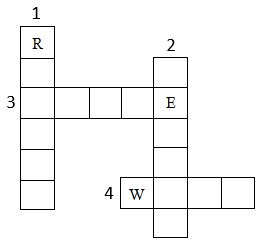
Solve the crossword puzzle using words from the passage referring to the clues given: (March '20)
Image

Down
(i) Restart/Start again
(ii) Sage
Across
(iii) A tool for digging
(iv) Intelligent
A4. Activities based on Contextual Grammar:
Pick out the finite and non-finite verbs from the sentences:
(i) He decides to go to a hermit.
(ii) The hermit was digging the ground.
(iii) I have come to you to ask you to answer three questions.
(iv) He gave the reward to no one.
A5. Personal Response:
(i) The hermit 'spoke only to common people': so the king 'put on simple clothes'. Do you think the king hoped to be mistaken for a common man, or was he just showing that he was a humble person? What shows that the hermit knew him to be the king?
A1. Simple Factual Activities:
Arrange the following incidents in Steve Jobs' life in proper sequence based on this passage:

(i) Jobs underwent surgery.
(ii) Jobs was diagnosed with cancer.
(iii) Jobs was advised to get his affairs in order.
(iv) Jobs was cured of a rare form of cancer.

   My third story is about death.
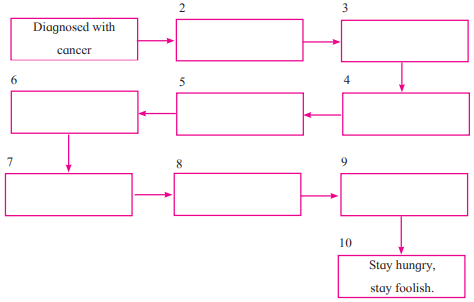
   About a year ago I was diagnosed with cancer. My doctor advised me to go home and get my affairs in order, which is doctor’s code for ‘prepare to die’.I lived with that diagnosis all day. Later that evening I had a biopsy. It turned out to be a very rare form
of pancreatic cancer that is curable with surgery. I had the surgery and I’m fine now.
   This was the closest I’ve been to facing death, and I hope it’s the closest I get for a few more decades.Having lived through it, I can now say this to you : Your time is limited, so don’t waste it living someone else’s life.
   Don’t be trapped by dogma - which is living with the results of other people’s thinking. Don’t let the noise of other’s opinions drown out your own inner voice.
   And most important, have the courage to follow your heart and intuition. They somehow already know what you truly want to become.
   When I was young, there was an amazing publication called The Whole Earth Catalogue. In the final issue, on the back cover they put a photograph of an early
morning country road. Beneath it were the words : Stay Hungry, Stay Foolish. It was their farewell message as they signed off. I have always wished that for myself. And now, as you graduate to begin anew, I wish that for you. Stay Hungry, Stay Foolish. 

A2. Complex Factual Activities:
Read the third story and complete the flow- chart given below:
Image
A3. Activities based on Vocabulary
Match the words in column 'A' with their meanings in column 'B':

'A''B'
 (i) diagnosis (a) a set of beliefs held by an organisation which others   are expected to accept without argument.
 (ii) catalogue (d) act of identifying the nature of a problem or illness.
 (iii) dogma (a) in a new or different way.
 (iv) anew (c) complete list of items especially in a special order   and description.

A4. Activities based on Contextual Grammar:
(i) I am fine now.
(ii) I have been facing death.
A5. Personal Response:
(i) "Your time is limited. So don't waste it living someone else's life."
      What are your views about these statements?

A1.Simple Simple l Factual Activities:
Choose the correct alternatives from the given statements:
(i) How can academic brilliance be diminished?
(a) by disturbance and frustration
(b) by going offtrack
(c) by a coating of dust
(d) by losing focus and seriousness
(ii) Who had directly influenced Dr Kalam's beliefs?
(a) Professor Satish Dhawan   (b) Srijan
(c) God                                     (d) countless great minds
 
    A few years later, in the early 1980s, Professor Satish Dhawan, the Director of ISRO, under whom Dr Kalam had made his first unsuccessful launch in 1970 and then a successful one in 1980, had provided him with more soul-shaping wisdom.
    One day in 2012, we were discussing the number of Ph.Ds Dr Kalam had received. He said to me, ‘Srijan, Professor Dhawan had so many master’s degrees- all from the best institutions, no less-so I asked him how one can become so academically accomplished.He responded saying that academic brilliance is no different from the brilliance of a mirror, which can be diminished by a coating of dust. Only when the dust is removed, does the mirror shine and the reflection becomes clear. We can remove the impurities obscuring our souls by living pure and ethical lives, and by serving humanity. And then God will shine through us.’ These words took me back to my meeting with Dr Kalam after my graduation from IIMA, in 2009. At the time, he had advised me to use my degree and gold medal to transform the society I lived in. Back in the present moment, it suddenly struck me that Dr Kalam’s advice had, in fact, directly resonated from Professor Dhawan’s beliefs. The more I lived and worked with Dr Kalam, the more I realized that through his words of wisdom I was getting to learn from countless great
minds. 

A2. Complex Factual Activity:
(i) 1970
(ii) 1980
(iii) 2009 
(iv) 2012 
A3. Activities based on Vocabulary:
Match the words in column 'A' with their their opposites in column 'B':

'A''B'
 (i) asked (a) increased
 (ii) obscure (b) impure
 (iii) diminished (c) clear
 (iv) pure (d) responded

A4. Activities based on Contextual Grammar:
(i) Academic brilliance is no different from the brilliance of a mirror. (Rewrite without 'no'.)
(ii) God will shine through us. (Add a question tag.)
A5. Personal Response:
Write in your own words what the following expressions convey in the context they occur in the text.
(i) Only when the dust is removed, does the mirror shine and the reflection becomes clear.