Question
A1.Simple Simple l Factual Activities:
Choose the correct alternative from the given statements:
(i) Dr. Kalam's father was an imam.
(a) a teacher (b) a scientist (c) a farmer (d) an imam
(ii) Dr. Kalam's friends discussed on science and spirituality.
(a) science and technology   (b) discoveries and inventions
(c) science and spirituality    (d) community's problems and solutions

   Dr Kalam’s own life was nourished by multiple faiths.
   His father, a boatman, also served as an imam at their local mosque, and his two best friends were from two different religions-one was a Hindu and the other was a Christian. Pakshi Lakshmana Shastrigal was the head priest of the famous Rameswara temple and a Vedic scholar, and the Reverend Father Bodal had built the first church on Rameswara Island. Dr Kalam recalled how ‘All three of them, in the unique attire of their religion, used to sit and discuss the community’s problems and find solutions. Throughout the nation and the world, the need to have a frank dialogue among cultures, religions and civilizations is felt now more than ever.’
   When asked where he got his humility from Dr Kalam would always attribute it to his father. In him, he saw how simplicity and divinity could go together. Even though his father was a boatman and Dr Kalam went on to become the President of India, they shared the same values in life. Both believed that if one leads a spiritual life then that spirituality can lift them out of any kind of confusion misery or failure.

A2. Complex Factual Activity:
(i) How were different virtues inculcated in Dr Kalam?
A3. Activities based on Vocabulary:
(i) Write from the passage four words that are connected with or related to religions.
A4. Activities based on Contextual Grammar:
Pick out the auxiliaries and state the function:
(i) All three of them used to sit and discuss the community's problems.
(ii) Simplicity and divinity could go together.
A5. Personal Response:
(i) What makes Dr Kalam a humble personality?
Answer

A1. Simple Factual Activities:
(i) (d) an imam
(ii) (c) science and spirituality 
A2. Complex Factual Activities:
(i) Dr Kalam inculcated the virtue of humility from his father who was a boatman. He learnt from his father how simplicity and divinity could go together.
A3. Activities based on Vocabulary:

(i) Imam, mosque, Hindu, Christian (priest, temple, Vedic, reverend father, church, divinity, spiritual, spirituality)
A4. Activities based on Contextual Grammar:
(i) used to - past habit
(ii) could - possibility. 
A5. Personal Response:
(i) Even though Dr Kalam was indisputably a great scientist, he had deep faith and supported the cause of the betterment of humanity. This shows that he was indeed a humble personality.

Need a full question paper?

Generate a complete, print-ready paper with questions like this in minutes — across 16+ boards, with answer keys.

Start Generating Free

Similar questions

A1.Simple Factual Activities:
Fill in the blanks:

(i) For 30 years, Stephen Hawking held the post of ..................... .
(ii) Stephen Hawking selected his words with a ...................... .
(iii) Stephen Hawking failed to appear at the conference because of a .................. .
(iv) ................ remains a constant anxiety.

   The predicament caught the attention of a California computer programmer, who had developed a speaking program that could be directed by head or eye movement. The invention allowed Hawking to select words on a computer screen that were then passed through a speech synthesizer. At the time of its introduction, Hawking, who still had use of his fingers,selected his words with a handheld clicker. Today, with virtually all control of his body gone, Hawking directs the program through a cheek muscle attached to a
sensor.
   Through the program, and the help of assistants, Stephen Hawking has continued to write at a prolific rate. His work has included numerous scientific papers,of course, but  also information for the non-scientific community.
   Hawking’s health, of course, remains a constant concern - a worry that was heightened in 2009 when he failed to appear at a conference in Arizona because of a chest infection. In April, Hawking, who had already announced he was retiring after 30 years from the post of Lucasian Professor of Mathematics at Cambridge, was rushed to the hospital for being what university officials described as “gravely ill.” It was later announced that he was expected to make a full recovery.

A2. Complex Factual Activity:
Explain the life of Stephen Hawking with reference to the following statement:
(i) Hawking's health, of course, remains a constant concern.
A3. Activity based on Vocabulary:
Choose three synonyms for each of the following:

(i) Write the adjective forms of:
(a) infection  (b) office.
(ii) Write from the last paragraph phrases that give an indication of Stephen Hawking's health situation.
A4. Activities based on Contextual Grammar:
Underline the determiners:

Today, with virtually .............. control of ............ body gone. Hawking directs ............. program through ............. cheek muscle attached to .............. sensor.
A5. Personal Response:
Do you agree or disagree with the following statement? Justify your stand/answer by quoting a line from the passage.
(i)  Though Hawking lost control over his body, he writes at a prolific rate with the help of assistants.
A1. Simple Factual Activities:
Fill in the blanks with the correct alternatives:
(i) The .................. is called a 'blockhead' by the squire.(Robert/steward)
(ii) The squire's name is .................... . (Robert/Dauphin)
(iii)The price of a horse is ................... .(17 to 18 francs/sixteen francs)
(iv) The ................. will give the girl whatever she needs to free Orleans. (Dauphin/Squire)

   The war fought between England and France from 1337 to 1453 has come to be known as the Hundred Years War. Joan was a peasant girl born in eastern France, who
led the French army to several victories during this war.
   This play begins at the time when all of northern France and some parts of the south-west were under foreign control. The English controlled some parts and the Burgundians controlled the others. The city of New Orleans, one of the few remaining French cities was held by the English. The year is 1429. Captain Robert de Baudricourt, a military officer is seated at the table.His steward stands facing him.

Robert :
I told you to throw the girl out. You have fifty armed soldiers and dozens of
strong servants to carry out my orders. Are they afraid of her ?
Steward : No sir, we are afraid of you, but she puts courage in us. She really doesn’t
seem to be afraid of anything. Perhaps you could frighten her, sir.
Robert : (grimly) Perhaps, where is she now?
Steward : Down in the courtyard, sir.(Robert goes to the window and asks the soldiers to send the girl up.)
(The girl enters. She is a well-built,strong country girl of 17 to 18 years.The squire’s glare neither frightens hernor stops her. She speaks confidently.)
Joan : Good morning, Captain Squire. You are to give me a horse and armour
and some soldiers, and send me to the Dauphin.
Robert : This girl is mad. Why didn’t you tell me so, you blockhead?
Steward : Sir, do not anger her. Give her what she wants.
Robert : I shall send you back to your father with orders to put you under lock and key.
Joan : You think you will, squire. But it won’t happen that way. You said you would
not see me. But here I am.
Robert : So, you are assuming that I’ll give you what you want.
Joan : Yes, squire. (Continues busily) A horse will cost sixteen francs. It is a big amount of money. But I can save it on the armour. I don’t need beautiful armour made to my measure. I can find a soldier’s armour that will fit me well enough. I shall not want many soldiers. The Dauphin will give me, all I need, to free Orleans.

A2. Complex Factual Activities:
Give reasons:
(i) Explain why Joan wanted to meet Captain Squire.
A3. Activities based on Vocabulary:
Classify the following words into adjectives and nouns and complete the table given below:
armed, courage, brave, armour, orders, well-built, squire, strong, amount, beautiful. Orleans
A4. Activities based on Contextual Grammar: 
Make the following sentences affirmative without changing the meaning:

(i) Sir, do not anger her.
(ii) I shall not want many soldiers.
A5. Personal Response:
(i) What, according to you, is the steward's opinion about Joan?<
A1.Simple Factual Activities:
Complete the following :
(i) The cost of the fob chain was  ____________ .
(ii) Della went through the goods in the stores when  __________ .
(iii) Jim avoided checking the time on his gold watch in a public place because __________ .
(iv) The gift Della bought for Jim was  __________ .

   Oh, and the next two hours tripped by on rosy wings. Forget the hashed metaphor. She was ransacking the stores for Jim’s present.
   She found it at last. It surely had been made for Jim and no one else. There was no other like it in any of the stores, and she had turned all of them inside out. It was a platinum fobchain simple and chaste in design, properly proclaiming its value by substance alone and not by meretricious ornamentation—as all good things should do. It was even worthy of The Watch. As soon as she saw it she knew that it must be Jim’s. It was like him. Quietness and value—the description applied to both. Twenty-one dollars they took from her for it, and she hurried home with the 87 cents. With that chain on his watch Jim might be properly anxious about the time in any company. Grand as the watch was, he sometimes looked at it on the sly on account of the old leather strap that he used in place of a chain.
   When Della reached home her intoxication gave way a little to prudence and reason. She got out her curling irons and lighted the gas and went to work repairing the ravages made by generosity added to love which is always a tremendous task, dear friends--a mammoth task.
   Within forty minutes her head was covered with tiny, close-lying curls that made her look wonderfully like a truant schoolboy. She looked at her reflection in the mirror-long, carefully, and critically.
    “If Jim doesn’t kill me,” she said to herself, “before he takes a second look at me, he’ll say I look like a Coney Island chorus girl. But what could I do—oh! what could I do with a dollar and eighty seven cents?”
 
A2. Complex Factual Activity:

(i) Explain why Della looked at her reflection critically.
A3. Activity based on Vocabulary:
Pick out from the story words that mean the following, and state if it is a Noun, Verb or Adjective :

PhraseWord From the
 passage
Part of Speech
 (i) wisdom  
 (ii) very huge  

A4. Activities based on Contextual Grammar:
(i) Frame a Wh-question to get the underlined part as the answer:
She was ransacking the store for Jim's present.
(ii) Rewrite the following sentence using 'No sooner.. than..':
As soon as she saw it she knew that it must be Jim's.
A5. Personal Response:
(i) How beautiful was the watch chain? Would you have liked to own it?

A1.Simple Factual Activities:
The following incidents in Stephen Hawking's life are given in jumbled order. Arrange the incidents in proper sequence as per their order of occurrence in Hawking's life:
(i) Hawking was diagnosed with ALS while studying cosmology at the University of Cambridge.
(ii) At college, Hawking was bored with life.
(iii) After the diagnosis. Hawking went on to became a noted scientist.'
(iv) Hawking reflected on the condition of the boy suffering from leukemia.

   Eventually, however, doctors did diagnose Hawking with the early stages of ALS. It was devastating news for him and his family, but a few events prevented him from becoming completely despondent. The first of these came while Hawking was still in the hospital. There, he shared a room with a boy suffering from leukemia. Relative to what his roommate was going through, Hawking later reflected, his situation seemed more tolerable. Not long after he was released from the hospital, Hawking had a dream that he was going to be executed. He said this dream made him realize that there were still things to do with his life.
   In a sense, Hawking’s disease helped him become the noted scientist he is today. Before the diagnosis, Hawking hadn’t always focused on his studies. “Before my condition was diagnosed, I had been very bored with life,” he said. “There had not seemed to be anything worth doing.” With the sudden realization that he might not even live long enough to earn his Ph.D, Hawking poured himself into his work and research. 
   As physical control over his body diminished (he’d be forced to use a wheelchair by 1969), the effects of his disease started to slow down. Over time, however, Hawking’s ever-expanding career was accompanied by an ever-worsening physical state. By the mid-1970s, the Hawking family had taken in one of Hawking’s graduate students to help manage his care and work.He could still feed himself and get out of bed, but virtually everything else required assistance. In addition, his speech had become increasingly slurred, so that only those who knew him well could understand him. In 1985 he lost his voice for good following a tracheotomy. The resulting situation required 24-hour nursing care for the acclaimed physicist.
  It also put in peril Hawking’s ability to do his work.

A2. Complex Factual Activity:
What effect did the incidents mentioned below have on Hawking?
(i) Hawking saw a boy in the same room he was in suffering from leukemia.
(ii) Hawking had a dream that he was going to be executed.
A3. Activity based on Vocabulary:
Write from the passage words that are the opposite of:

(i) allowed
(ii) hopeful
(iii) admitted
(iv) enthusiastic.
A4. Activities based on Contextual Grammar:
(i) A few events prevented him from becoming completely despondent.(Rewrite beginning with 'He was ....'.)
(ii) Only those who knew him well could understand him. (Rewrite using 'no one'.)
A5. Personal Response:
(i) Do you agree or disagree with the following statement? Justify your stand/answer by quoting a line from the passage.
Stephen Hawking was diagnosed with Alzheimer's disease.
A1.Simple Factual Activities:
Say whether the following are True or False:
(i) In Bombay, the family stayed with their aunt.
(ii) The doctors told the family directly that Anant did not have many days to live.
(iii) The family voiced their fears to Anant.
(iv) Anant was well enough to take part in the forthcoming table tennis tournament.

   Whenever they came to Bombay they stayed with Aunt Sushila. Her apartment was not big but there was always room for them.
   They had come with high hopes in the miracles of modern science. They told themselves that Anant would be cured at the hospital and he would again walk and run and even take part in the forthcoming table-tennis tournament. And, he would play the sitarperhaps be a great sitarist one day. But his condition grew worse with each passing day and the doctors at the cancer hospital said, ‘Take him home. Give him the thing he likes, indulge him,’ and they knew then that the boy had not many days to live. But they did not voice their fears. They laughed and smiled and talked and surrounded Anant with whatever made him happy. They fulfilled his every need and gave him whatever he asked for. And now he was asking to go to the concert. ‘The chance of a lifetime,’ he was saying.
   ‘When you are better,’ his mother said. ‘This is not the last time they are going to play.’
   Smita stood at the window looking at the traffic,her eyes wet with tears. Her mother whispered, ‘But you Smita, you must go. Your father will take you.’
   When she was alone with Aunt Sushila, Smita cried out in a choked voice, ‘No, how can I? We’ve always done things together, Anant and I.’
   ‘A walk in the park might make you feel better,’ said Aunt Sushila and Smita was grateful for her suggestion.
   In the park, people were walking, running, playing ball, doing yogic exercises, feeding the ducks and eating roasted gram and peanuts, Smita felt alone in their midst. She
was lost in her thoughts.
   Suddenly a daring thought came to her and as she hurried home she said to herself. ‘Why not? There’s no harm in trying it.’
   ‘It would be nice to go to the concert. I don’t know when we’ll get another opportunity to hear Pandit Ravi Shankar,’ she said to her mother later. And her father agreed to get the tickets.

A2. Complex Factual Activity:
Complete the table:

Smita's mother tries to 
Smita's aunt suggests that 

A3. Activity based on Vocabulary: 
Match the columns:

AB
 (i) choked (a) exercises
 (ii) roasted (b) thought
 (iii) yogic (c) gram
 (iv) daring (d) voice

A4. Activities based on Contextual Grammar:
Frame Yes-No questions to get the sentences as answer :
(i) There's no harm in trying it.
(ii) It would be nice to go to the concert.
A5. Personal Response:
(i) "Two contradietory pictures are depicted in the story. Deseribe them in your words.

A1.Simple Simple l Factual Activities:
Choose the correct alternatives from the given statements:
(i) What was most astonishing about the 102-year- old Swamiji?
(a) He was a great speaker and orator.
(b) He was a great scientist.
(c) He was a great admirer of technology.
(d) He looked as steady and alert as any other youngster.
(ii) The year 2009 is significant because of:
(a) The invitation extended to Dr Kalam.
(b) The 102nd birthday celebrations of His Holiness Dr Sri Sri Shivakumara Mahaswamiji.
(c) The establishment of the free residential education system in Dr Sri Sri Shivakumara Mahaswamiji's ashram.
(d) The discourse given by Dr Sri Sri Shivakumara Mahaswamiji.
 
  Dr Kalam sat contemplating deeply.
  He recollected the tenet of goodness of action from Pramukh Swamiji. Then, perhaps swimming in silence to the shores of Mahapragyaji, he gathered the sands of conscience to be our guide, our best friend. Deeper down in the space-time of memory, he must have heard Professor Brahma Prakash’s words about the need of living a pure and ethical life, and Father Pereira’s and Dr Sarabhai’s lesson of selflessness in service. Eventually his thoughts would have settled on Swami Sivananda of Rishikesh, in whom he saw great tranquility, and finally they must have come full circle with the memory of the life of simplicity of his father, who always espoused the value of giving back.
  At long last, he spoke. ‘It is the very spirit of  What Can I Give.’ He elaborated, ‘Mahaswamiji lives with the beliefs and ethos of our mission. He gives and gives - education to famished minds, food to famished bodies. In giving so much, he becomes strong. His munificence fuels his strength. That is what keeps him standing tall and active in life. The essence of a happy life and a peaceful society lies in one sentence -What can I give?’ 

A2. Complex Factual Activity:
Rearrange the letters to form sensible words:

(i) y e s i l l e t
(ii) s c e n e c o i n c
A3. Activities based on Vocabulary:
Write the noun forms of :
(i) tranquil
(ii) pure
(iii) settle
(iv) final.
A4. Activities based on Contextual Grammar:
(i) In giving so much, he becomes strong. (Rewrite using "because'.)
(ii) His munificence fuels his strength.(Rewrite beginning with 'His strength ....'.)
A5. Personal Response:
(i) What was the secret of Mahaswamiji's fitness even at the age of 102 years?
A1.Simple Simple l Factual Activities:
Write True or False for the statements:
(i) The narrator had heard of Bach.
(ii) The narrator's answer displeased Einstein.
(iii) The upper room had a gramophone.
(iv) The narrator liked the kind of music where he could follow the words.

   I knew that I must tell this man the truth. He looked at me as if my answer was very important.
  “I do not know anything about Bach”, I said, “I have never heard any of his music.” He looked surprised.
  “You have never heard of Bach?” he asked.
   He made it sound as if I had said that I had never taken a bath !
   “I’d like to understand music so that I could understand Bach,” I said, “but I’m not able to. I’m tone-deaf.”
  The old man got up.
  “You will come up with me ?” he asked. I just remained seated. “I’m requesting you to come with me”, he said again.
   So I went up with him. He took me to a room which had a gramophone in it and asked, “What kind of music do you like ?”
  “Well,” I answered, “I like songs that have words,and the kind of music where I can follow the tune.”
   He smiled and nodded, obviously pleased. “You can give me an example, perhaps ?” 

A2. Complex Factual Activity:
Complete the following sentences:
(i) Einstein was surprised to hear that ...................... .
(ii) The narrator could not understand music because ..................... .
A3. Activities based on Vocabulary: 
Write opposites of the words using the prefixes 'dis', 'mis', or 'un':

(i) able
(ii) important
(iii) pleased
(iv) like
A4. Activities based on Contextual Grammar:
(i) I'm not able to.(Rewrite using a modal auxiliary.)
(ii) He said, "What kind of music do you like?"(Rewrite using the indirect form of narration.)
A5. Personal Response:
(i) What do you learn from Einstein's treatment of the young man?
A1. Simple Factual Activities:
Relate the following actions with the king and the hermit: (March '20)Image
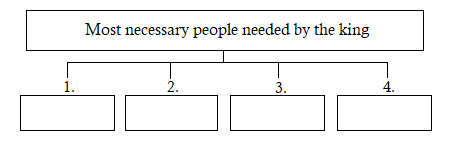
   Equally varied were the answers to the second question. Some said, the people, the king most needed,were his councillors; others the priests; others the doctors while some said the warriors were the most necessary.
  To the third question about what was the most important occupation, some replied that the most important thing in the world was science. Others said     it was skill in warfare; and others, again, that it was religious worship. The king was convinced by none of
these answers and gave the reward to none.
   He decided, instead to go to a hermit who was widely renowned for his wisdom. The hermit lived in a small hut in a forest which he never left. He spoke only to common folk. So the king put on simple clothes and approaching the hermit’s cell, dismounted his horse and left his bodyguard behind.
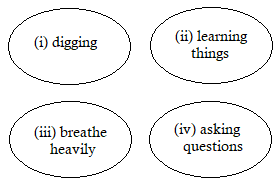
   When the king arrived, the hermit was digging the ground in front of his hut. He greeted the king but went on digging. The hermit was frail and weak, and each time he struck the ground with the spade and turned over a little earth, he breathed heavily. The king went up to him and said, “I have come to you, wise hermit,to ask you to answer three questions-How can I learn to do the right thing at the right time ? Who are the
people I most need, and to whom should I, therefore,pay most attention? And what affairs are the most aimportant and need my first attention?”
    The hermit listened to the king but said nothing. He just spat on his hand and resumed digging. The king watched in silence for a while. 

A2. Complex Factual Activities:
Complete the tree diagrams associated with the happening of this passage.
Image
A3. Activities based on Vocabulary:
Choose the correct answer and fill in the blanks:

(i) The synonym for 'convinced is ................. .
(a) persuaded   (b) happy   (c) unhappy  (d) angry
(ii) "Varied' means ................ .
(a) different       (b) unnecessary
(c) unequal       (d) unimportant
A4. Activities based on Contextual Grammar:
Do as directed: (March 20)
(i) When the king arrived the hermit was digging the ground. (Name and identify the subordinate clause.)
(ii) The hermit listened to the king but said nothing. (Rewrite the sentence beginning Though......)
A5. Personal Response:
(i) The learned people were sometimes divided in their opinions, different people giving quite different answers; at other times, none of them
gave an answer. They all suggested ways to look for an answer. Can you point out one example of each?
A1.Simple Simple l Factual Activities:
Complete the following:
(i) Two singers mentioned in the passage are: 
(ii) The singer whose song was more advanced was: 

   I told him I like anything by Bing Crosby. At once, I could hear Bing Crosby’s voice filling the room.
   “Now, can you please tell me what you just heard?”, he said.
    The simplest answer seemed to be to sing the lines. So I sang it back to him.
    He smiled. “You’re not tone-deaf,” he said.
    I told him this was one of my favourite songs, something I had heard hundreds of times, so it didn’t really prove anything.
    “Nonsense !” said Einstein. “It proves everything! Do you remember your first arithmetic lesson in school ? Suppose, at your very first contact with numbers, your
teacher had ordered you to work out a problem in, say, long division or fractions. Could you have done it ?”
    “No, of course not.”
     “Exactly! It’s like learning maths. You have to learn addition and subtraction in order to do multiplication and division. Now I’m playing something a little more advanced.”
   It was John McCormack singing The Trumpeter. “Sing that back”, he ordered.
   And we went on from level to higher level until he was playing just music without words.

A2. Complex Factual Activity:
(i) How did Einstein help the narrator appreciate music?
A3. Activity based on Vocabulary:
Rewrite the sentences inserting the appropriate phrases in their proper form:

(in order to, to get into, to work out)
(i) You should get into Mathematics so that you can work out problems.
(ii) He read the passage two or three times in order to understand it.
A4. Activities based on Contextual Grammar:
Rewrite using the indirect form of narration:

(i) "Could you have done it?" said Einstein.
(ii) "You are not tone-deaf," he said to me.
A5. Personal Response:
(i) What do you learn from Einstein's treatment of the young man?
A1.Simple Simple l Factual Activities:
Fill in the blanks:
(i) Dr Kalam's message made an Impact on the writer because of its .............. and the ............... it posed became his silent motivation.
(ii) The .............. of .............. lies in the answer to the question 'What can I give?'
 
  ‘Turning to me, he asked, ‘What is the reverse of “What can I give ?”
  Circumspectly I replied, ‘What can I...take ?’ ‘Yes,’ he said, ‘and that is the thought which is responsible for all the wrong we see around us. We think that we can take from the environment and destroy it indiscriminately; we think of what we can take from other humans, leading us to corruption and inequity. This attitude of taking and taking even
destroys families. To keep this planet liveable and the human race thriving, we have to replace this attitude of ‘what can I take’ with the goodness of ‘what can I give’.
  The gravity of the message struck me. This challenge became my silent motivation.
  Three years later, in 2012, this idea became a reality as our What Can I Give movement, through which Dr Kalam tried to combat corruption, environmental degradation and social evils.
   It is important that we ask ourselves this question for in the answer lies the truth of humanity. So go ahead and question yourself.
   What can I give ?
   The answers will be astounding.  

A2. Complex Factual Activity:
Rearrange the letters to form sensible words:

(i) To keep this planet liveable and the human race thriving, we have to replace this attitude of 'what can I take with the goodness of 'what can I give.
(ii) Dr Kalam tried to combat corruption, environmental degradation and social evils.
A3. Activities based on Vocabulary:
From the passage write one word for:
(i) without making a difference :
(ii) in a cautious way :
A4. Activities based on Contextual Grammar:
Write what the underlined auxiliaries indicate:

(i) What can I give?
(ii) We have to replace this attitude ....
A5. Personal Response:
(i) Why is there an urgent need to replace 'What can I take' with 'What can I give'